Tesco’s vertiginous slide continues. On Tuesday, the company – one of Britain’s few remaining global businesses – issued its fifth profit warning in 12 months, sending its share price tumbling, again. The group’s chief executive, Dave Lewis, celebrated his first 100 days in charge with a warning to shareholders that there was a long road ahead. But he promised that in the future the new Tesco would be a fairer as well as a cheaper place to shop. If Mr Lewis is marking a new model for his business, that deserves a cheer. But retail grocery is too big for this crisis to be allowed to go to waste.
With Tesco in the vanguard, from the mid-1980s the supermarkets had 30 glorious years. For most people, the death of the high street seemed a small price to pay for the out-of-town superstore with cheap food, free parking and a climate-controlled environment. By 2007 Tesco had nearly a third of the retail grocery market and its profits were heading north of £2bn. By 2009, the big three supermarket groups had a massive 70% of the market. In 2011, Tesco profits peaked at £3.4bn.
For more than a decade, suppliers have protested at supermarket practices. Two separate competition inquiries failed to establish any evidence of unfair pressure. Yet the casualties were unmistakable – the minimum wage and zero-hours contracts of the food-processing industry, or the more picturesque plight of dairy farming, where the supermarket squeeze (and the global milk market) have, since the mid-1980s, forced two-thirds out of business.
But disquiet about the concentration of buying power in so few hands has always been set against the desirability of cheap food. Here is what has happened since supermarkets stopped being able to increase profits by accruing an ever larger share of the market. In the past six years, according to the government’s own publication, the Food Statistics Pocketbook, rather than that keeping costs down, the price of food has risen by 22% while median incomes have been static or falling (falling sharply for the poorest 10%). Rising commodity prices were blamed, yet in Germany food prices rose by only 12%, and in France by 13%.
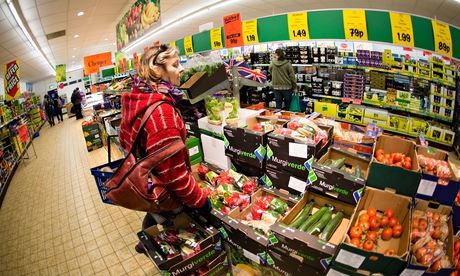
No wonder the so-called hard discounters, Aldi and Lidl, have so successfully soaked up hard-pressed shoppers. The shopping experience may be minimalist, but they carry half the product range and many more high-quality own-label products. Their sales pitch is not the special offer but consistent low prices. That, Mr Lewis suggested yesterday, is much more what the Tesco of the future would look like too. No more of the complex deals where buyers negotiated prices that depended on successful promotions funded by the suppliers themselves, he promised, and certainly no more of the accounting practices that have led to the continuing Serious Fraud Office investigation and the abrupt departure of eight senior executives. But Tesco’s troubles show that the model of supermarkets as an extractive industry has failed. Councils have the power to demand something more locally rooted and better for the local economy – and they should use it.