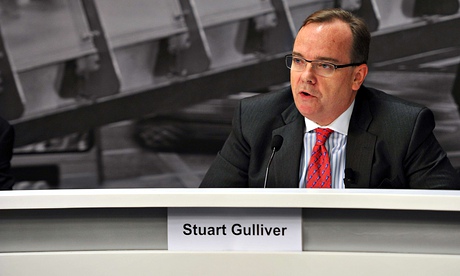
We should try to put the rewards, and the embarrassments, of Stuart Gulliver in perspective. The chief executive of HSBC has just trousered £7.6m for his performance at the head of a bank which has been shaken by some awe-inspiring scandals. By comparison, a successful British comedy might make £30m, as Notting Hill did in this country alone. The question that naturally arises is whether Mr Gulliver’s performance as a hapless operator is a quarter as funny as Hugh Grant can manage. Obviously it can’t be for the shareholders. They have seen profits drop by 17%, of which a whopping £2.4bn is accounted for by “fines, settlements, UK customer redress and associated provisions”, many imposed for misdemeanours committed before Mr Gulliver was in the top job – behaviour which was not just unethical and unsavoury but illegal as well.
That is a lot for a bank to lose by malevolence rather than mere incompetence. Perhaps Mr Gulliver can console himself that his pay cost the shareholders far, far less than the misbehaviour of his colleagues and subordinates did – but the shareholders do in theory pay him to manage and direct his subordinates. When he asked, rhetorically, whether he could possibly know what every one of the bank’s 257,000 employees was doing, the answer is obvious: he’s only supposed to know what the ones who can cost the bank billions are doing. Right at the moment, he doesn’t look much like a man who knows what he’s doing himself.
But perhaps it is not the shareholders whose sense of humour he should appeal to. For the rest of us, there is the delicious spectacle of bankers’ gravity, an arrangement whereby money and credit only ever flow uphill. Last year, Mr Gulliver was paid £8m. This year it will only be £7.6m. So he has lost £400,000 – mere chickenfeed, scarcely enough for a studio flat in the parts of London a banker might deign to live in – as a result of the bank’s profits falling by about £2.6bn. Can anyone doubt that if the bank’s profits had risen by the same amount, his own compensation would have bounded upwards like a happy chamois in recognition of his tireless labours and executive brilliance?
When a bank’s profits fall, it is, of course, the fault solely of subordinates, whose actions the men at the top cannot possibly monitor. That responsibility is passed on instead to “systems”, which will inevitably fail again: at least, they will fail if you suppose their purpose is to stop bankers failing or misbehaving. In fact, these systems exist to maintain the steady current of blame heading downwards, while praise and money ascends to the top of the organisation.
All this comes on top of the embarrassments of discovering that in 2005 Mr Gulliver held his own bonus, through a Panamanian company, in the disgraced Swiss subsidiary of HSBC which the Guardian has exposed as encouraging other clients towards tax dodging. His motive, apparently, was to keep secret from his colleagues in Hong Kong, where he then worked, the size of his bonus. What could possibly explain a culture where this seemed natural and necessary? Greed, actually.