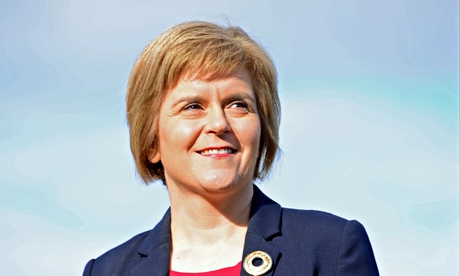
Officially, Nicola Sturgeon will not be Scotland’s first minister until the middle of November. But she is already making new waves, not just in the politics of Scotland but in those of the UK too. It took only a few hours today for her proposal that each of the four UK nations should have a veto over UK withdrawal from the European Union to be raised at prime minister’s questions by an irate Sir Bill Cash. Not surprisingly, David Cameron was also quick to knock the idea down. One UK, one in/out referendum, he said.
Ms Sturgeon’s suggestion is nevertheless an important one. It should start a more serious debate than it got today. Her proposal is for an amendment to any bill that a victorious Conservative government introduces after 2015 to authorise a UK referendum on EU membership. The amendment would require that all four constituent nations of the UK would have to vote for withdrawal for it to happen. It is a model already used for constitutional change in Australia and Canada. In practice, what Ms Sturgeon has in mind is that if the Scottish voted no to withdrawal – which opinion polls suggest would be the likely outcome there – it would veto an overall UK yes.
As ever in nationalist politics, Ms Sturgeon’s proposal contains several political objectives rolled into one. Part of her idea is simply to defend Scotland’s place in the EU, by making it more difficult for a UK majority to force Scotland to leave against its will. She is also trying to embarrass Scottish Labour, not hard to do at the moment, by posing as a more effective defender of Scotland’s EU membership than Ed Miliband. If her move simultaneously provokes the Tories and Ukip to attack Scotland’s leader for her presumption, then that is politically useful to the nationalist cause too.
Yet the real significance of Ms Sturgeon’s amendment – which she is likely to invite other parties to support – is that it poses a genuinely federal answer to a massively divisive question for the UK. If the UK were simply one homogeneous nation, a simple majority in a referendum might suffice. But if you accept that the UK is made up of a number of nations, which it is, then minorities and difference need to be considered and perhaps protected. On such an important issue as the EU, a 60% majority of those voting might be one solution. But the affirmative consent of all the home nations is possibly a reasonable alternative too.
Yet Ms Sturgeon’s proposal is not just about Europe. It is also about Britain. It poses questions about the terms on which Scottish and other national identities can be better respected in a continuing political union. This inescapably involves placing constraints on the power of the governing majority. This is a question whose time has come. Without quite admitting it, Ms Sturgeon’s idea could be a way of strengthening the union, not of breaking it up. Post-Scottish-referendum Britain is grappling, without any help from Mr Cameron and his party, with the essential question of finding ways of making the union work better and more fairly for all. Federal options like those proposed by Ms Sturgeon are undoubtedly part of that debate.