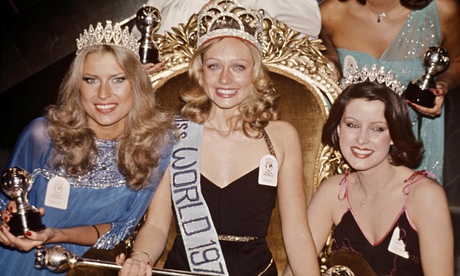
The 1970s are acquiring the patina of a pre-lapsarian age, unexpectedly imbued with a kind of Edwardian glow, the moment before the world fell apart – or, in the case of the 70s, before feminism went mainstream. A few years ago, the time-travelling DCI Sam Tyler in Life on Mars had a car accident and was transported back in time to 1973 and sexism, on-screen smoking, and flares. It was a format that licensed viewers to revisit a smuttier world, one of the hits of the 2006 season. Now, in a Saturday night show called It Was Alright in the 1970s, Channel 4 has reproduced the effect, with clips of TV shows of the period – with more sexism, on-screen smoking and the Wheeltappers and Shunters Social Club. The series launched with a reminder of one of television’s most successful formats, the beauty contest, replete with lingering shots of breasts and bottoms, and leering, fully dressed male presenters. Most shows of the time are a toe-curling memory, but the beauty contest lives on, a faded auntie to some truly brazen progeny.
Next month Miss World 2014 will hold its grand final. It is 63 years since a young Eric Morley dreamed up the idea of stripping off young women from around the world to sex up the Festival of Britain, and a quarter of a century since British television was embarrassed into taking it off air by a feminist campaign against the objectification of women (although Channel 5 revived coverage in 1999). The trappings of the show that started in London last weekend are modernised to some approximation of relevance to the 21st century. Contestants are now called delegates and the ambition to travel the world and meet people has been replaced by an obligation to do charitable work. In the carnivorous world that it contributed so much to creating, it now feels almost quaint. The format is as flawed as it ever was, but the show is not quite as hypocritical as it was in the days when it twice forced out contenders for being single mothers. It belongs to a kinder, gentler TV age, and if the unprobing questioning and life-enhancing projects to which the “delegates” aspire might be little more than a flimsy sanction of voyeurism, they still contrast favourably with the ruthlessly destructive judgments of Britain’s Got Talent or The X Factor.
The idea of assessing women, and increasingly men, against some fantasy ideal – and then criticising them for failing to meet it – is a staple of social media. The Daily Mail website’s “sidebar of shame” exposes celebrity cellulite on a daily basis. Grace Mugabe, the wife of the Zimbabwean president, who is engaged in a bitter vendetta with his vice-president, Joice Mujuru, attacks her on the grounds that she is too fat to wear a miniskirt. Set against these norms, the question of which of 120 young women has longer legs or better hair seems almost innocent. The regrettable truth is that the creators of Miss World were among the first to understand the marketability of the universal desire to judge our fellow human beings. They have been successful beyond parody. But at least there’s the off button.
• This article was amended on 2 December 2014. An earlier version said the Miss World final would be screened on ITV. That is not the case.