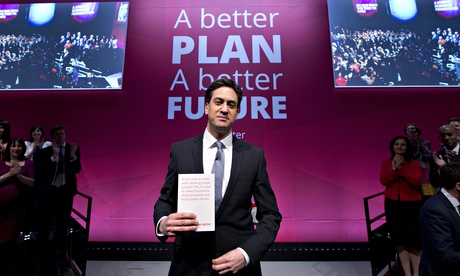
Labour’s 2015 general election manifesto is two separate things in one. It is an affirmation of deep-rooted Labour conviction and, simultaneously, an admission of continuing Labour electoral weakness. Its core content is a recognisably Labour message, with a blue tinge. This message stresses community, hard work, public services and decency in ways that will encourage the third of the electorate who are likely to vote Labour come what may. But the commitments that frame the core message, and the manner in which it was launched by Ed Miliband in Manchester on Monday, address a different goal. They are aimed at the voters who would like to embrace the core but are uncertain whether to do so. This bit of the launch is a recognition that a significant section of the electorate still needs encouragement and permission to vote Labour.
Opinion polls have long made clear that Labour will struggle to win the election if it does not address the problems of economic credibility and Mr Miliband’s popularity ratings. For much of the past four and a half years, the party has preferred to duck and dive on both issues, as a result of which its ratings have suffered. But in launching its manifesto, Labour did its best to confront these negatives. The manifesto opens with a so-called budget responsibility lock to reassure voters about Labour’s fiscal discipline. No spending commitment requires extra borrowing; all will audited by the Office for Budget Responsibility. The deficit will be cut every year. And there will be a current account surplus within five years. All this was presented by a plainly invigorated and confident Mr Miliband, a man obviously determined to raise his game on the big occasion. The Labour leader has had bad days in Manchester. This time he had a good one.
The key question is whether the message or the messenger will make the desired breakthrough in the 24 days before the country goes to the ballot box. Labour has left this terribly late, a challenge reinforced by the latest Guardian/ICM poll. This underscores the electoral gamble that the party took on Monday. The lock raises questions with which Labour will be assailed by friend and foe. What is the target date for the current budget surplus? Without that, the voters cannot know what scale of cuts Labour might impose. How can the books be balanced when Labour has also pledged not to raise VAT, basic rate income tax or national insurance? And doesn’t the “budget lock” rhetoric have the smack of spin when the specific commitments appear to allow Labour considerable and sensible scope for borrowing?
These are real uncertainties, not to be dismissed. But these uncertainties encircle a modest but tough and consistent core social democratic message in the manifesto, which was summed up by Mr Miliband when he said that real changes can come even in an era of relative scarcity. These changes will not satisfy the purists, but they are real enough: an increased minimum wage, safeguarded budgets for health, education and aid, the freeze on energy bills and rail fares, a cut in tuition fees, a female-friendly agenda on childcare, a mansion tax, the abolition of non-dom tax status, a constitutional convention. It is an agenda that can seem bitty. Not every bit is well thought-out, such as student fees. But overall the bits add up politically.
The manifesto has ambiguities and silences too. There are interesting ideas in corporate governance, but they have not been fleshed out. The new directors of school standards may be the vanguard of a stronger system of local school accountability, but this is left vague. The commitments on housing and immigration use robust language, but lack detail. Big issues such as the NHS budget, Labour’s ultimate position on Trident and whether there will be further cuts in Scotland have not been nailed down unambiguously.
Against that, the pledge to keep Britain in the EU is a serious policy of principle. And this manifesto cannot be depicted as having been written by the union bosses, by a coterie of business donors or by image consultants. Labour still has a mountain to climb, but this manifesto is not a return to either Old or New Labour. It is a recognisably Labour manifesto for difficult and impatient times. Mr Miliband has said in it what he means. He will take the credit or the blame for what happens next.