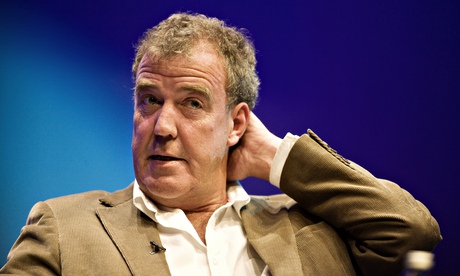
There could not be a better moment for the Guardian to praise Jeremy Clarkson than today. He appears to be on the ropes, although at the same time he is the beneficiary of an uprush of public support and may be contemplating an auction for his future services that will make him richer still. So here goes: he is a rarely talented broadcaster, a man who can play a part with absolute conviction and compel belief. If he were to thrash the air guitar, his audience would hear the music. He embodies the sense that limits are there to be broken and nannies exist to be cheeked. The disapproval of respectable opinion is essential to his appeal and to his success. Top Gear is a revolt against lace curtains, and a tribute to rude health, which is more important than safety. He represents the unrespectable id, the bold fellow who tramples across the landscape bellowing and belching, drunk on his own testosterone, entirely free.
Of course this is all make-believe. That’s where its power comes from. The experience depicted by Top Gear has nothing to do with real driving. In its swinging anarchic freedom it is the opposite of life as a modern driver whose life is one of harried misery. Even his new car is full of electronics to beep at him when he forgets his seatbelt or when he parks like an incompetent human rather than a robot. But inside every hunched commuter in the daily traffic jam who crawls meekly forward to the next red light, there is a shouting ogre out of Robert Graves, “wide-mouthed, long-yarded and great-bellied” – and Mr Clarkson is his spirit animal.
This makes him immensely valuable to the BBC, just as its role as the Auntie whom he scandalises as she cowers behind lace curtains is valuable to him. The BBC needs him partly because of his connection to a part of the nation, as of the psyche, which seldom connects to the metropolis, but which still pays its licence fee and must continue to do so if the corporation is to survive. It also needs him in simple cash terms. Top Gear brings in hundreds of millions of pounds a year worldwide. It is by a huge margin the BBC’s most profitable programme. And Top Gear is, or at least it seems to be, Jeremy Clarkson.
The BBC management’s dithering is in this light understandable. First they suspend him, and cancel the last three of his shows, which suggests that there is very strong evidence indeed of his misconduct. Then, there is silence. Either the evidence against Mr Clarkson is weaker than it looks, or else the management is desperately trying to make it look weaker. But at this point, the corporation must stand up to the ogre. If Mr Clarkson did in fact punch his producer he must be sacked. Playing the hero in the imagination of his fans cannot excuse boorish bullying in real life. If he did not, this must be established and he should continue as before. The one thing the BBC cannot do is faff around for another day, let alone another fortnight, which is undoubtedly what the instinct of the management is demanding that it do now. Violent ogres are only entertaining in fairy tales. They don’t belong in public service broadcasting.