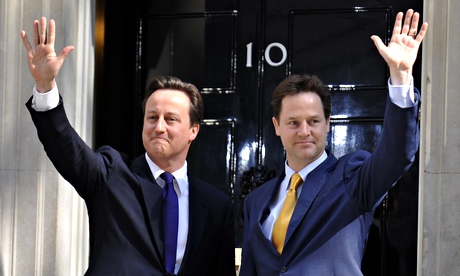
After the general election of 2010, five days elapsed before the formation of the Conservative-Liberal Democrat coalition. The delay, which seems small now, nevertheless took much of Britain by surprise. During those five days in May, Gordon Brown remained prime minister, as the draft cabinet manual of the time required. Mr Brown had lost the election, but he was constitutionally correct to remain prime minister and continue governing – albeit with “discretion” – until a new government could be formed. But he got nothing except grief for his efforts from the Tory press. The Daily Mail denounced him as a squatter. The Sun savaged him for refusing to let the “rightful tenant” into No 10.
Caretaker periods of this kind are in fact universal in parliamentary democracies. This country’s rules have now been codified still further by the coalition. It is clear that the issue may arise again after 7 May. Indeed, hardly a day passes without some new speculation about the form such events may take. If the Guardian’s new poll of polls is mirrored in the May result, for example, coalition negotiations could be much more complex than in 2010, with the possibility of three-party arrangements being necessary before a new government is formed. In those circumstances, it is unlikely that the caretaker period will be as short as it was in 2010, and quite possible that it will last several days longer, as is routinely the case in many European countries. If that is to happen, the rules that would apply to caretaker David Cameron need to be watertight and well understood in advance by all concerned. Right now, that is far from the case.
In one respect, Mr Cameron would be at an advantage, providing that he observes the rules properly. Britain’s leftwing press lacks the rightwing media’s killer instincts. Mr Cameron would be unlikely to be attacked as a squatter in the way Mr Brown was. In other respects, however, Mr Cameron would have to behave with care and constitutional responsibility. That’s because, as Petra Schleiter and Valerie Belu argue in the current issue of the Political Quarterly, Britain’s new rules are not watertight and thus provide “inadequate guidance”. There is, for example, no provision preventing a caretaker from resigning after a hung result. Nor are the limits on the “discretion” to be exercised by a caretaker made clear. According to one calculation, the next UK caretaker period could last as long as 51 days, 10 times more than 2010. That may seem a stretch; yet it is dwarfed by the 541 days it took Belgium to form a government after its 2010 election, a stalemate which stands as a warning to those who assume the political system will always find a way.
Over the next month, the parties should agree rules to limit the possibility of mischief and confusion in any caretaker period. Public expectations ought also to be better managed than in 2010. But the deeper lesson is that potential prime ministers and coalition partners need to be well prepared for all eventualities. They should plan for the unexpected and not rule too many options out. If they only start thinking about their approach on the morning of 8 May, then they and we could be in big but avoidable trouble.