Parliament returns to work, if that is the right expression for it, on Monday. But the reality is that there will not be much useful work done or wisdom displayed in the House of Commons now until a new one assembles after the election on 7 May. The 2010-15 parliament is waiting to be removed to the knackers’ yard. The Conservative-Liberal Democrat coalition has effectively finished its work. The political class is fixated on the election outcome. The budget excepted, the legislative programme facing MPs is now so thin as to be almost irrelevant. Were it not for the need to keep up appearances, MPs could in fact spend most of the next few weeks in their constituencies campaigning. Many will quietly do just that.
Unfortunately for healthy politics, the election date is now set by law. That date is more than four months away. This ensures that, although parliament has little to do, the 2015 campaign will fill the space that the government has vacated. Prepare for a season of partisan squabbling and parliamentary behaviour of the sort that gives modern politics a bad name and which the coalition was supposed to have consigned to the waste bin. It is a gift to the insurgent parties.
The 2011 Fixed-Term Parliaments Act, which sets the election date in stone, may have seemed like a good idea at the time. It was supposed to restrict old-style opportunism by prime ministers in hung parliaments, giving the Lib Dems a guarantee that the Tories would not walk out on them midway through the parliament. But this law may return to haunt British politics if there is another hung parliament in May. The act makes it extremely difficult to call a second election before the next scheduled one in 2020. Nevertheless, both Labour and Conservative sources are speculating increasingly openly about doing just this, as though the law did not exist. Party leaders urgently need to read the act and get real about this option.
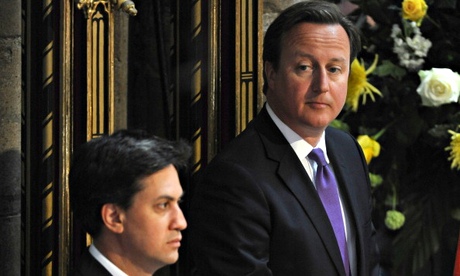
In the meantime, the 2011 law ensures the vacuum until 7 May will be filled by campaign activities, of which David Cameron provided a taster in his interviews on Sunday, while Labour gave its supposed NHS trump card an early airing too. In reality this formalises a process, sometimes dubbed “the near-term campaign”, that is familiar from other recent elections. Officially, the campaign has not yet begun. In practice, the gloves are off. The battle to control the media agenda is already up and running. Policy commitments will be set out and rebutted on an almost daily basis. This raises the real danger that the voters – and the media – will already have had enough by the time the official dissolution takes place around Easter.
It would be seriously bad for democratic politics and genuinely risky for Britain if that were to happen. All general elections are important. But the 2015 election will be particularly significant. It is not primarily an election about personalities, though personalities always matter and will inevitably be a factor in May. It is not even primarily an election about who does a deal or forms a coalition with whom. But it is absolutely certainly an election about issues that matter. The 2015 election will set this country’s course over the size of the state, the treatment of the poor and the foreign, and about controlling the deficit. Even more important, it will pass a verdict about the unity of the UK itself, and the relationship with the nations of Europe. It may also reshape the party system in a way that has not happened since the first world war.
Britain already stands close to the top of a slippery slope on some of these questions. The divides on each of them could hardly be more consequential, not only for ourselves but for future generations. Getting the answers right will certainly be a profound test of the political system’s robustness and resilience. But it will also be a profound test of the British people’s collective wisdom and common purpose. The unity of the country does not always rest on the outcome of an election. The stability of Europe is not always affected by our votes. But these outcomes are in the balance this time. It is important that the parties, the political class and the media do their best to raise their game and illuminate the argument; which is why there should be televised leaders’ debates in 2015. But it is even more important that the public grasps how much is at stake too, however frustrating our politics can sometimes be.