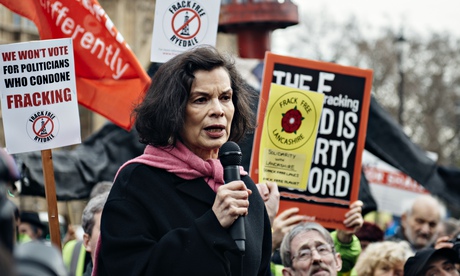
The government’s approach to the critics of fracking has been a bit like the 17th-century royalist hero Prince Rupert’s approach to the parliamentarians during the English civil war. The faster you charge at your enemies, the further they will run. It was a tactic that turned out badly for Prince Rupert, as it did too for David Cameron and George Osborne last night, when – in the face of rebellion – the government made an 11th-hour embrace of a bundle of opposition amendments, tightening up the detailed regulations.
The faster they insist on pressing ahead with shale gas extraction – on Monday we reported that the chancellor had written to cabinet colleagues instructing them to fast-track fracking as a “personal priority” – the more opponents they have created, including several Tories such as the former environment secretary, Caroline Spelman. On Monday, MPs on the environmental audit committee pointed out the weaknesses of a regulatory regime that, in England alone, involves three government departments and several agencies, with at least as many more in the devolved administrations. Labour pushed for a single fracking permit, to give the Environment Agency an overarching regulatory role. Such details, as well as concessions to protect national parks and the water supply are important. But serious critics will continue to demand a moratorium so that outstanding questions can be considered: most fundamentally, the consequences for the UK’s commitment to cutting emissions and the wider implications for climate change.
It is, to say the least, questionable for the UK to claim the need to bring on stream a new fossil fuel at a time when it is also notionally committed to greening its economy. Fracking will never produce American amounts of shale gas, and certainly won’t even be viable for at least a decade. But, by 2030, the UK intends to have decarbonised electricity supply. Gas will not be needed for power stations, only for domestic and industrial heating. Industry representatives argue that shale gas will be a necessary bridge between the end of coal, which has to be phased out to meet EU emissions targets, and the wide availability of renewables. They point out that to have a domestic gas source would enhance energy security and, by replacing imported liquid petroleum gas, lower the nation’s carbon footprint. Industry critics fear that shale gas would be used not as a short-term stopgap but as a convenient way of avoiding necessary investment in renewables that might offer less certain returns.
But the deeper question is when UK policymakers will face the fact that, if there is to be any chance of keeping global temperatures below the danger level of two degrees celsius, there are reserves of fossil fuel that must be left in the ground. Instead, Mr Osborne’s focus is on bulldozing through the development of an unconventional fossil fuel that is likely to be locked into the UK’s energy mix by the sheer scale of investment required. He is ignoring serious dilemmas, that demand serious consideration. Bullying and bribing people into accepting fracking is no substitute for winning the argument.