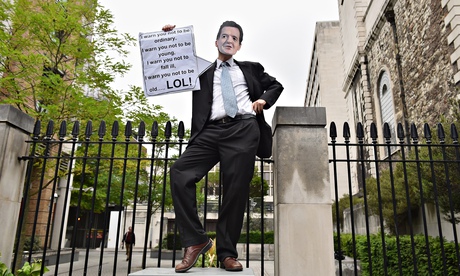
All through the austerity years, the unravelling of the Greek economy – now seemingly heading for another interim deal – has served as a convenient backdrop for George Osborne’s own drive to hack back the state. The British banks are not about to fail, nor are British pensioners about to suffer the plight of millions of their Greek counterparts, but some pretty severe belt-tightening is coming here too. On Saturday, tens of thousands of demonstrators marched through British cities, including a quarter of a million in London and Glasgow, in a show of support for the other side of the argument: that austerity should be ended now. Meanwhile, Labour has been fumbling for a response for five long years. The construction of a coherent, persuasive narrative on welfare reform, and what part it should play in deficit reduction, must be at the top of the in-tray for the party’s next leader.
The Conservative attack on Labour’s opposition to the coalition government’s cuts played a big part in reinforcing their claim that the longest and deepest recession in modern times was all down to excessive state spending. And barely had the anti-austerity protesters got home on Saturday than Mr Osborne and the work and pensions secretary, Iain Duncan Smith, were declaring their commitment to go full throttle with more austerity measures. In a joint article in the Sunday Times, they declared that they had reached agreement on the £12bn cuts pledged before the election, despite speculation that Mr Osborne was under pressure from other senior Tories, including Mr Duncan Smith, to back off for fear of the reputational harm that more cuts might bring.
This is a debate mired in misleading statistics, and there were more of them on Sunday. Take, for example, the fundamental argument Conservatives make about welfare spending, that there is too much of it. Mr Osborne repeated the assertion that he made at prime minister’s questions last week, that Britain had 1% of the world’s population and 7% of the world’s welfare spending. It is not untrue, but it is not the whole story either. Spending on benefits both globally and as a percentage of GDP is in line with spending in similar countries, including Germany and France. Most of the countries that spend less are not places many Britons would care to live. The two ministers also repeated the familiar point that the impact of cutting another £12bn should be contrasted with the £21bn already made. Except they cautiously used the word “legislated” for, rather than made: cuts announced are far from the same as cuts delivered. The number on incapacity benefits stopped falling, for example, after the reforms, because of administrative incompetence.
But making the case in detail is an uphill task. In particular, capping household benefits to non-working households at £26,000, around the level of average earnings, sounds fair and reasonable to the millions of people struggling to get on the housing ladder and stretch static pay packets across rising household bills. It is also the case that as it was introduced, the numbers getting into work began to rise. But that may well have been because of a general pick-up in the economy, rather than the incentivising impact of a reform that hit nearly 60,000 families. According to a leak just after the election, a further cut to £23,000 would pitch another 40,000 children into poverty, on top of the 50,000 affected by the existing cap. It is already warping provision of new social housing, as housing associations worry that larger homes will be unaffordable.
So far, the Tory cuts have been broadly popular. They have been perceived as being all about fairness and ending unintended disincentives to work. But another £12bn of cuts will almost certainly be agonisingly hard to find. With pensioner benefits excluded and many other payments already frozen, savings are most likely to come at the expense of working-age young people, families with children, and people on housing benefit. The pain is likely to be felt more widely and go deeper than it did over the last five years. There will be more losers, more people experiencing real cuts in household incomes. There could, at last, be a real sense of public anger. It could provoke a real popular revolt. But Labour, as the leadership contenders recognise, would be unwise to count on it.