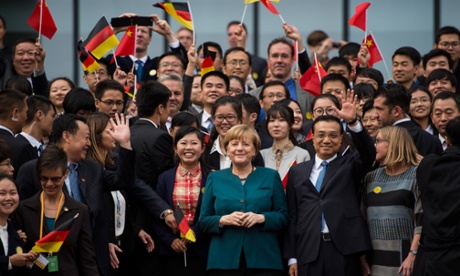
When a political leader has been in power for 10 years, as Angela Merkel has been, attention inevitably begins to focus on what comes after. Such a change would be happening in Germany around now anyway, whether or not Mrs Merkel decides to run for a fourth term as chancellor in 2017. But it is happening in a more volatile manner this autumn because of the domestic political consequences of the refugee crisis, which is expected to have brought more than a million refugees to Germany by the end of this year. Mrs Merkel’s authority is under challenge, which is not helped by national embarrassments over emissions cheating at Volkswagen and the alleged backhanders that brought the Fifa World Cup to Germany in 2006. Returning to Germany from a two-day trade trip to China, she now faces key meetings this weekend to try to stabilise a slide in her fortunes that is threatening to get out of hand.
Mrs Merkel drew much praise, at home and abroad and from opponents, by boldly embracing Germany’s new migrants in the summer. She told the public that Germany’s doors were open and that the country could handle the influx. But German public opinion, and opinion within her own centre-right CDU and its longtime coalition partner the Bavarian CSU, which governs the part of Germany where most refugees first enter the federal republic, have faltered in recent weeks. The CDU-CSU’s polling percentages have fallen from the low 40s to the upper 30s. Mrs Merkel’s own ratings hover above 50%, down nine points in a month.
These are unfamiliar reverses for a leader and a party that are long accustomed to commanding the political stage and riding high in the polls. But they have to be seen in perspective. The CDU-CSU has been enjoying unusually good polling for a long time. It still leads all other parties in Germany by substantial margins. Mrs Merkel likewise still wins notional match-ups against other putative chancellor-candidates by a stretch. The refugee crisis has given a modest boost to the rightwing AFD and has triggered renewed demonstrations by the hard-right Pegida movement in Saxony. But the AFD remains tiny, Pegida is largely localised in one part of the old east, and Mrs Merkel would win a general election if one was held today. This is only a crisis if her rivals in her own party and coalition choose to make it into one.
That is not out of the question, even though it is not obvious who from within the CDU would do any better as leader. The immediate problem for Mrs Merkel comes from the Bavarians, whose leader Horst Seehofer, the CSU chair, has taken a strong anti-immigrant stance and has been flirting with pulling his party out of the federal government. Bavaria is unquestionably the latest part of Europe to be and to feel itself on the front line as the migrants from Syria and elsewhere arrive. Towns and villages there are under genuine pressure. But it is also Germany’s industrial and financial powerhouse. If there is one place in Europe where there are the resources to cope with the impact of refugees it is Bavaria.
The two partners meet in Berlin today to try to sort out their differences. It is important that they succeed. The outcome matters far beyond the confines of German domestic politics. No leader is indispensable, but it is not in the interests of either Germany or of Europe – let alone in the interests of Britain in Europe – that Mrs Merkel should be ousted now or over migration.
The immediate reason for this is the stance she has taken on the refugees. Her strategy is a humane and decent response to an unavoidable problem. She cannot be blamed for the existence of the refugees and her policy should be given time to work. But there is also a genuine danger that the ousting of Mrs Merkel would begin to move Germany, the most powerful and pivotal nation in Europe, into the ranks of those nations that pull up their drawbridges and surrender to populist pressures. If that happened, there would be consequences in Germany, but there would be large repercussions in the EU too, not least for Britain.
With good luck this will not happen. Germany has come through the crises of recent years with its values and institutions challenged but intact. Its civic culture is as well equipped to deal with the refugee situation as any in Europe. Mrs Merkel may be wise to step down in 2017, and it is important she does not allow herself to become the nation’s political comfort blanket, but she has important work to do before that in steadying Germany and the EU alike.