THE SPIN’S XI OF THE YEAR
Christmas is a time for family, for feasting, for goodwill, and, of course, for lists. Lists that help weary journalists meet onerous end of year deadlines. With great fanfare then, it’s the Guardian’s International XI of the Year! It’s been selected after consultation with a special panel, two of whom have more than 1,500 first-class wickets between them. And four of whom don’t. Thanks, then, to Mike Selvey, Vic Marks, Rob Smyth, John Ashdown, and Daniel Harris. Rigorous rules, in no way concocted in a last-minute rush, meant that the team was selected to play across all three formats, with the most weight being given to performances in Tests, then ODIs, then T20s, and after hours, minutes, seconds of heated email debate, this is the side we came up with:
David Warner
Tests: 1,096 runs at an average of 68.50
ODIs: 406 at 36.9
T20s: 184 at 36.8
Total: 1,686 at 52.68
It’s been 18 months since something inside Warner snapped. Ever since he came back into the Australia team after being dropped for clobbering Joe Root, his form has been such a deep shade of purple that he could walk out to the riff from Smoke on the Water. He has achieved a level of success in Tests that no one would have predicted when he made his international debut – before he had even played a single first-class game – back in 2009. No one, that is, except for his kindred spirit Virender Sehwag, who told him: “You’ll be a better Test cricketer than you are a T20 player.”. Even Warner didn’t believe him. Until now. In 2014 he scored six Test centuries and went on a back-to-back jag of 115, 70, 66, 135, and 145 against South Africa in the spring.
Hashim Amla
Tests: 667 at 66.7
ODIs: 892 at 52.47
T20s: 191 at 27.28
Total: 1,750 at 51.47
In February, Amla was dismissed LBW for a duck by Mitchell Johnson at Port Elizabeth. The great Barry Richards was one of the few who floated the idea that perhaps, at the age of 30, Amla’s reflexes were on the turn. But it turned out to be the full stop at the end of a lean run. Amla made an unbeaten 127 in the second innings. He took over from Graeme Smith as Test skipper in June. Since then, he has deftly switched the tempo of his batting to the needs of the team. There was a treacle-slow century against the Sri Lanka spinners in Colombo and a rather more rapid 208 against West Indies last week, as he looked to push for a declaration. In one-day games he has been better yet, with five centuries in 18 innings.
Kumar Sangakkara
Tests: 1,431 at 79.5
ODIs: 1,256 at 46.51
T20s: 119 at 19.83
Total: 2,806 at 55.01
Take in those numbers, and roll them around your mouth. At the age of 37, Sangakkara has produced a vintage season; no one in the history of the game has ever scored more international runs in a calendar year. He quit the shortest form in April, after scoring a match-winning 52 against India in the final of the World T20. He plans to give up ODIs when the World Cup is done, even though he has scored more runs in the format than anyone else in the world in 2014. Limited overs cricket has long since ceased to puzzle him; it’s a little like watching Erno Rubik solve his own cube. And in Tests, he has had his best year yet. The pick were his four innings in England, 147, 61, 79, and 55, in conditions many thought he could never master.
Steve Smith
Tests: 940 at 78.33
ODIs: 541 at 49.18
T20s: 3 at 3
Total: 1,484 at 61.83
Cut back 18 months. Early in August 2013, Smith would have seemed a longer shot to make this team than even his mate Warner. His skittery, jittery, scrappy batting looked as ill-suited for the Test middle order as his leg-breaks did for the job of frontline spinner, which was what Australia first picked him to do. He hadn’t made a century in 64 international innings, and his Test average was the wrong side of 30. Darren Lehmann selected him on a hunch, and stuck with him. Smith made his first ton in the next Test, at The Oval, and he hasn’t looked back since. This year there have been six more centuries, against Pakistan’s swing, India’s spin, and South Africa’s speed, and England’s … well, against England. He ends the year as Australia’s new captain and the most improved player around.
Younus Khan
Tests: 1,064 at 66.50
ODIs: 163 at 27.16
Total: 1,227 at 55.77
A sentimental pick this, since there are others – notably Joe Root, Virat Kohli, and Kane Williamson – who have scored considerably more runs than Younus this year, and did it in all three formats to boot. But at the age of 37, Younus deserves a lucky break. Especially since his own selectors have dropped him five times in the past four years. When he was left out of the ODI side this September he was so furious that he used the ire as fuel for an extraordinary spree of run-scoring. He made 106, 103 not out, 213, and 46 in two Tests against Australia, then followed it with 100 not out against New Zealand. For three weeks he was unbeatable. Amusingly, he pointedly refused to thank the Pakistani Cricket Board when he was asked to do so during a TV interview.
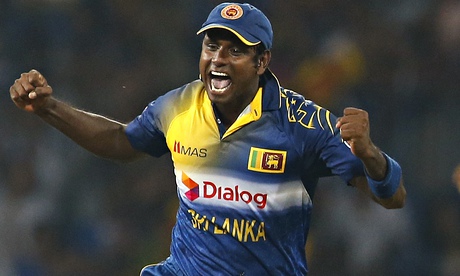
Angelo Mathews (C)
Tests: 1,044 at 80.30 / 7 wickets at 44.85
ODIs: 1,244 at 62.20 / 18 at 36.16
T20s: 126 at 21 / 6 at 23.16
Total: 2,414 at 61.89 / 31 at 35.61
Much as it stung at the time, now that the pain has eased English fans may be able to look back on Mathews’s match-winning performance in the Headingley Test as one of the great moments of 2014. First he took four for 44. Then, with his team four wickets down and leading by only 68 in the second innings, he unfurled a career-best 160. Finally, in the field, he orchestrated England’s dismissal for 249. It led to Sri Lanka’s first ever series win in England – bar the one-off Test back in 1998. It was a peak in a year that otherwise resembled one long plateau – since March he has been out in single figures only once in 38 innings, and has made at least 30 in 24 of those knocks. Right now his batting average as a Test captain is second only to Don Bradman’s.
AB de Villiers (WK)
Tests: 621 at 51.75
ODIs: 879 at 73.25
T20s: 140 at 28
Total: 1,640 at 56.55
In October, South Africa were playing New Zealand in a one-day game at Mount Manganui. After 14 overs, New Zealand were 54 for two, in pursuit of 283. At which point AB de Villiers decided to bring himself on to bowl. Even though he’d never actually taken a wicket in limited-overs cricket. In his first spell he had Tom Latham caught at short fine leg. And in his second, he bowled Trent Boult with a slower ball. They used to call the Australia rugby union captain John Eales “Nobody”, on the grounds that “nobody’s perfect”. The name would suit AB too, since it seems there’s nothing he can’t do. Earlier in the year, doubling up as wicketkeeper in the Test series against Australia, he scored 341 runs and took and took eight catches in three Tests.
Mitchell Johnson
Tests: 42 wickets at an average of 21.92
ODIs: 14 at 30.85
Total: 56 at 24.16
Years from now, Johnson will be the central character in a spook story that elderly English batsmen tell their kids at night.: “Practise your defence in the nets, or Mitchell will come and get you.” Seldom in the history of the sport can a team have been so comprehensively dismembered by a single quick bowler. He carried that fire-snorting form into the series against South Africa at Centurion, where he took 12 for 127. On a slower deck at Port Elizabeth, he was less effective. It was a similar story against Pakistan in the United Arab Emirates. But still, he seems to have found a degree of consistency and his figures for the year stand comparison with any. On a quick pitch, with his dander up, he must be the most destructive bowler in the world at the moment.
Rangana Herath
Tests: 56 at 27.17
ODIs: 13 at 26.53
T20s: 6 at 8.83
Total: 75 at 25.60
Stuck for so long playing the supporting role to Muttiah Muralitharan’s star-turn, Herath has emerged as the leading spinner in the world since his team-mate retired from Tests in the summer of 2010. The odd thing is that hardly anyone seems to have noticed. In the past four years, Herath has taken more Test wickets than anyone in the world – 182 in just 33 matches. Which is many more than either of the more ostentatiously talented pair of Graeme Swann and Saeed Ajmal managed. Herath has won six man-of-the-match awards too, which is the equal of anyone. With eight days of 2014 to go, he’s the leading wicket taker in Tests, and indeed in all formats. The peak was the first Test against Pakistan at Colombo, when he took 14 for 184, including nine for 127 in the first innings. And he has done it all with a smile and a straight arm.
Dale Steyn
Tests: 39 at 18.33
ODIs: 22 at 26.54
T20s: 9 at 17
Total: 70 at 20.74
It’s easy to imagine Steyn was tickled by the idea that Johnson had overtaken him as the best fast bowler in the world. This is a man who has been tearing teams apart for years now. Steyn is 31 and has played more than 200 international matches, and his career average (22.63) across all three formats is as low as it has ever been. His numbers have a throwback feel: they hark back to the 90s, when a Test average of 30 was a passing grade for a fast bowler, and the very best of them expected to achieve something in the high teens. Just last week he eviscerated the West Indies at Centurion – he took six for 34 in 50 balls. He needs 11 more in his next three Tests to become the first quick bowler in history to take 400 wickets in under 80 matches.
Jimmy Anderson
Tests: 40 at 22.15
ODIs: 12 at 29
Total: 52 at 23.73
Amid all England’s chaos and confusion, Anderson has enjoyed one of his better seasons. He had a hard time of it in Australia but in his element, back on his home soil, he was as good as ever. At Lord’s against Sri Lanka he bowled 19 overs and took four for 25, as England fell a wicket short of a win, and then at Headingley he batted through 20 overs before he got out to the penultimate ball of the match. In his next Test he made 81 at Trent Bridge against India. And then, after he had been accused of shoving Ravindra Jadeja, he buttoned his lip and let the ball do the talking. He finished the series with 25 wickets at a shade over 20 runs each. His strength of character helped haul England through one of their tougher years of cricket.
• This is an extract taken from the Spin, the Guardian’s weekly cricket email. To subscribe, just visit this page, find ‘The Spin’ and follow the instructions.