Over and out
Thank you to everyone for joining us. It’s been a fantastic summit. We will be publishing follow-up articles over the next few days as well as video highlights of the sessions.
Here’s to another ten years of disruption,
The Guardian Media Network team
Updated
Final thoughts
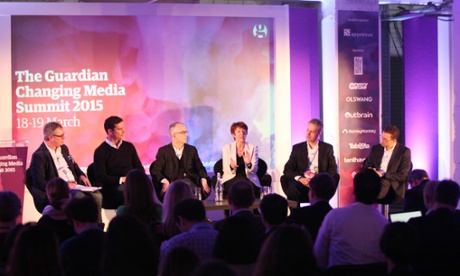
Following those survey results, a panel featuring Yahoo, AppNexus, Reed Elsevier, addictive and SurveyMonkey discussed what next for the media and technology sectors.
You can review the whole event here. We’ve published some key comments and quotes.
AppNexus’ Nigel Gilbert
One of the biggest issues is that mobile behaviour is consolidated in two or three companies
You’ve got to keep evolving. You can’t possibly stick something at the top of the screen [the banner ad] and expect that to be the way you get your message across
addictive’s Simon Andrews
Things like Tumblr, Instagram, you’re seeing people creating art
Simon says micro-payments might encourage people to buy more online but adds that ultimately we’re going into an advertising-funded world.
Yahoo’s Dawn Airey
We’re just beginning to see the power of native advertising but it’s still much more powerful than the banner ad
The best ads are those that are highly relevant
Reed Elsevier’s Mark Kelsey
[In the B2B world] users will pay for content
Updated
10 industry trends for the next 10 years
All good things must come to an end (sadface). So, with the applause still ringing in our ears, here’s a roundup of the Changing Media Summit’s closing keynote presentation and panel debate.
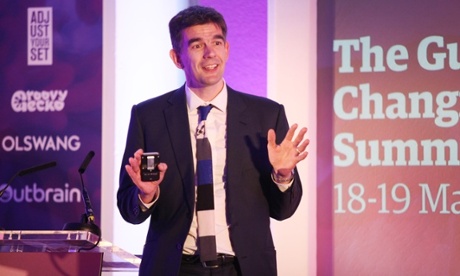
Jon Cohen of SurveyMonkey unveiled the results of an exclusive survey around what trends will dominate the media landscape in the next 10 years. Some of the key findings included:
- Being slow to adapt is the biggest challenge facing publishers
- 45% of publishers are not creating content for mobile
- 37% of consumers say content provided on mobile content is either ‘fair’ or ‘poor’
- Only 4% of publishers are creating content for wearables
- Only 29% of publishers see banners ads as a major part of future revenue
- Most publishers (68%) say access to more consumer data will make us more creative
- 72% believe creativity will be more important than technology in the next ten years
- 72% of consumers believe social media will overtake TV as an ad platform
- 70% of publishers support government regulation of third-party data sharing agreements
- 76% publishers anticipate more challenges in the next ten years
The future of agencies
What does the future hold for agencies? C-level execs from Wolff Olins, MediaCom, Hailo and Adjust Your Set have just tried to answer that quetion in the first of the afternoon’s panel debates.
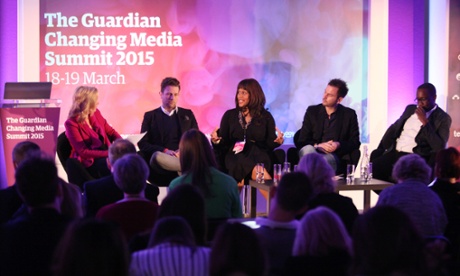
Here are some of the key takeaways and quotes:
Hailo’s Gary Brammel
There is no answer any more, it’s just a series of iterations and challenges. If the agency is able to adapt and the client has the competence and capabilities, a mistake or an opportunity can be alleviated in a few hours
Mediacom’s Karen Blackett
With any sort of partnership, you want to recruit people who are interesting and interested
To future proof my business we need people who care as much about the context as the content
Karen says that working for a company such as MediaCom might not offer the fortune that a tech giant can potentially provide, but that it equips its employees with a plethora of valuable skills.
Chris Gorell Barnes, Adjust Your Set
On the rise of content
A huge amount has changed and a lot of that is to do with the rise of mobile and the speed of broadband. The customer, the consumer is now in charge. [Rather than interrupting what you’re interested in] brands need to be what you’re interested in
Wolff Olins’ Ije Nwokorie
On agencies in ten years
That question pre-supposes that we’ll have agencies in ten years. [Because of the real time nature of marketing] this notion that you can go to a group of people who can tell you how to communicate, you have to challenge that
Content is a growth area as social was a few years ago
At Wolff Olins we think that everything we create should encourage [the audience] to take radical action
Updated
Personalised content
Lunch is over and so is the first fireside chat of the afternoon. Jeff Moriarty of Johnston Press and Taboola’s Jon Westnedge spoke to Forrester Research’s Ryan Skinner about personalised content.
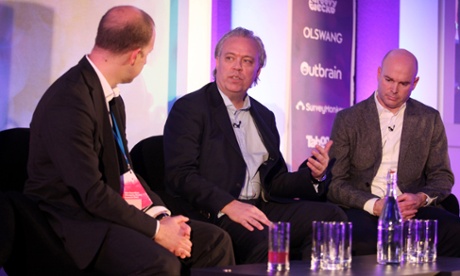
Here are some of the key points and quotes from the session:
Johnston Press’s Jeff Moriarty
We’ve gotten to a place now where the technology has started to catch up and personalise in a way that’s never been done before
We’re able to give you content around you, near where you are
I don’t think there’s any reason why we’re giving two people the same UI or content
We will test headlines online and see which work best to publish in print
Taboola’s Jon Westnedge
Two or three years ago the web was a different place [as social has overtaken search as the primary driver of traffic]
Jon adds that people who arrive at articles through Facebook apps tend not to reach the bottom of the page and asks whether they should be served different content.
Updated
Beyond the box: the future of television
We’ve been sitting in on the first breakout session, which featured speakers from Viacom, Sky, Sony and ThinkBox.
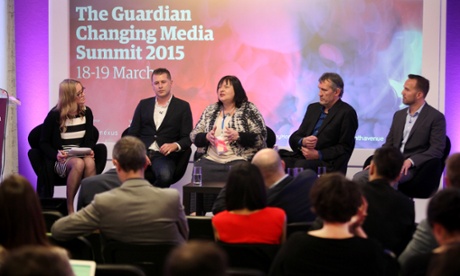
Viacom’s Philip O’Ferrall
On cross-platform engagement
There’s no question that people want to spend more time with our brands
On new platforms
Don’t underestimate people watching TV on their watches
ThinkBox’s Tess Alps
On immersive television
We find people do want to immerse themselves in brilliant fiction
About 12% of people watching The Million Pound Drop are playing along online
On Netflix
Netflix is really investing in TV
Sky’s Ian Lewis
On the state of television
I think we’re in a golden age of television. The quality of production has never been better
People are going to go to where there is great content. It’s all about creating those new experiences
Lewis says production teams are telling fans in advance where they will be filming so they can turn up and create a buzz on social media.
Sony Pictures Television’s Eric Berger
Fan participation is never going to go away
Streaming is by far the second most common way of watching TV after live viewing
Updated
Tweets about Twitch
Twitch founder Emmett Shear: “Over time you will see Twitch literally replace your television” #GDNCMS
— Lara O'Reilly (@larakiara) March 19, 2015
Twitch compelling because of mix of mass live events and small interactive ones #GdnCMS
— StrategyEye (@StrategyEye) March 19, 2015
"Luck is about being prepared for an opportunity when it comes by - and seizing it." Emmett Shear on the success of @Twitch #GdnCMS
— Jason MacKenzie (@jasonmackenzie) March 19, 2015
Twitch founder on the future of gaming
Walking off stage now is Emmett Shear of live streaming video platform Twitch. The CEO and founder spoke to Guardian games editor Keith Stuart about the future of gaming and how to build and engage massive digital audiences online.
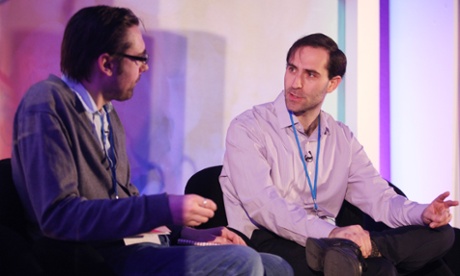
Some key comments and quotes:
Twitch is a place for the best players in the world, but also the most entertaining and creative players, explained Shear.
We did two things differently. First, we focused on gaming. Equally importantly, we focused on the broadcasters … we designed everything we did through that.
On Amazon buying Twitch:
More than half of active gamers are consumers of Amazon already
Sometimes when a big company buys a smaller company, the big company threatens the smaller business, he said. The thing with Amazon is that Twitch is not its core business, so it’s complimentary, not a threat:
They didn’t think that they knew the Twitch business better than the people who built it
In terms of the platform’s users, some are actually replacing watching television with watching Twitch, Shear said. It’s something people can switch on, sit back and relax to:
We see pretty incredibly high viewer retention rates
You can read more about Twitch and Shear in our pre-event interview…
Updated
Total retail: the merging of online and offline shopping
The panel on modern retail has just finished. We heard from speakers at Net-A-Porter, Rakuten Deutschland and xAd. The key point from the discussion was that online doesn’t kill offline.
We’ve posted some more highlights below…
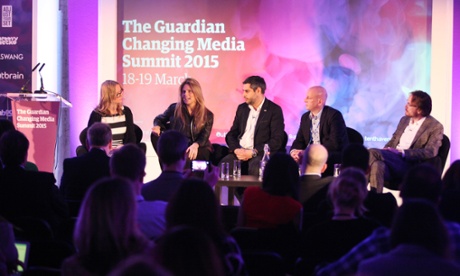
Net-A-Porter’s Lisa Bridgett:
Whenever new technology comes into the fray, people have queries about it. Despite the fact we are immersed in tech, we are very aware of consumer behaviour. In our business, the relationship with the customer is prime because we have a lot of intimate knowledge of their lifestyle.
So we’re very guarded about their data. So when something comes along like iBeacons, we trial them out, because any kind of mass messaging that doesn’t give you any purpose will put you off the brand.
Rakuten Deutschland’s Christian Macht:
There is a place for [pop-up shops] but they won’t overtake high streets
Beacon technology helps to get a better set up of your store
xAd’s Theo Theodorou:
25% of people are reverse-showrooming, finding items online and checking them in-store. Consumers are not predicatable
Paul Taylor:
There has to be a value exchange with the consumers […] things like vouchers or giveaways
Updated
What you’re saying
Some tweets from you about today’s Twitter session on politics and engagement.
Some stats:
34% of Twitter users have changed their vote based on content they've seen on Twitter #GdnCMS
— James Jones (@JJ_5) March 19, 2015
Politicians need to be more authentic - 5 in 6 Tweets from politicians are them broadcasting political messages #GdnCMS
— StrategyEye (@StrategyEye) March 19, 2015
And some food for thought for our MPs (but do we really we really need to know about what they had for dinner?):
@AdamS says MPs do not tweet enough about their personal lives. US example says this increases policy engagement #GdnCMS
— Jonathan Welsh (@JonWelsh) March 19, 2015
Updated
Views from the web
Miss any of the action from day one of the event?
Try some of these on for size:
‘Context is God’: Why the media needs a change in focus
In a keynote speech at the Guardian’s Changing Media Summit, entrepreneur Gary Vaynerchuk stressed the need for media companies to experiment with new platforms and treat each differently
(Journalism.co.uk)
Listen: Are we close to seeing virtual reality in news?
The technology is there but are news organisations using it?
(Journalism.co.uk)
Brands should take the visual web seriously, says Facebook’s EMEA boss
Nicola Mendelsohn has laid out the company’s vision for an immersive, visual-based web that makes communications easier in an increasingly frantic world
(Marketing Magazine)
ASA turning attention to Vine, says star Huw Samuel
The ASA is ‘looking to do more’ on Vine, says the content creator, who has gathered hundreds of thousands of followers but claims his clips with product placement can run without any disclosure
(The Drum)
Updated
Twitter’s Adam Sharp takes to the stage
We’ve just heard from Adam Sharp, global head of news and politics at Twitter. His session looked at how news-gathering organisations can analyse and understand political conversations taking place on the social platform, as well as offering insights into what British politicians and campaigners can learn from their international counterparts when it comes to electioneering on Twitter.
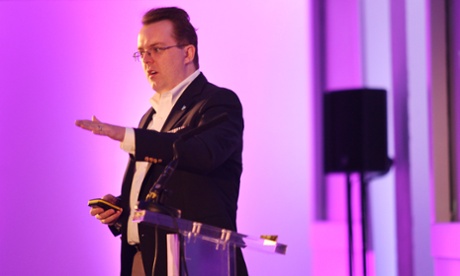
Here are some of his key quotes:
People are turning to mobile devices to connect to the [political] process.
He also announced the results of a poll Twitter carried out with 3,000 of its users. The results are, as Sharp put it, startling:
- 45% of Twitter users aged 18-34 have become interested in or joined a political or social cause they learned about through Twitter
- 47% of Twitter users aged 18-34 have reconsidered their views on a specific issue as a result of using the platform
- 37% of Twitter users would go to Twitter to actively look for information about politics or the UK general election
Sharp also lauded the Twitter skills of US Senator Claire McAskill.
Read our pre-interview with Sharp below…
Updated
Some more key quotes from Koechley’s keynote
On empathy:
Telling empathetic stories is really hard for brands and for large organisations because it requires a level of authenticity that is not normally [there]. The people in these organisations who are telling these stories are the people doing the CSR work in the basement. Brands know they all need to have their story and do good in the world and that requires vulnerability. That’s where we come in.
He added:
The idea that we used to only be able to extend empathy to the other people around the campfire. Then, with the rise of religion, we were not just tribes, we were whole religions. Then, with the rise of nations, we were Germans or French.
Even as societies grew bigger, [‘us’] was defined against the ever-bigger ‘them’. There is an opportunity with technology to take this to the logical conclusion: to treat all other humans with the dignity that they deserve; to learn that each human life is equally valuable. It’s a crazy dream. But so were democratic societies at one point, and now almost half the people on the planet live under them.
Much of the media is still writing much less interesting headlines than they should, he added, before finally saying:
It’s our job, as media-makers, to make as much progress toward this vision of global empathy as we possibly can.
Updated
Highlights of Peter’s speech
We’ve rounded up some of the best bits of Koechley’s visionary speech about the role of the media to help people empathise with those outside of their immediate circle.
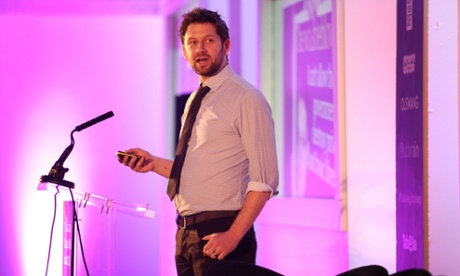
I want to talk today about the purpose of media. I want to posit that the purpose of media is to help make society work and that the most important way to do that is to doggedly cover the fashion mishaps of important people. No, I’m joking…
So how do you do that? Koechley offered two ways:
The first way is to to hold powerful people to account. That’s not really what we do. The second is by actually informing the electorate – giving them the information they need to actually make decisions.
That’s also not really what we do at Upworthy…
Upworthy doesn’t report the news, he added. “We’re not journalists in a traditional sense.” So what do they do?
I think there’s a third, very important, role for media in society. That is: I think media can be a powerful force for nurturing empathy in society. Empathy is a soft word [for hard-hitting journalists]. Without it, society has a really hard time making progress.
Luckily, we all know how to care. We all care innately for our families. It’s pretty easy to care for people you know but it’s harder when they’re outside your point of view. Extending your circles of compassion outside your [field of view – that makes society work]. That’s really necessary when you’re trying to get good public policy passed.
The way we do this is by sharing powerful stories…
Updated
Upworthy's Peter Koechley opens with the first keynote
We’ve just heard from one of the co-founders of viral publisher Upworthy, Peter Koechley.
The site, perhaps most famous for its “curiosity gap” style headlines (“What happened next will make you cry…”) has, to date, logged more than 1.5bn minutes of reader attention. It also attracts between 50-60m visitors a month.
There’s was an apology, of sorts:
We know that Upworthy-style headlines got a little out of control on the internet last year. [As mad scientists trying to work out what we could do to make people care], we unleashed a monster. Sorry for that. Sorry for kinda breaking the internet.
Read our pre-event interview with Peter below…
Updated
Juliet Scott-Croxford, director of commercial operations at Guardian News & Media, welcomes event delegates and introduces us to Guardian Membership.
What is it, we hear you ask?
Here’s Alan Rusbridger, Polly Toynbee, Jonathan Freedland, Owen Jones and Zoe Williams talking about why readers (yes, you!) are such an important part of what we do.
Find out more about Guardian Membership here.
Welcome to day two of the Changing Media Summit
The delegates have arrived here at B1 Location House in the heart of London for day two of the Guardian’s flagship media event.
On day one – which you can catch up with here – we heard from the likes of Google, VaynerRSE, Coca-Cola, News UK, Penguin Random House and Big Brother Watch. Panels focused on privacy and consumer trust, new marketing technologies, native advertising and book publishing.
What will today hold for us?
One thing’s for sure, the event coffee is strong.
So join us live for all the best insights and takeaways from the second day of today’s summit. We’ll be bringing you the best comments, stats and quotes as soon as the speakers exit the stage.