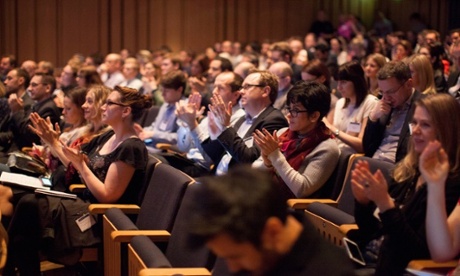
Until tomorrow...
That’s it for today. What a fantastic series of sessions. You can find recordings of them all here. We look forward to seeing you all again tomorrow morning!
Updated
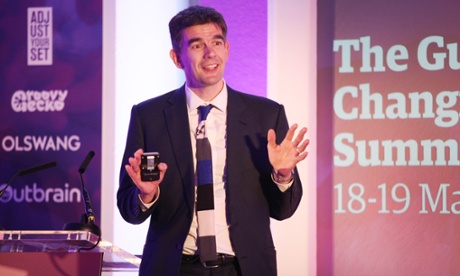
Matt Brittin, president, Google Europe gives the final keynote of the day
Matt shows the following compilation of some of YouTube most viral videos to celebrate the site’s 10th birthday:
We have well over 100 content creators in the UK whose videos go out to over 1 million people
One of the interesting things about YouTube is that it doesn’t know the bounds of time or space so [a large percentage of views come from outside the country where the video is published]
Four of the top 10 videos in the UK last year were from brands
Ultimately YouTube is about you, the audience, creating content, curating content - because the user is in control
What’s coming next? I don’t know. What we do know is that the internet population is going to close to double by 2020
Updated
Big bang: the collision between digital media, privacy and consumer trust
Following some lightning-fast lightning presentations, we have the final panel debate of the day, featuring Olswang, iProspect, Big Brother Watch and Philips.
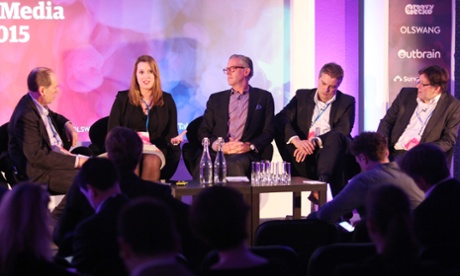
Here are some of the key comments and quotes…
Blake Cahill, Philips:
Brands have to be the stewards of data and consumers have to be the custodians of data. Privacy comes first. That’s our motto
The biggest thing we focus on is building consumer trust and ensuring there is the right value exchange
The customer has to opt into want to be a part of that. They have to be a willing participant
Emma Carr, Big Brother Watch:
We [consumers] want things to be done with us, not to us
The education around cybersecurity in this country has been pretty poor
Matt Adams, chief media officer, iProspect:
What we do is always about delivering positive business outcomes... We have empirical proof that [using data to increase efficiency of adverts] does work for brands
We’ve seen a rise in people using incognito browsing
As technology advances [it’s going to be easier to opt-out]
We see more and more brands exposing the way they use data
John Enser, Olswang:
Broadly speaking, if you are transparent and attain the appropriate consent, you can do more or less anything, but you need to make sure the consumer understands what their data is being used for
You will potentially be able to be fined 2% of global turnover for a serious data breach
Updated
Some tweets (and sketches) while we break…
Part I of @SurveyMonkey's study "10 Media Trends for the next 10 Years" #live #sketching #workinprogress #GdnCMS pic.twitter.com/jpZL5RH5hE
— LiveSketching (@LiveSketching) March 18, 2015
Weldon: we could become a retailer; but it would be quicker to burn the money. "Scandalously naive" to believe otherwise. #GdnCMS
— Richard Mollet (@RichardMollet) March 18, 2015
Tom Weldon, CEO of Penguin Random House: "so many of the world's greatest creative franchises stem from the book industry" #GdnCMS
— Dan Ison (@Dan_Ison1) March 18, 2015
Updated
A pair of Vines, this time from event sponsor tenthavenue and its CEO Rupert Day…
What’s the biggest challenge that marketers face?
Rupert Day, tenth avenue https://t.co/QXBMZ1DCZa
— Oscar Williams (@oscwilliams) March 18, 2015
And what’s the most important thing he’s learned today?
Rupert Day, Tenth Avenue https://t.co/S9c9kWp1Ok
— Oscar Williams (@oscwilliams) March 18, 2015
The future of publishing
Philip Jones, Bookseller editor, now talks to Tom Weldon, CEO of Penguin Random House UK.
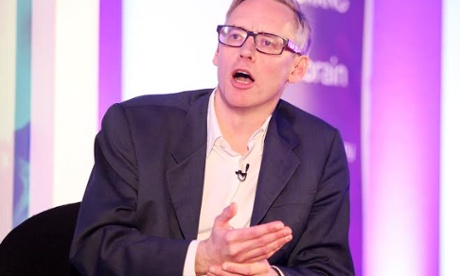
Here are a few key quotes and insights from the session:
Technology has given us, a traditional book publisher, the reach of a broadcaster
Digital is more than just a sales channel, admits Weldon, but merging digital and physical can work wonders, for example using social media to push physical events with authors.
Consumers want to come to a publisher’s website to forge a bond between author and reader
We have a cautious view around subscription … we’re only interested in [it] if it takes us to new audiences.
Physical retail is still very important to the brand, he adds:
The great challenge to publishing isn’t digital, but how you get your next book noticed
Weldon also adds that he can’t bear the cultural cringe around books, that they might be dead:
The book industry has never been a more exiting place to work … book publishing is a great place to be
Updated
Questions from the floor
A good query from a delegate at the reinvention of marketing session:
What’s the one piece of current of future tech you’re most excited about?
The panel respond: big data, stronger social media analytics, monetisable Facebook video, Oculus Rift and, finally, whatever it is that replaces cookies.
Panel debate: the reinvention of marketing – fact or fiction?
Here are some of the key quotes and comments from the afternoon’s first panel on new marketing technologies and solutions.
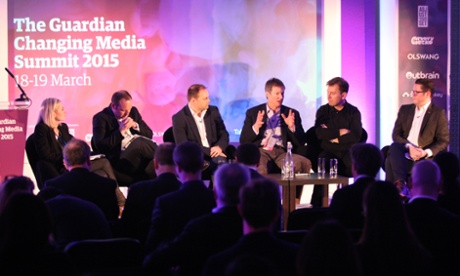
Javier Sanchez Lamelas, Coca Cola
The reason we have labs is because we still don’t know what the future will be
Wearable tech
What’s the potential of wearables for brands that are not in the fashion or luxury market? What about life insurance? Group marketing director at Direct Line, Mark Evans, says that wearable tech will transform the insurance sector by giving insurers data on the health and lifestyle of users.
The panel also wade in on the matter. The consensus? When it comes to content, such as content delivered by publishers, you have to understand the consumer. “Context is key,” says Rupert Day of tenthavenue. Brands must think: how much or how little do consumers want? Knowing where they are, what they’re doing and how long it will take them do it is key to understanding and mastering something like wearable tech.
Updated
Delegates on Vine
We asked a few delegates and speakers over lunch what their key learnings were from this morning’s sessions. Here they are, six seconds at a time…
Mimi Turner, Lad Bible https://t.co/4urJCupjN8
— Oscar Williams (@oscwilliams) March 18, 2015
Amy Lines, Pan Macmillan https://t.co/50CHExcdMK
— Oscar Williams (@oscwilliams) March 18, 2015
Oliver Ruff, Zenith Optimedia https://t.co/EbMAi5KtC2
— Oscar Williams (@oscwilliams) March 18, 2015
Updated
Native advertising: the saviour of publishers or fools gold?
That’s the subject of the next session.
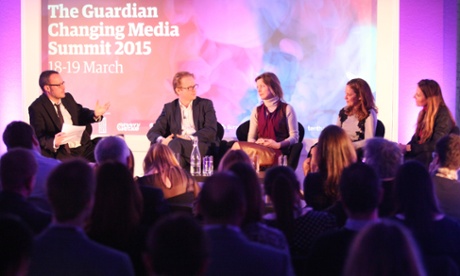
Chair Jon Bernstein focuses the discussion around the role of labelling.
The Guardian’s Anna Watkins:
We’ve got just two labels: ‘sponsored by’ and ‘brought to you by’
Our belief is that even among a young audience, they come to the Guardian for objectivity and opinion, so that makes labelling all the more important
News UK’s Tiffanie Darke:
I realised there was a desire to create content by brands around the news agenda. In order for it to work, brands have to hand over control to the publisher
Wouldn’t that be lovely [to have universal labelling]?
Outbrain’s Stephanie Himoff:
Labelling […] is key to the long-term success of native advertising
Updated
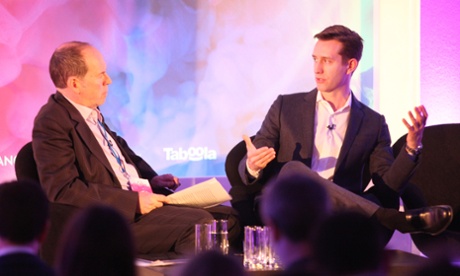
Rory Cellan-Jones introduces AppNexus’ Michael Rubenstein as the emperor of programmatic.
Rubenstein says people should be forgiven for not knowing what programmatic advertising is. He estimates that more than 80% of online ads are now bought programmatically.
Programmatic is not a media channel
We are not going to be talking about programmatic advertising in two or three years; we’re just going to talk about buying and selling adverts
Our belief is the idea that you can leverage data to assist with the decisioning [of where to buy ads]
What we need to produce better content and programming is more dollars in the hands of the people creating the content. If powerful technology, like that which AppNexus supplies, allows that money to be channeled directly back to content creation, that’s how we create a viable content creation system going forward
Independent publishers can fight back by forming alliances
Rubenstein says that in the early days, there was a fear that agencies would use programmatic to […] drive prices down and it scared away a lot of publishers. But he says that the tipping point has been reached and publishers have adopted the technology.
Updated
Become a member of the Guardian Media Network
Like what you’re hearing today?
Become a Media Network member for free to get industry news, updates and analysis like this every day, including discounts on events such as the Changing Media Summit.
Updated
The catering – if you were wondering – is going down a storm on Twitter
#GdnCMS cookies...amazing
— Type (@TypeComms) March 18, 2015
Updated
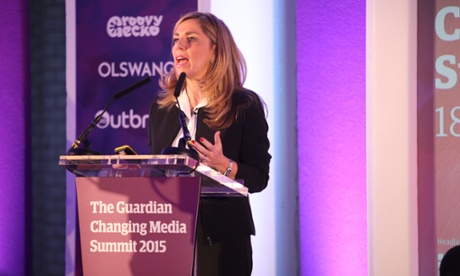
Facebook's Nicola Mendelsohn takes to the stage
The VP EMEA is, according to Rory Cellan-Jones, one of the two most powerful people in European media (Google’s Matt Brittin is the other, who you can catch later).
Here’s a summary of Nicola’s best quotes:
At Facebook we’ve learned that the mobile revolution is about people, not technology. Mobile revenue accounts for 69% of our total revenues
The screens in our pockets have got bigger and created a more compelling canvas for content
Mobile gives us the power to create and consume anything, anywhere, at anytime
Many organisations are still very slow at putting mobile at the heart of everything they do
News alert
Nicola reveals: “I’m addicted to [Facebook] stickers.”
… who isn’t?
Updated
We’re trending…
We're trending on Twitter in the UK. Can we overtake the budget? Keep 'em coming #GdnCMS
— Gdn Media Network (@GdnMediaNetwork) March 18, 2015
Updated
Some more tweets from the #GdnCMS hashtag…
"Working in an organisation like ours is like being on a white water raft"Anna Jones, CEO, Hearst Magazines #GdnCMS @NewsUK_Sales
— Cat Stokes (@CatStokes) March 18, 2015
Interesting panel discussion at #GdnCMS all agreed that quality content and context will win the day.
— Anna Jones (@annajoneshearst) March 18, 2015
"become a full service agency" @ashleyhi Interesting way of looking at the future for Johnston Press #GdnCMS
— Jennifer D Begg (@JenniferDBegg) March 18, 2015
.@ashleyhi The big threat to old media organisations are lean, mean, heavily venture backed young guns that are digital to the core #GdnCMS
— Molly Flatt (@mollyflatt) March 18, 2015
Updated
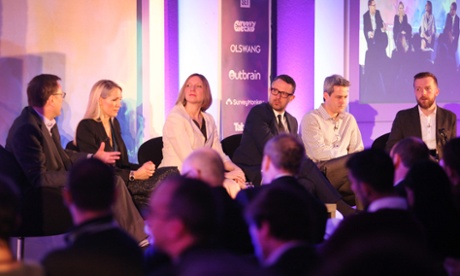
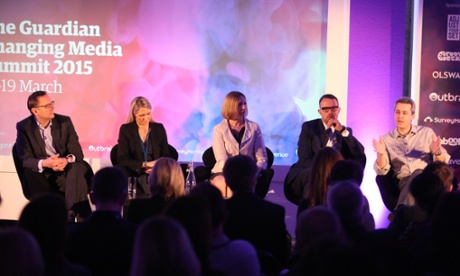
Some honest admissions from the opening panel on adapting and profiting from ten years of digital disruption.
Hearst’s Anna Jones:
I think the magazine industry took quite a while getting up to speed technologically
Fremantle’s Keith Hindle:
The real challenge for us is: how well can we compete with Vox, Vice, BuzzFeed?
The FT’s Christina Scott:
We’ve always believed paid content is the way to go
The Guardian’s David Pemsel
Guardian Membership is a 10-year strategy that we are investing in over time
Concluding the first panel, Ashley Highfield (CEO, Johnston Press) and Pemsel say that both of their titles will have a long history in print.
Updated
High praise for Gary’s session.…
First 20min @garyvee presenting at #GuardianCMS @GdnMediaNetwork was better than entire of other 'digital disruption' conferences. Awesome!
— Anna Lawlor (@little_lawlor) March 18, 2015
Updated
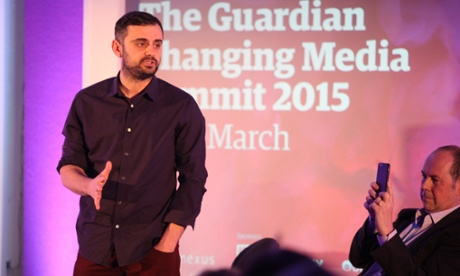
Introductory keynote: Gary Vaynerchuk
We’re not just a mobile-first society, we’re a mobile-first, -second and -third society.
What is most important to me is that the majority of the advertising world will understand that the attention graph is key. You guys are glossing over everything because you’re getting pounded. How do you break through? It’s going to be the people who move fastest…
Please respect and audit the room you’re storytelling in and make sure people are actually paying attention in that platform.
Updated
Some early tweets from the #GdnCMS hashtag…
Nod to David Pemsel @GdnMediaNetwork: You do need a trusted brand, to scale globally and to enable people to share your content #GdnCMS
— venturethree (@venturethree) March 18, 2015
Updated
David Pemsel announces Pangea Alliance
• Read the Guardian’s report here on the initiative, which will give brands access to more than 110 million online readers using programmatic advertising system
Updated
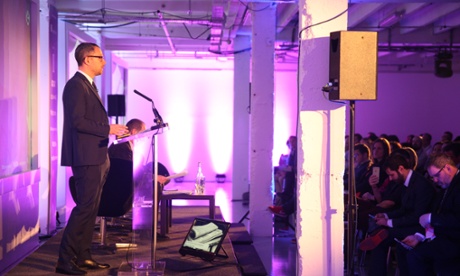
The Guardian’s David Pemsel opens today’s event:
I hope we’ll be able to debate and discuss the future ten years … You know in a few years’ time the Guardian will be 200-years-old. For hundreds of years, news organisations remained largely the same…
In the last 10, everything has changed. We have used digital to increase our influence on a global stage. We’re one of the two biggest quality newsbrands in the world, regularly trading the number one spot with the New York Times…
I hope all of us embrace the next ten years with the same bravery and passion that we have in the last ten years.
Updated
It begins!
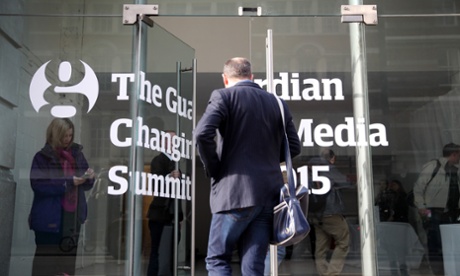
Location House is filling up fast ahead of the tenth Guardian Changing Media Summit. BBC tech correspondent Rory Cellan-Jones and Guardian deputy CEO David Pemsel will be kicking things off very soon.
Updated