Do you agree with the 'casual Tuesday' policy?
Test Yourself is where you can improve your reading skills. Whether it’s for tests like University Entrance Exams or IELTS and TOEFL, or even just for fun, these pages help you to read, understand and improve your English.
NEW: you can now download a PDF of this story to be used in class or at home. Click the link below.
Read the following story by Dumrongkiat Mala from the Bangkok Post. Then, answer the questions that follow.
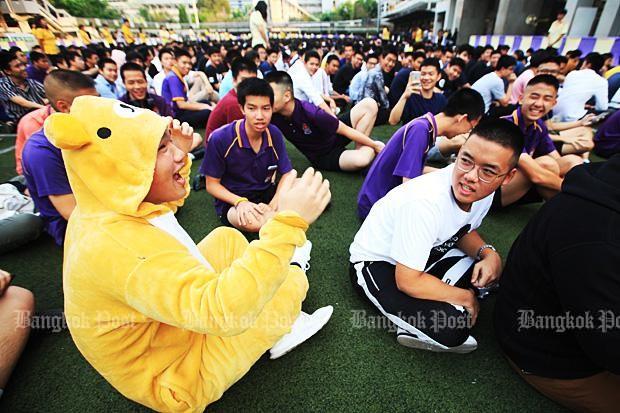
School uniforms have become a hot topic in Thailand over the past week after the country's first all-boys private school, Bangkok Christian College (BCC), implemented a "casual Tuesdays" policy, allowing students to ditch their uniforms once a week.
EXPRESS YOURSELF
BCC director Suphakit Jitklongsub said the decision is aimed at giving students the option to express themselves by wearing casual (clothes)clothes as a part of an effort to make the school a happier place.
He described the move as "a research experiment on student uniform", and said the school had obtained approval from the school's board and parents.
He promised that if the policy is shown to harm students' academic performance, it will be scrapped.
However, just a day after BCC students were allowed to pick their own clothes to wear to class for the first time, the Office of the Private Education Commission (Opec) asked the school to reconsider its policy.
Opec secretary-general Chalam Attham said his office was concerned about orderliness and discipline. He said it could also have a negative impact on some parents' expenses, and raised several other general issues related to Thai society.
TWO SCHOOLS OF THOUGHT
BCC's move has divided people into two camps -- those who support the idea, and those who are opposed to letting students dress down for school.
Supporters called it a "human right", and said casual attire will not negatively affect academic performance, while opponents believed it could lead to friction between students from different backgrounds.
Student activist leader Netiwit Chotiphatphaisal, who has been calling for uniforms to be abolished since his high school years, said he supports BCC's experiment and is happy to see a school that dares to challenge the norm.
Mr Netiwit, now a student at Chulalongkorn University, said student behaviour will be transformed if uniform rules are relaxed.
"It would allow critical and creative thinking, which students in Thai schools often lack," he said.
Mr Netiwit said the problem with the education system in Thailand is much deeper than a matter of appearances. As well as having to dress the same, Thai students are taught to think the same too; they are taught to think only what they are told, and not to question anything, he said.
Unlike the younger generation, many parents still believe that uniforms are necessary to maintain order, discipline and equality, although most acknowledge that dress codes have no impact on students' academic performance.
OLD SCHOOL MUMS
Alisara Peeramontee, 46, a mother of two high school students, said uniforms were never intended to stifle student creativity and personality, but to promote discipline.
"There are many ways for students to show off their creativity. They don't have to do it with their uniform. You can stand out from other students by being confident, not by the way you dress," she said. "A school is a place for learning, not fashion shows."
Education expert Sompong Jitradub said the negative responses and feedback from policymakers and some parents reflects the typical mindset of conservative older people, which is different to those of free-thinking students of today.
He said letting go of the uniform code will offer students a sense of greater freedom, paving the way for them to come up with creative innovation, based on critical independent thinking.

Section 1
Read through the story and answer the following questions.
1. When can BCC students wear casual clothing? …………….
2. Who is the director of BCC? …………….
3. Opec thinks casual Tuesdays are a cool idea. True or false? …………….
4. Supporters say casual clothing affects students’ grades. True or false? …………….
5. What does Netiwit say is missing from Thai schools? ………….....
6. What does Alisara say the purpose of school is?
a. Fashion shows. b. Learning. c. Discipline.
7. According to Sompong, negative responses are typical of who?
a. People who dislike change. b. Free thinkers. c. Parents.
8. What does Sompong say casual clothing gives students?
a. Innovation. b. Critical thinking. c. Freedom.
Section 2
Underline one grammatically incorrect word in each of the following sentences. Then, write down the grammatically correct word in the space given.
9. All students are requirement to wear uniforms. ……………
10. If a student’s uniform is acceptable, they will be penalised. ……………
11. Students will miss their uniforms after they graduation. ……………
12. Adults can wear what they want but child cannot. ……………
13. Students must dare to questioning the rules. ……………
Section 3
Read the following passage. Then, fill in the blanks with the correct words from the choices given.
Manus On-sang, editor of DEK-D.com, the ….14…. website for Thai high school students, said that ….15…. from the uniform code, the decades-old hair rules should be relaxed ….16…. because hairstyles also have no ….17…. on academic performance.
“Many teachers spend a lot of time ….18…. that their students abide by the uniform and hair rules as though the future of the nation depended on it," he said. "This needs to ….19…. .”
14. a. large b. larger c. largest
15. a. apart b. away c. also
16. a. however b. instead c. as well
17. a. affect b. impact c. difference
18. a. ensuring b. making c. allowing
19. a. be change b. changed c. change
Section 4
Find a word used in the story that matches the following definitions.
20. Disagreement or a lack of friendship among people who have different opinions about something.
21. Involving making fair, careful judgements about the good and bad qualities of something.
22. The practice of training people to obey rules and orders and punishing them if they do not.
23. Having the usual qualities of a particular type of person, thing or group.
24. The introduction of new things, ideas or ways of doing something.
Answers:
1. On Tuesdays. 2. Suphakit Jitklongsub. 3. False. 4. False. 5. Critical and creative thinking.
6. b. 7. a. 8. c.
9. requirement; required 10. acceptable; unacceptable 11. graduation; graduate 12. child; children 13. questioning; question
14. c. 15. a. 16. c. 17. b. 18. a. 19. c.
20. friction. 21. critical. 22. discipline. 23. typical. 24. innovation.
SCORE
21-24: Excellent! 17-20: Good. 13-16: Fair. 12 or fewer: You'll do better next time!