DECLINING STANDARDS
When it comes to awards, gongs and tearfully tuxedoed backslapping of all kinds, the Spin agrees wholeheartedly with the words of the great Jesse Owens, who said "awards become corroded, friends gather no dust" – albeit with the caveat that he might like to consider storing his awards in a cool dry place rather than, say, a fish tank. But like it or not, awards season is now upon us with the ICC's announcement of the shortlists for its annual Test, one day and Twenty20 categories. The winners will be announced at a tearfully tuxedoed backslapping ceremony in London next week. And naturally enough there has already been much pshawing comment on the identities of the assorted contenders, not to mention accusations of toadyish institutional bias among the ICC's freelance selection panel, which includes the likes of Nasser Hussain, Andy Bichel and the cricket correspondent of the Independent.
The main objections have included some carping at the presence of Kumar Sangakkara as wicketkeeper and captain in the ICC Test team of the year, a peculiar choice given that Sangakkara is neither a wicketkeeper nor a captain; and all the more so given that Matt Prior has been easily the best wicketkeeper batsman in the world and – if we're really going to do this – deserves to be recognised.
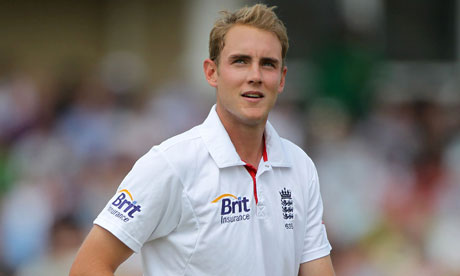
Similarly, the panel has chosen the wrong seam-bowling England all-rounder in their Test team. Stuart Broad's recent figures are excellent, but they are also based around four Tests against a flaccid India and a hundred against Pakistan. Meanwhile Tim Bresnan is currently shaping up as a kind of Yorkshire Imran Khan, averaging 48.25 with the bat in the last year and taking 27 wickets at 17.62, including some decisive thrusts in an overseas Ashes triumph.
Still, these are all fairly minor objections. The most jarring element in the whole exercise is the general underwhelmingness of the names involved. Here is that ICC Test XI in full: Alastair Cook, Hashim Amla, Jonathan Trott, Sachin Tendulkar, Kumar Sangakkara (capt/wk), AB de Villiers, Jacques Kallis, Stuart Broad, Graeme Swann, Dale Steyn, James Anderson.
It is no secret that Test cricket is bathing in a low-tide talent pool right now, but this is still an unavoidably low-key line-up. Compare this selection with the ICC's first ever annual Test XI in 2004: Matthew Hayden, Herschelle Gibbs, Ricky Ponting (captain), Rahul Dravid, Brian Lara, Kallis, Adam Gilchrist, Chaminda Vaas, Shane Warne, Jason Gillespie, Steve Harmison.
The Spin makes that seven genuine greats, some high-class filler and one gangly, frowning north-easterner in the middle of an all-conquering purple patch. The 2011 top three of Cook, Amla and Trott – followed by the same Sachin Tendulkar who looked for the first time a genuinely superannuated genius on English pitches against a disciplined bowling attack – is unlikely to spread ripples of fear among the ranks of past-time hall-of-famers. Mainly though, it is clear that bowling stocks are at a generational nadir. The clincher here is surely the elevation to world XI status of Broad, who might have been dropped at the start of the summer and who still seems no more than an encouraging work in progress.
Then there is James Anderson's presence as the only bowler in the four-man Test player of the year shortlist. In the last 12 months Anderson has taken more than 50 wickets at about 26, figures that, replicated consistently, would give him a career roughly equivalent to that of Jason Gillespie, a worthy top-10-in-the-world merchant in his own time, with reasonable hopes of being considered the third best bowler in his own international attack.
The further you look back the more pronounced this talent gap becomes. Ten years ago only Steyn of the current lot would have got anywhere near the ICC's top rated Test bowlers, Glenn McGrath, Shaun Pollock, Allan Donald, Muttiah Muralitharan, Shane Warne, Waqar Younis, Anil Kumble and even Darren Gough, whose Test record is still superior to that of Anderson.
Go back another decade to August 1991 and you're looking at an attack of Curtly Ambrose, Wasim Akram, Courtney Walsh, Imran Khan and Kapil Dev. Thirty years ago to the day the ICC could have thrown its hypothetical new ball to Colin Croft, Ian Botham, Joel Garner, Denis Lillee, Jeff Thomson, Richard Hadlee, Michael Holding or Malcolm Marshall. Hard to picture Broad muscling in to claim the "enforcer" role in that company.
The Spin is, of course, entirely unqualified to explain why this talent-drain should have taken effect. Some will say it is merely cyclical. Others will point to the de facto collapse, for various reasons, of two great Test bowling nations in West Indies and Pakistan. Perhaps there will even be those who suggest Test bowling is a refined art, one that rests on an acute and painstaking process of skill-refinement and the honing of a specific kind of fitness, something that is just much harder to achieve on the current multiformat treadmill.
Easiest of all would be to blame the decline of Test bowling on the lukewarm, generalist's skill-set of the sport's newest and shortest format, Twenty20. The Spin, naturally, would never stoop so low. Although it is worth noting that Bresnan is at least up for an entire award – Twenty20 International Performance of the Year – for his 3-10 against Pakistan last year, while Shane Watson is also in the mix for for scoring 59 (yes: 59) against England.
Still, never mind, eh? No doubt fresh legions of Test class seam and swing merchants, unreadable mystery spinners and reverse-swinging toe-manglers are even now preparing to emerge silhouetted against the sky. In the meantime, the Spin still has its memories, its collection of cobwebbed VHS tapes of the 1995 West Indies v Australia Test series, and its comforting sense of irreversible historical decline.
• This is an extract from The Spin, guardian.co.uk's weekly cricket email. To sign up click here. Andy Bull is away.