What makes a film a classic? In this video series, film scholar Bruce Isaacs looks at a classic film and analyses its brilliance.
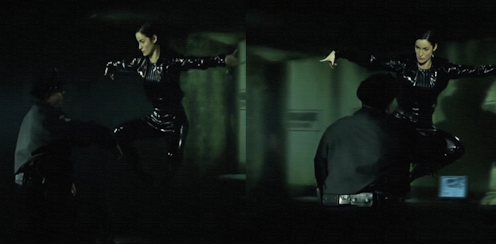
Most films represent the world as we know and perceive it. Even when portraying alien worlds or super heroes, there are certain rules of perception that films adhere to. Which is why, when I first experienced bullet-time during the opening scene of The Matrix, I had to turn to my partner and ask: “what was that?”.
Bullet-time broke the common rules of perception as I knew it. How can a film freeze-frame and move during the still image, where the entire visual frame rotates on an axis? It was stunning, bold and new. And it has become one of the most influential special effects in the history of cinema.
See also:
Hitchcock’s Vertigo
Antonioni’s The Passenger
Eternal Sunshine of the Spotless Mind
Steven Spielberg’s Jaws
Hitchcock’s Psycho
The Godfather
Stanley Kubrick’s 2001: A Space Odyssey
Sofia Coppola’s Marie Antoinette
Darren Aronofsky’s Requiem for a Dream

Bruce Isaacs does not work for, consult, own shares in or receive funding from any company or organisation that would benefit from this article, and has disclosed no relevant affiliations beyond their academic appointment.
This article was originally published on The Conversation. Read the original article.