Open this book at random and you might imagine it to be another example of the new nature writing. Dillon makes generous concessions to the genre, and not just in his description of the explosive ripples caused by a darting insect known as the pond-skater in the watery woodside to which he has brought us. Who is this unexpected guide, standing there with his old three-speed bicycle and an equally archaic Rolleiflex camera in his hand?
Dillon, who is known for his writings about contemporary art, introduces himself as a Dubliner who ended up in Canterbury as a result of a short-term academic appointment. Displaced and depressed, he lived in the area for years before overcoming his “sullen indifference” to the world in which accident had dumped him. A recovering melancholic, then (and one who has surely learned much from WG Sebald’s The Rings of Saturn), he sets out to investigate the marshlands of north Kent. Wandering under vast skies, he finds a landscape that has the power to confirm anybody’s sense of abandonment: a series of flat vistas in which “everything was visible, or almost visible, on the surface and at the same time threatened to sink into the earth or disperse on the air”.
Dillon certainly captures the impressive bleakness of the territory, but his main interest lies in the discovery that these natural wastes are also littered with the often strangely inscrutable debris of various human projects. More like a derelict art installation than a conventional landscape, his marsh is a place where semi-wild horses graze among derelict remnants of brick and concrete, where the howling wind uses rusted wire as a gibbet on which to hang tattered fragments of plastic from the sea, and where you can walk on paths that have outlasted the buildings and jetties to which they once led. For some, these once-malarial wetlands may be no more than a vast brownfield site waiting for another round of development. Dillon, however, recognises them as the true face of a nation “haunted” by its military-industrial past: a habitat not just of plants and wild creatures but of peopled “stories” that can never be pulled fully clear of the mud.
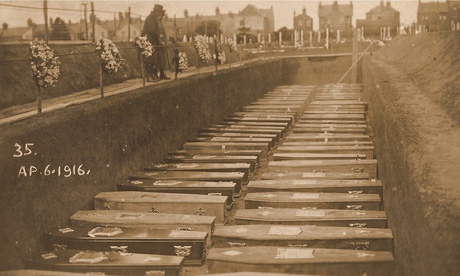
Dillon found his primary theme at Oare, just north of Faversham, where one day friends took him to look at a vast pit built into a wooded hillside, lined with what turn out to be the blast walls of a gunpowder works closed in the 1930s. Picking up a booklet by a local historian, he learned that he was near the site of a horrifying accident that happened at Uplees on the marshes on 2 April 1916. Two factories, the Cotton Powder Company and the Explosives Loading Company, were then working under enormous pressure to produce munitions demanded by the first world war. A fire, which appears to have started in a carelessly placed pile of sacks, ignited a building in which TNT was unwisely stored together with ammonium nitrate. Windows rattled as far away as Great Yarmouth and Norwich. At the site, the “Great Explosion” caused utter mayhem, leaving a crater estimated at nearly 14ft deep and 108 people dead.
Dillon’s account of the disaster is artfully distributed through the length of his wandering exploration of the “Gunpowder Archipelago”. The form of his book reflects its content. Dillon traces the explosion as it resounds in different domains and contexts. He sketches the history of explosives, and tells of the rise and interwar fall of the industry in north Kent. He reviews the attempts of engineers, scientists and doctors to understand the devastating consequences of the new “methods of propulsion and detonation”. He offers an intriguing enquiry into the narrative and pictorial ways in which we learned to register and record the experience of such instantaneous explosions – “the problem of the vanishing moment”, as he describes it. He includes a suggestive reading of Russell Hoban’s dystopian novel Riddley Walker, claiming it to be closely informed by the history he is surveying.

Dillon also keeps a whole series of dreadful explosions going off around his muddy-booted and disorientated reader. No sooner have we got over the “Delft Thunderclap” of 1654, when a store of 90,000lb of gunpowder exploded, causing huge destruction in that Dutch city, than we are tunnelling under the Hawthorn Ridge Redoubt, a fortified German position under which the British detonated a huge mine at the beginning of the Battle of the Somme in July 1916. Closer to home, Dillon’s anthology of devastations includes HMS Bulwark, a battleship that blew up when anchored off Sheerness in November 1914, killing over 700 men. Also in the Medway, the Princess Irene (a liner turned to war use as a minelayer) disappeared in a vast fireball while being loaded in May 1915, killing more than 300 sailors and dockyard workers, and scattering debris and limbs for many miles around. There was more devastation at Silvertown, east London, where a former chemical works being used to purify TNT went up in January 1917; and, at the end of that same year, in Halifax, Nova Scotia, where more than 2,000 died after the Mont Blanc, a ship filled with munitions destined for France, collided with another ship, caught fire and annihilated an entire district of the city.
Dickens and Conrad receive due tribute as earlier witnesses but the marsh, being a place of true downstream potency, keeps coming up with less predictable offerings, which Dillon knows better than to overlook. So we find ourselves passing through the early days of the North Sea oil boom and, indeed, meeting Tony Benn, then a government minister, who waves a bottle of newly landed crude in the air and prophesies: “I hold the future of Britain in my hand.” That was on the Isle of Grain (“the most ravaged industrial landscape in the Medway”, as Benn described it) – barely a decade before the refinery in which he stood was closed, leaving Britain’s “short-lived industrial optimism” to sink, as so much else has done, into the marsh on which Boris Johnson may foolishly still imagine floating an international airport.
Although this book is a brilliant evocation of place grasped in its modernity, Dillon ends with a romantic salute to nature. He has finally discovered the water-filled crater of the Great Explosion at Uplees and is back on his bike, heading home through the evening towards Canterbury. The world is suddenly lit up with a strange arresting light, a “golden emanation of the land” that sets “the whole territory glowing”. This unexpected explosion of light is attended by a rising mist, and then night falls, leaving our author peddling along ever darker paths through Blean Woods, known for its nightingales and charcoal burners (the latter alone were vital to the explosives industry). A renovating “spot of time”, then, to close a book that has done things to the spirit of place that William Wordsworth could surely never have imagined.
• To order The Great Explosion for £15.19 (RRP £18.99) go to bookshop.theguardian.com or call 0330 333 6846. Free UK p&p over £10, online orders only. Phone orders min p&p of £1.99.