Like many organic farmers in New Zealand, Mike Moss had some difficult years during his conversion from a conventional to a chemical-free approach. For him, it meant not just preparing the cows, but also the soil.
"Organics basically starts with the soil. So we have healthy soil and healthy lives from the soil," said Moss, owner of Koraha Farm, explaining how good soil contributes to a good pasture for his cows and the nutrients in the milk they produce.
In New Zealand, organic farming is big business and the country's organic sector is rapidly growing. With an international reputation for being clean, green and pure, New Zealand exports various chemical-free products to the rest of the world. According to the Organic Exporters Association of New Zealand, current export value is US$360 million (11.3 billion baht). Fresh fruit and vegetables lead the way for New Zealand's organic export sector, with a total worth of around US$140 million, followed by dairy, meat and wool.
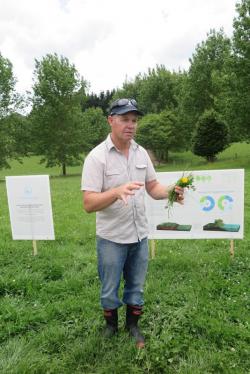
Mike Moss explains soil management on his lush green pasture. Patcharawalai Sanyanusin
Moss' produce even finds its way to Thailand. His farm is among many organic dairy farms in New Zealand and Europe that provide raw materials for S-26 Organic Progress, Thailand's first organic milk powder, designed for children aged one year and above.
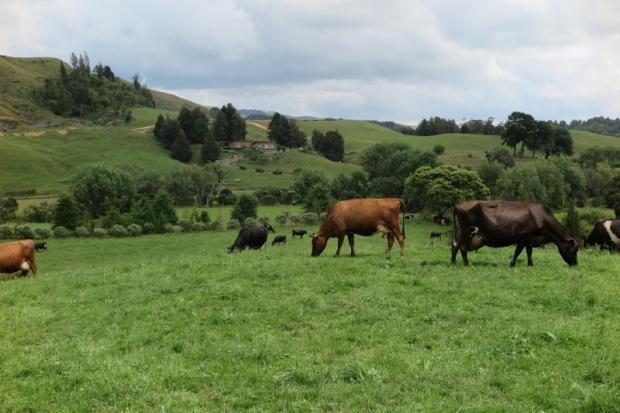
Moss' 65 hectare organic dairy farm, located in Waitetuna Valley in the Waikato Region of New Zealand's North Island, is a picturesque landscape of green grass, blue skies and peace -- an ideal home for his herd of 120 cattle. He decided to go organic in order to have sustainable and trouble-free farming, with a system that was good for the land and the cattle. He took the decision two decades ago. After three difficult years converting his conventional farm into one that was chemical free, Koraha Farm was certified organic in 2000.
Moss never uses synthetic herbicides, pesticides or fertiliser. Several earthworms could be seen wriggling in the soil that we dug up. With its loose and gritty texture, the soil crumbles easily and long roots of wild grass and clover are clearly visible. These grow alongside various legumes in the lush open farmland, providing the cows with what Moss calls "a beautiful salad bar".
As well as the good-quality soil, there is a great deal of focus on the importance of good water.
Moss has planted trees on his paddocks and on the banks of the waterways in his farm. He said that they help provide shade, prevent land erosion and filter out bacteria and nutrients like phosphorus and nitrogen. He has put up fences too.
"We make sure [the cows] can't get into the water," he said. His theory is that if they get into the water, so will their poo. "We have to make sure that the water is clean," he added.
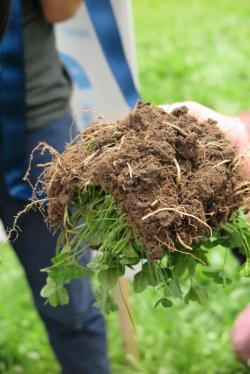
The long protruding roots of grass and legumes show that the soil is healthy. Patcharawalai Sanyanusin
At times, Moss can catch eels and black creek crayfish at his farm. The presence of crayfish in particular is an indicator of how clean the water is, since they are very sensitive to polluted environments and can survive only in clean water. At the farm, visitors are encouraged not to make loud noises or sudden movements that could startle the fawn-coloured Jersey and black and white Holstein-Friesian cows that happily wander around, grazing on the thick green grass with the sunlight on their backs.
According to Moss, adopting an organic system isn't only about providing the animals with natural green grass but also ensuring that the ecosystem and biodiversity is taken care of. That's why he has tried to restore the surrounding forest. He also described how his cows benefit from the organic system: they can stay outdoors all year round, roaming freely around a large area of land, free to follow their natural behaviours.
Compared with cows in conventional New Zealand dairy farms, which have an average lifespan of eight to nine years, most organic dairy cows can produce milk until they are 10 to 13 years. At Koraha Farm, many of them remain productive until as old as 16. Moss believes this is mainly because they are happy and have no stress.
Cost-effectiveness is another reason to go organic. Even though running an organic farm is generally more costly than running a conventional farm, Moss earns a lot more money. He sells raw milk at his farm but he also supplies it to Fonterra Co-operative Group, the largest processor and marketer of organic milk in New Zealand.
And if that weren't enough, there is yet another reason, just as rewarding as the others.
"This is a good place to live and raise children," Moss said.