Each year the American music industry embarrasses itself by nationally televising a 90-minute display of the irrelevant and the ridiculous – the Grammy awards.
It’s invariably a frustrating evening, but everyone even tangentially involved in the recording business feels obliged to tune in. And although reasons why it’s so infuriating are obvious – the Grammys’ unconcealable anti-rock bias – even the most cynical would be shocked to learn that none of these artists (and many others) has ever won an award: The Rolling Stones, the Allman Brothers Band, Joan Baez, Rod Stewart, the Who, Eric Clapton, David Bowie, Chuck Berry, Jackson Browne, Bob Dylan, Yes, Leiber & Stoller, Marvin Gaye, Phil Spector, Van Morrison, Smokey Robinson, Elton John, Randy Newman, Richard Perry, the Beach Boys, Diana Ross, the Band, the Byrds, Led Zeppelin and Sam Cooke.
No matter what your musical affiliation, there’s something here to make you slap your forehead in dismay. Several in that list, including the Rolling Stones, have never even been nominated.
According to the official list of Grammy winners, of course, Phil Spector, Bob Dylan and Eric Clapton were winners in 1972 because of their involvement with the Concert for Bangla Desh album. In Spector’s case, this is like giving Albert Einstein a Nobel prize for doing it all without a pocket calculator. For Clapton and Dylan, there may be some solace in knowing that, by Grammy standards, Elvis Presley’s two best recordings are How Great Thou Art and He Touched Me, a pair of gospel recordings that won in 1967 and 1972.
I’m writing this a couple of weeks before the 1976 debacle, which can’t be an improvement because the nominations omit such significant 1975 artists as the Jefferson Starship, Bruce Springsteen, Gary Stewart, the Who and, once more, Bob Dylan. If it’s any consolation, Elton John will probably win something, making up for last year’s snub.
There are two ostensible alternatives to the Grammys, Dick Clark’s American Music Awards and Don Kirshner’s Rock Awards. But the AMAs are even blander than the Grammys, and the balloting is done by the public, which votes (in effect) on the national charts every time they purchase a disc. The Kirshner awards – presuming they make it to their second year – are selected by critics and disc jockeys, not by industry peers. Moreover, I have an innate distrust of any awards conferred by one of the industry’s leading song publishing magnates, which is a certified conflict of interest.
Although elected by industry workers only, the Grammy selection process is more open to question than it may seem. Only active members of the National Academy of Recording Arts & Sciences (NARAS) may vote, but once an active member qualifies (by working on six singles or one LP, in most cases), he remains a member as long as he pays his yearly dues. For example, an engineer who left the industry in 1957 for broadcast work remains eligible as long as he pays his dues, as are singers who’ve dropped out for gas-station gigs, arrangers who have become high-school teachers, liner-note writers who’ve gone back to college.
The failure to weed out inactive members may account for some of Grammy’s woes. But many record companies vote in wholesale lots, without regard for quality. This problem is endemic to industry awards. The Oscars, particularly in their restrictive rules against pop music, are worse.
Some conflicts are too blatant to be ignored. Janis Ian, who leads this year’s Grammy nominations with five, is produced by Brooks Arthur, whose name appears on the New York NARAS chapter letterhead as a past president. Is Ian’s At Seventeen really superior to Dylan’s The Basement Tapes and Blood on the Tracks? (Blood’s liner notes, written by Pete Hamill as though he first heard Like a Rolling Stone the night before, were nominated, even though Dylan had them removed from the album cover after the initial pressing.) Are NARAS consultant George Simon’s notes for a Glenn Miller collection likely to survive longer than Greil Marcus’s piece on The Basement Tapes cover or Chet Flippo’s notes for Doc Watson’s Memories? Is Glen Campbell’s Rhinestone Cowboy a more lasting work than David Bowie’s Fame, or Love Will Keep Us Together a superior single to Jefferson Starship’s Miracles? Is a 20-year-old outtake of John Coltrane’s Giant Steps really worth two nominations in the jazz category and Stanley Clarke’s breakthrough album, Journey to Love, none?
Dylan and Ian, like Coltrane and Clarke, record for the same record label, so corporation collusion isn’t the problem. I still haven’t been able to find out who arranger Gene Puerling and the Singers Unlimited record for, much less what they sound like, but somehow they’ve copped three of the five Best Arrangement Accompanying Vocalist nominations.
This isn’t meant to disparage Ian, whose album was an impressive comeback, or Simon, a respected jazz writer, or Coltrane, a giant. But the Grammys ought to bring some artistic recognition to a form and an industry all too often seen as shallow and corrupt. For much of the public, the Grammys establish popular music’s artistic reputation. Yet the Grammys continue to snub art whenever it rears its head, whether in rock (the lack of a nomination for either the Starship or Springsteen), jazz (the absence of Clarke and Keith Jarrett), country (no mention of Willie Nelson’s Red Headed Stranger or Gary Stewart’s remarkable Out of Hand) or soul (the dismissal of Smokey Robinson’s A Quiet Storm album, for instance).
The five nominees for the Album of the Year are Janis Ian, Paul Simon, the Eagles, Elton John and Linda Ronstadt. As an artist, rather than as a commercial force or pleasant entertainer, Paul Simon stands out like Kareem Abdul Jabbar in a kindergarten. But I’ll bet he doesn’t win.
© Dave Marsh, 1976
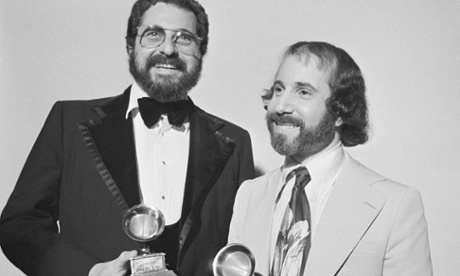
Some of the 1976 Grammy award winners
Record of the Year: Love Will Keep Us Together, Captain & Tennille, Daryl Dragon (producer)
Album of the Year: Still Crazy After All These Years, Paul Simon, Phil Ramone and Paul Simon (producers)
Best Pop Vocal Performance, Female: Janis Ian, At Seventeen
Best Pop Vocal Performance, Male: Paul Simon, Still Crazy After All These Years
Best Pop Vocal Performance by a Duo, Group or Chorus: Lyin’ Eyes, the Eagles
Best Album Notes: Pete Hamill (notes writer) for Blood on the Tracks performed by Bob Dylan