Forget David Cameron’s claim that a Labour government would lack legitimacy if it won fewer seats than the Conservatives. Dismiss the idea that Alex Salmond would vote down a Tory Queen’s speech. I wouldn’t put much store behind the stories that senior Labour figures are considering the option of forming a minority coalition with the Liberal Democrats. Words don’t win elections, numbers do.
As polling day approaches, the odds favour the Scottish National party emerging as the third biggest party with about 50 seats – wiping out Labour in its working class heartlands. Labour and the Tories would end up short of a majority in the UK but, crucially, Cameron would have the largest number of English MPs as Labour relies on a Celtic fringe.
Assume the Tories were the largest UK party with, say, 280 seats. To continue as prime minister Cameron would still need a deal with the smaller parties – one in which they would undertake not to collapse his government. The Lib Dems are unlikely to have enough votes to guarantee a majority for Cameron, even if bolstered by the Democratic Unionists in Northern Ireland. But the SNP could.
The key question is how much Cameron is willing to sacrifice to stay in power. If history is any guide, the answer is quite a lot. No one thought Nick Clegg, who before May 2010 posed as a leftwing champion of the anti-establishment, would fall into bed with the Tories. However, there is no greater aphrodisiac than power.
With the Lib Dems’ 57 seats in 2010, Clegg won seats in the cabinet, a deputy prime minister’s post, vetoes over “Thatcherite blue” policy and a referendum on voting reform. True, there was much the Orange Bookers could agree on with the Cameroons, but there was a lot of Tory give and Lib Dem take.
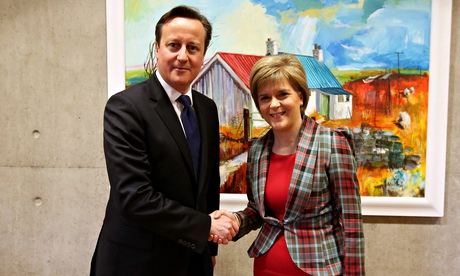
From afar, the SNP would appear to be more rose thorns than Downing Street rose garden. Nicola Sturgeon has attack the Tory campaign. But on closer inspection the Tories and the SNP do not scorn compromise. Alex Salmond ran an SNP minority government from 2007 to 2011, but relied heavily on the Tories to pass all four of his annual budgets. Never mind that Sturgeon was reported to have told a French diplomat that she’d “rather see” Cameron in Downing Street.
So Cameron may opt to be generous and give the SNP what Sturgeon has already admitted “electrifies” her: a “powerhouse parliament” in Scotland. The Tories and the SNP both agree already on Scotland having “fiscal autonomy”. If Cameron gambled he could put forward a Queen’s speech that presented Scotland with a chance of controlling all its own taxes – apart from VAT, which has to be UK-wide under EU law – and all spending except defence and international services. This would be the “devo max” that Salmond and Sturgeon have always dreamed of getting, and would effectively create an independent Scottish state.
Such moves would put rocket boosters on the West Lothian question – the constitutional oddity by which Scottish and Welsh MPs can vote on laws affecting England while English MPs have little power over Scotland and Wales. The Tories have already proposed to resolve this by stripping Welsh and Scottish MPs of voting rights in parliament, denuding Labour further of power.
The SNP would then be dared by Cameron to vote away this once-in-a-generation chance. There are roadblocks: the SNP will have to find ways to rewrite its constitution (which embeds anti-Toryism into the party DNA) and Sturgeon will have to wriggle out of the fact that she told the party faithful last November the “SNP will never, ever, put the Tories into government”. The rhetoric on the campaign trail has been tough too: vowing never to put a Tory government in power and to reverse austerity.
Nationalists north of the border are animated by constitutional matters, not redistributive policies. The hallmark of SNP governments has been canny populism, and with devo max the SNP could argue that it has delivered independence, diluted maybe but no doubt popular.
In short, the prize is too big for either the Tories or the SNP to ignore. What gets the Scots Nats out of bed is a chance to run their own country, to steer a nation’s destiny. Who cares, Sturgeon might argue, what goes on in faraway Westminster when the SNP will be in charge of a North Sea version of Dubai – home to big oil and big banks?
There’s nothing to suggest the SNP is bothered about what happens outside Scotland’s borders. Those beyond its lands are neighbours, not family. The alternative for Sturgeon is a deal with Labour, which offered less devolution to Scotland than the Tories when the issue was discussed by the parties last year.
A pact with Ed Miliband would mean the SNP ultimately seeking extra cash from Westminster for Scotland’s NHS or its welfare budget. It’s the begging bowl mentality that the SNP wants to escape with a new, energising constitutional settlement. For separatists, nations are reborn in a civic, cultural and economic sense only when the nationalists take power. The SNP wants to make Scotland and then make Scots.
Down south, Westminster would become an English parliament in which there was a permanent Tory majority. The Conservatives could easily wear the clothes of nationalism, stealing them back from Nigel Farage’s Ukippers, and Cameron would give free rein to his party’s assertive Englishness and Euroscepticism.
In fact, the only losers here are opponents of the Tories and the SNP: Ukip and Labour. Cameron would outflank Ukip’s Little Englanders and, by creating a parliament where only English MPs create English laws, he will signal the arrival of a new national legislative body for the English state.
Cameron’s policies point to the fact that he is willing to sacrifice Scottish unionist MPs at the expense of separatist ones. In the process he has ensured that Scotland really is another country. This election will show, perhaps, that England will become one too.
• This article was amended on 7 May 2015 to change a reference to “full fiscal autonomy” to “fiscal autonomy”.