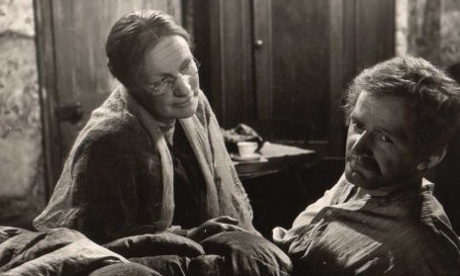
A classic film portraying working class life in Glasgow’s Gorbals community is to be screened in the area for the first time since it was released 65 years ago.
The Gorbals Story, directed by David MacKane and first screened in 1950, tells the story of a successful artist who remembers his upbringing in the city’s notorious tenement slums through a series of flashbacks.
The film will be shown at the area’s St Francis Community Centre on Friday 9 October as part of Glasgow’s Southside Film Festival, one of several ‘pop up’ cinemas being used by the festival, including Govanhill baths where Bill Forsyth’s cult classic That Sinking Feeling will be screened.
Karen O’Hare, the festival’s director, said The Gorbals Story, which has come from British Film Institute’s Britain on Film archive, was important not only to the local community but in the wider context of British cinema. She said:
It’s an opportunity to resurrect this film and for people in 2015 to see just how much life in the Gorbals has changed since 1950.
But it’s also well-loved and well-respected because it’s one of the first British films to offer a sympathetic portrayal of working class life, particularly in Glasgow. The Gorbals has been portrayed in many ways over the years, often in quite a negative light, but this film is respectful towards the place and the people who lived there.”
The film, adapted from a successful stage play first produced in 1946, combined social commentary with warm-hearted nostalgia, O’Hare added, helping to lay the foundations for later works.
It wasn’t marketed as a political film.
But it takes a very particular aesthetic approach that’s about honouring and accurately portraying a working-class community, which at the time was a very radical thing to do. It’s certainly very different from many other British films of the period.
It makes a point about the social and economic conditions that people were living in in a way that’s similar to the British kitchen sink dramas of the 1960s. It looks at an area and at people who weren’t really having their stories told through drama, and I suppose that’s something that you could still say about parts of Glasgow today.”
Long a home to Glasgow’s industrial workforce, the Gorbals became notorious as one of Britain’s worst slums. Its overcrowded, dilapidated and unsanitary tenement buildings were replaced with high-rise flats, which were themselves later demolished as part of an extensive campaign of redevelopment.
There is an irony in its first screening in the Gorbals taking place so long after it was first released. O’Hare said cinema would have been the most important form of entertainment for Gorbals residents in the 1950s.
At around that time there would have around 60 cinemas across Glasgow.
It was a hugely popular source of cheap entertainment, and people would have had their local cinema on their street corner. One thing we’re trying to work out is exactly which cinema the film would originally have been shown in, and we’re hoping that someone might come along to the screening who remembers seeing it and can tell us what sort of reaction it had from local audiences.”
The BFI summary for The Gorbals Story says of the story line:
Johnnie, a newspaper boy who wishes to be an artist, shares the tenement with the good-natured Peggy, the lazy Mutrie and his long-suffering wife.
Others in the building include Magadelene, a waitress, who agrees to marry the Asian, Ahmed; the landlady Mrs Gilmour; and Francis Porter whose wife is dying. Johnnie is in love with Nora Reilly, another tenant, but her father threatens and beats up Johnnie and he leaves the building to seek solace in the dance halls.
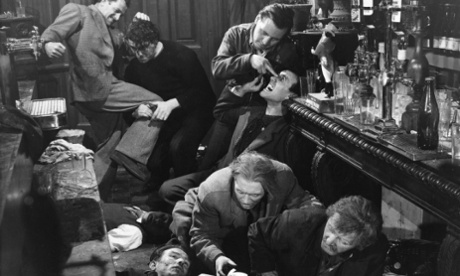
Meanwhile, Mutrie discovers that he has won the football pools if only he had posted them. The neighbourhood comes round to rejoice but he tells them the truth. He then goes on a drinking spree with Hector and they end up in a barroom brawl.
Having failed to find love, Johnnie returns home and ties to seek consolation from Peggy, but she locks herself in her room. Johnnie wrecks the communal room and leaves determined to build a better future for himself.
The Southside Film Festival takes place at venues across the south of Glasgow from 8 until 11 October.