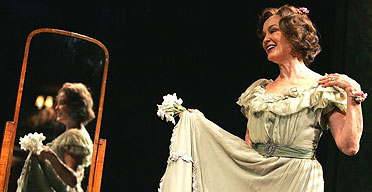
Who is the central figure in Tennessee Williams's famous memory-play? Is it Amanda Wingfield, the faded Southern belle living in a world of illusions? Is it her shy daughter, Laura, with her collection of glass animalculae? Or is it her son, Tom, who acts as narrator and authorial voice? In Rupert Goold's slowly developing production it takes time to realise where the true focus lies.
Up to the interval, I felt less than gruntled. Williams's 1944 play, although derived from the tensions within his own family and a mother's desperate attempts to marry off her reclusive daughter, seemed slenderly anecdotal. Matthew Wright's design, while boasting a mightily impressive fire-escape, contained a false proscenium-arch that pushed too much of the action upstage. And, even though Jessica Lange had already played the role on Broadway, her Amanda seemed underpowered.
Williams described Amanda as "a little woman of great but confused vitality": Lange, in contrast, has a formidable physical presence. Far more significant was the fact that Lange never persuaded me she inhabited a world of fantasy: her reminiscences about her past gentleman-callers lacked the right cocooned delirium and her refusal to accept her daughter's disability wanted angry evasiveness. Lange has good touches, such as her reflex attempts to smooth down her son's hair, but her Amanda never fully inhabits her own private world.
But where the evening takes off is in the celebrated scene where Laura is confronted by a gentleman-caller in the shape of a colleague Tom has brought home to dinner. This is not only Williams at his best: it also brings forth a transcendent piece of acting from Amanda Hale as Laura. Earlier Hale has established Laura's patient goodness by lovingly draping her brother in the very coat with which he has destroyed part of her collection. But Hale reminds us, in the scene with gentleman Jim, that Laura is a youthfully pretty woman who simply needs to be reminded of her self-worth. First she shows us the hope in Laura's eyes as she is discreetly courted; and then, unforgettably, she shows us hope extinguished as she holds her arms out in front of her as if briefly paralysed.
Hale makes the play Laura's story. But she is aided by the subtlety of Goold's direction which paces the climactic scene perfectly. Mark Umbers as the gentleman caller has the right blend of compassion and bruising dynamism. Ed Stoppard conveys the restlessness of the narrating Tom whose obsessive movie-going is clearly a metaphor for something darker. The evening belongs, however, to a relative newcomer who embodies the love Williams felt for his damaged, real-life sister, Rose.
· Until May 22, Box office: 0870 8901101