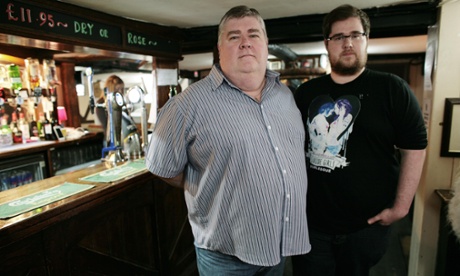
Ritchie Henshaw had many of the advantages his father, Paul, could only dream of. The 26-year-old was the first member of his family to go to university – and spend a year studying abroad – before graduating from Leeds University with a degree in microbiology.
Fast-forward nine months and, like thousands of young people at the sharp end of the UK’s patchy economic recovery, Ritchie’s dreams of a secure, well-paid job like that enjoyed by his father – which would allow him to start thinking about standing on his own two feet – are as far away as ever.
Paul, by contrast, seemed to face greater barriers when he was a similar age to his son but, in many ways, he had an easier route through life. Restricted by his class from going to university, Paul left school at 16 to start an apprenticeship, which led to a life of secure employment, pensions and a mortgage.
“It’s not great,” says Ritchie, who has moved back into his parents’ pub in Waltham Abbey, Essex. “I’d love to move out but it’s impossible. There are lots of ways – key ways – the system has let me down.”
Ritchie’s experiences mirror the findings of new Resolution Foundation research, which shows younger workers have been the worst affected by the economic crisis, suffering higher unemployment and deeper average cuts in wages than older people, while the incomes of pensioners have been better protected from the welfare cuts that have hit many other groups.
After graduating, Ritchie says he applied for 10 jobs a week for three months before getting a place with a Cambridge pharmaceuticals company on £20,000–£25,000. He is on a temporary contract with a one-week notice period. This forces him into a level of financial insecurity that puts renting his own home out of reach. Being in a position where he can get a mortgage, he says, isn’t something he can even envisage.
“I’d put the blame squarely on government legislation for the problems in my sector,” he says. “A number of pharmaceutical companies have recently closed their UK sites and moved abroad, like AstraZeneca and GlaxoSmithKline.”
So after four years at university, one of which was spent living and working abroad, Ritchie is back in the pub with his parents and his younger brother, 20-year-old Jamie, who works for a local tiling company.
But as Ritchie himself acknowledges, the picture is more complicated than that. “My generation has been failed by politics,” he says, “but there are other key ways in which we’ve benefited in ways our parents couldn’t have dreamed of.”
Paul, 56, agrees. “I left school at 16. I took five O-levels but failed them all and got CSEs instead. Kids who went to comprehensive schools in my day weren’t supported at all. Ritchie’s secondary school was very poor but, even there, what he got far outstripped anything we had.”
Paul grew up before Margaret Thatcher came to power. “By the time she appeared on the stage, my generation and class was already firmly in the ‘We Know Our Place’ mindset,” he says.
Unlike his son, however, Paul didn’t leave school and enter a world where jobs needed to be fought for and where even an insecure, moderately paid position is cherished. “I failed my O-levels because I wasn’t that bothered,” he admits. “I knew I was going to be all right because I’d already got an apprenticeship at the Royal Small Arms Factory in Enfield.”
Paul wasn’t unusual. “There were loads of apprenticeships then. Every firm which had anything to do with engineering had them. Most of those companies no longer exist and if the bigger ones still have apprenticeships, you don’t hear about them.”
By the time his son was going through the education system, the class restrictions had evaporated but so had the plethora of career options at the other end. Instead of glass ceilings, Ritchie had choices – although he also had to contend with the failures of his own generation of politicians.
“It was a massive failure of the system that my dyspraxia wasn’t picked up earlier,” says Ritchie. “From nursery onwards, teachers were saying they thought I might have a problem, but because I was always in the higher end of my classes, no one actually sent me for a formal diagnosis.”
Although Ritchie’s secondary school was in special measures for three of the five years he was there, he still got 10-and-a-half GCSEs at A-C level (the half was in religious studies, which the school didn’t offer as a full GCSE). When he left to go to sixth form college, however, his learning disability started dragging him down.
“I told them I was having problems but they didn’t help and I dropped out,” he says. After the four years spent working in his parents’ pub, Ritchie went to his GP and asked to be referred to an educational psychologist. Within six months, he had an official diagnosis of dyspraxia. Four months after that, he had applied, and been accepted, into a different local college to do a BTec in applied sciences.
“I thrived,” he says. “I told them about my diagnosis and they gave me all the support I needed. Twenty years ago, I would have had zero help with my learning disability.” Ritchie got two distinctions and a merit in his BTecs, the equivalent of two A-grades and a C at A-level. Suddenly, going to university was the obvious choice.
“I was the last year to pay the lower fees of £3,000 a year but it was still daunting to know that after my four-year course, I’d have accrued a debt of £21,000,” he says. “I’m currently paying that debt off now at £2 a week, but I honestly don’t think I’ll ever manage to pay in back in total. The rate at which I’m earning, and which I might continue to earn, means I will barely be able to make a dent in it.”
The path through work was very different for Paul: more restricted but more certain. “In my day and in my social class, education was about getting out and earning. Had I grown up in Richie’s generation, I would have gone to university too and then gone into engineering at a more theoretical and less practical level.”
But Paul had a secure career path stretching ahead of him, something his son does not. “I applied for my position as apprentice at the RSAF and worked there for six years – where, incidentally, I had a contributory pension. I then fell into another engineering job for 14 years – where I also had a pension. For the last 16 years, I’ve run this pub, and had my own pension.”
With such a solid future, Paul was able to get a mortgage from his local building society when he was just 29 years old.
Ritchie also has a pension with the National Employment Savings Trust, set up by the government in 2008 and compelling employers to provide their UK workers with a pension plan. “I’m really pleased the government introduced that legislation,” says Ritchie. “I’m only paying in £5 a week but I know how important it is to have a good pension – and there’s no way I could have afforded to start a meaningful one myself.”
Getting a mortgage and moving out of his parents’ home, however, remains a distant dream. “I can’t envisage it,” he says. “Mortgages for people my age are virtually out of reach for as long into the future as we can see.”