Spoiler warning: This blogpost contains references to episode five of The Game on BBC2 in the UK. Please do not post spoilers if you have watched further in the series on BBC America. To read the recap for season one, episode five of The Game, click here.
“Bang. I win”
Finally Operation Glass was revealed: a network of KGB agents hidden in plain sight amid the Whitehall establishment. “We would have thought it too vulgar,” mused Bobby as he and Daddy surveyed the array of solicitor generals, deputy assistant commissioners, even home secretaries, all progressing their careers for 20 or more years, waiting for the moment when a power vacuum would allow them to come to power. “It’s a silent coup!” yelped Daddy, as he realised the full ambition of events and, with Soviet snipers moving into position, the immediate danger to the prime minister.
It was a largely satisfying conclusion to events, in that writer Toby Whithouse had laid much of the groundwork in earlier episodes – Joe’s possibly murky motivations, Alan and Sarah’s marriage, the bond between Jim and Joe – so it wasn’t an ending that came entirely from nowhere. But as is often the way with this kind of show, the pacing still felt slightly off to me: effectively everything important happened in the final two episodes, while earlier events don’t entirely come together. (I’m not sure I understand why the letter of last resort, for instance, would have been so important if a KGB officer was about to become acting prime minister, and therefore responsible for that very letter.)
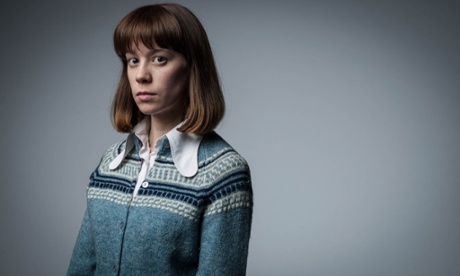
It was pleasing, too, to see Wendy basically crack the operation wide open, although things did rather happen off screen – Bobby giving her an order to look for people who appeared/disappeared off the map, and Wendy coming back with the solutions after having looked at lots of paperwork. Which is undeniably the way these things are solved, but not really very dramatic. Still, I’m sure we all enjoyed Bobby trying to persuade Wendy that “this is such stuff as careers are made of”, only for her to remind him of why he does the job. “Take all the glory for yourself, I really don’t care. That is reward enough for me.” Marvellous. Such an unlikely and oddly pleasing double act.
While the reveal largely held together for me, there are a couple of loose ends: mainly, the timeline between Joe confronting Sarah about her treachery, having listened to the tape Alan cleaned up in perhaps a rather over-zealous manner. (As an aside: both the reimagining of the tape, with its jumping figure on the phone, and the meeting between Joe and Sarah – protesting over having the conversation in her nightie – were beautifully directed.)
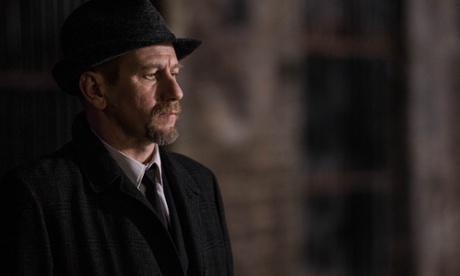
Sarah called Joe’s bluff by revealing Yulia’s continued existence – although surely that was always her objective given the KGB’s apparent need to have Joe in the same room as the gun intended to kill the prime minister – only for him to gamble that meeting by involving Daddy: “Well I walked into a KGB trap once before, I wasn’t going to make the same mistake again.” But when did that happen? Daddy only realised what was going to happen to the prime minister after he’d left Downing Street; Sarah was allowed to go and visit Alan, unaccompanied, only a short while earlier. It felt like that timeline didn’t quite work. Anyone else?
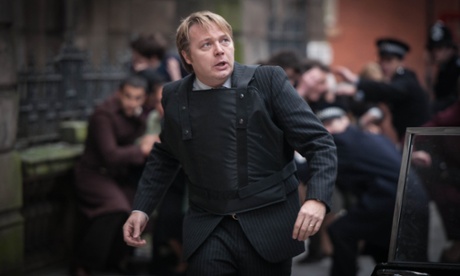
Other good things: it was an excellent episode for PC Jim, managing to outsmart Bobby and track down Colin Blakefield by threatening everyone with a visit from the IRA (“Yes, you should probably watch out for them”) before haring up to the north west to visit Joe’s dad, and then back to London to don a 1970s flak jacket and stand in for the prime minister. It’s the busiest anyone’s been all series, Odin possibly excepted.
The Montags
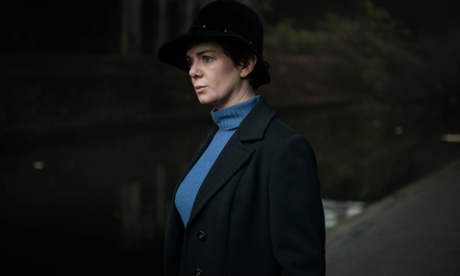
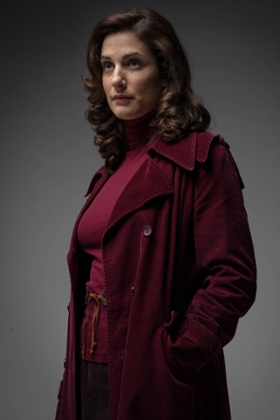
For those of us who doubted whether Alan could really be involved with the KGB, the revelation that he was just covering for Sarah came as no enormous surprise. In fact, it is rather more surprising that nobody at The Fray cottoned on more quickly. Still, this was well-played, with Odin sending in the KGB hoods to silence Alan for good – through an extremely convenient opening in the roof, it’s worth noting – before Sarah eventually realised that, as Alan was unable to throw Joe to the wolves, so she was unable to allow him to sacrifice his life for her cause. A special mention here to Victoria Hamilton: her face as she reacted to hearing that Odin had tried to kill Alan was exceptional.
So all very dramatically satisfying, and I was pleased, I must admit, that Sarah didn’t then undergo a complete personality change to allow for a neater ending. She ended the show unrepentent about her mission; dismissive of democracy and the British state she had ostensibly served.
Joe Lambe
But the most interesting ending was saved for Joe who, having failed to bring Odin in alive, was left with enough doubt over Yulia’s motivations to destroy the pair’s relationship. It’s a neat bit of writing this: we suppose that Joe tried to defect to the KGB after they found out Yulia was working for him as a double agent. (Although what exactly was he doing in Poland as an MI5 agent?) But we’ve never quite pinned that down. And now there’s an extra question mark: was Yulia in fact turned triple agent? Part of a long game that would allow the KGB to set Joe up in the case of the prime minister’s death? The facts are (deliciously) no clearer.
Although there is a slightly odd thread I can’t stop picking at here: namely why would they need to frame Joe so thoroughly? If KGB agents are about to take control of pretty much the whole government – and MI5, though one imagines Sarah would have had to wrestle Bobby for the job perhaps literally – then surely a few hints here and there would have been plenty.
As it is, Joe and his fashionable mac live to spy another day. Still, he’s got the moody, heartbroken glower down pat.
Thoughts and observations
- “When sorrows come, they come not not single spies but battalions.” Bobby looks to Hamlet as he realises the extent of Operation Glass.
- That bit about Joe’s dad abusing him when he was a child? Shoe-horned in from an entirely different drama, I thought. Very odd.
- We had lots of suggestions that MI5 used torture, but a rather polite attitude to showing it on screen. (Not necessarily a bad thing.) A radio with non-stop static must have been particularly awful for Alan.
- It was fairly peculiar, I thought, that the KGB hoods should come for Alan in shirts, ties and city overcoats …
- “If he proves to be red, then I want his heart, on a platter, on my desk.” Bloody hell, you wouldn’t argue with Daddy in a bad mood.
- Where else to hide a gun and big bundle of cash, but in a childhood jigsaw?
- Odin really does like the dramatic cliches, doesn’t he? Choosing an open but oddly deserted music hall in which to die, lit only by a spare spotlight.
- A shame that Kate didn’t make a reappearance in this final episode – she made The Game a more interesting show.
- “The righteousness of the righteous will be upon himself, and the wickedness of the wicked will be upon himself” – Daddy reaches for Ezekiel.
- And the exchange between Daddy and Bobby I rather wished had brought this series to a close: “I’m not going anywhere.” “No, you’re not, are you?”