It has been a good few days to be a bloke. A lad. A fella. There was the new edict that if you’re not bothered about rugby, you’re a traitor to your people. There was the launch of Radio X, a station designed by blokes for blokes, which has sprayed Lynx Fever all over the airwaves and given Chris Moyles and Johnny Vaughan new banter vehicles, which, I imagine, have spinning alloys and extra-loud exhausts that you can hear from three streets away. When I saw that The Gadget Show (Channel 5) was coming back, I made an unkind snap judgment. I had remembered it as a laddish, banter vehicle prototype, a sort of Top Gear for laptops and Xbox games.
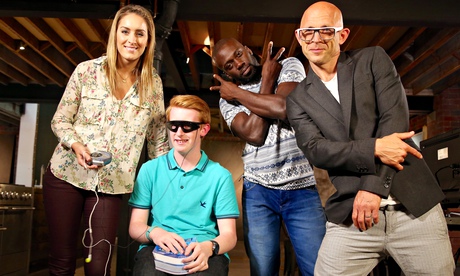
All that Lynx had clearly gone to my head, because, 22 series in, it is open to everyone and probably always was. The Gadget Show has had a tiny revamp and is now set in a Dragons’ Den-style warehouse space, which resembles one of those chain coffee shops made over to look like a local business, with all the authenticity that wooden surfaces and exposed brickwork can muster. It has three of its long-time hosts: former CBBC presenter Ortis Deley, the enthusiastic one; Jon Bentley, the knockoff Dara O’Briain; and Jason Bradbury, the Heston Blumenthal lookalike with a wad of Vision Express vouchers and a keen desire for spectacle experimentation. They are joined by Olympic gold medallist skeleton racer Amy Williams, who isn’t given much to do in this series opener, though she does manage to make a “mind spa” – flashing goggles and an ambient soundtrack – seem appealing. They’re an amiable bunch, never sneering, and an hour in their company passes quickly.
It’s the friendly, magazine approach that makes it so watchable, I think. There’s no elitism in its coverage, nor is it so dumbed down for the broadest audience that you end up just watching a man shout: “Smartwatch good! Tells time!” It covers smartwatches by making them seem inessential. The show did a survey and found that 91% of people think they’re a bit pointless. Then Bentley joins a group tasked with trying out various models (I notice that he pulls rank, bagging the Apple Watch for himself). “It wasn’t … better than looking at my phone,” declared one tester, decisively. Some of the tester group quite liked having one. Some of them weren’t that bothered. Bentley thinks they might be better in time, though he did not actually say that, missing a dad joke to be proud of. It’s more light than fluffy and it felt honest, like a pub chat. Noticeably, it did not ram a raging consumerist need to own the best stuff right now, right this second, down viewers’ throats.
Next up, a segment about helping a viewer with a gadget-based dilemma: Gadget Help, which makes me think the production company ran out of free coffee on the morning they were deciding what to call it. Young Dan is about to learn to drive but he feels nervous and would like to get some practice in. How can the team help him? With gadgets! There’s an app that is like a diary for your driving lessons. There’s a driving simulator that costs more than my first car and does not have perilous clutch issues and a sunroof that offers a mere suggestion of cover. Then there’s the aforementioned mind spa, a frankly bizarre and also quite expensive relaxation device that makes Dan look like a superhero and promises to make learning the theory test that little bit more fun. Dan chooses the app, although I suspect that’s because it’s more free than the others, which both cost more than £200. Again, a victory for thrift.
In fact, frugality is a bit of a theme: this is followed by a feature on tech-based medical advances. There’s a clinic in California that uses a retinal implant to offer blind people “sight” by connecting a camera to their retina, which sends signals to the brain. It is remarkable, if not quite the stuff of science-fiction films. It is also expensive, coming in at roughly £92,000 for the implant. They contrast this with a clinic in Bristol that is developing 3D printing technology to create bionic arms that use the arm’s remaining muscles to control a functioning hand. Their aim is to make cheap limbs, quickly. The results are also remarkable. They hope to bring it down to £2,000.
And just as you start to think that The Gadget Show may be slyly pushing an anti-capitalist agenda, it’s time for the competition. All that consumerist envy has been building to this point, and it explodes all over the place with obscene gluttony and a prize bag so stuffed it takes six whole minutes to read it out. Three TVs. Three cameras. Three smartphones. Four computers. Two tablets. Three bikes. So much stuff. It costs two quid to enter, but imagine if you actually won it – your house would look like the villain’s lair in a superhero film. You could cycle around it wearing your Oculus Rift, using every limb to take a photo from a different angle, all documented by a GoPro on your collapsible cycle helmet. So The Gadget Show isn’t quite a socialist paradise, after all. But I bet it doesn’t like rugby.