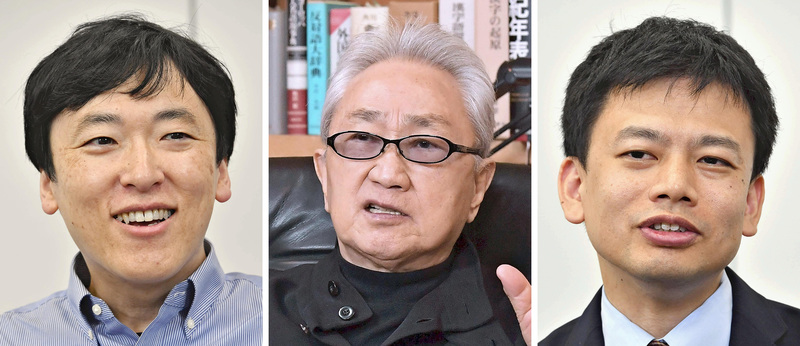
The Yomiuri Shimbun asked a writer who has battled cancer and two doctors on the front lines of medicine about the realities and challenges surrounding medical costs and treatment. The interviews were conducted by Yomiuri Shimbun Staff Writer Nobuaki Suzuki. The following are excerpts from the interviews.
(From The Yomiuri Shimbun, July 25, 2018)
Put patients' values first, discuss issue openly
I was told I had cancer in 2012, and together with my wife, we researched treatment methods online. When I came across "proton therapy," which was little known at the time, I got that feeling of joy when you just manage to find the lyrics to a song. The cancer relapsed 2-1/2 years later. That time, my anticancer drug treatment was a success, and I underwent proton therapy again.
The first time, all four of the excellent doctors I consulted recommended the same thing: surgery. Proton therapy was beyond their expertise, and they had no information on it. I have chronic heart problems. I doubted whether I could take surgery, and did not want to take anticancer drugs, either. I told the doctors, "Please don't force the standard treatments available in this small Japan on me." It was a pretty indelicate thing to say.
I saw a truly wide variety of patients. Even cancer patients each have their own values and ways of living. Based on those, they should be able to choose the treatment method right for them.
In Japan, doctors are still captives of specializations and sectionalism -- coordination on patients' behalf is lacking. The recent ongoing issue of doctors missing important details in CT images is one negative effect. It makes me feel very frustrated.
Paradoxically, I chose proton therapy because I have faith in Japan's medical expertise. Japan is ahead of the game. Its scientific and technological capabilities, as well as the skills of its technicians, are the best in the world. There's no way they wouldn't be able to cure me, I thought.
Patients cannot undergo any treatment beyond the national and economic strength of the country in which they live. As Japanese society is facing a population decline, how can medical expenses be used that most effectively leverage its strength? This is truly a philosophical matter facing the nation.
Regarding just the issue of high treatment costs with drugs costing several million yen or tens of millions of per year, the foundation of philosophy and discussions, or such questions as how expensive will the drugs get and for whom they will be approved, has yet to be presented to the public. Life-prolonging treatment, organ transplants, and even cost-related issues are viewed as taboo and kept covered up. These should be discussed more in society.
Battling cancer is tough -- really and truly tough. You get so exhausted. Cancer permeates your daily life. You begin to see the extraordinary notion of death as a preview of coming attractions. How good of a story you turn it into depends on you. By getting cancer, becoming dismayed and finding "hope within nothing," I was able to grow.
I want doctors to learn about humanity, to work out how to care for the suffering of people who have cancer. If they don't, I think they won't be able to show kindness to people whose bodies are in agony during treatment.
Making the world a healthier place, and bringing meaning to the lives of patients -- these are major roles for doctors from now on. I cannot help feeling that when I dwell on "the cost of life."
-- Rei Nakanishi / Writer and Lyricist
Nakanishi, 79, was born in Heilongjiang Province, China (formerly Manchuria). He graduated from Rikkyo University's College of Arts. Nakanishi has won the Japan Record Award as a lyricist and the Naoki Prize for his novel "Nagasaki Burabura Bushi" (Nagasaki aimless song). He has written a number of works about cancer, including "Tatakau Chikara" (The power to fight).
From drug dependence to a human studies approach
As I consulted with a female patient who'd been suffering from sharp pains for unknown reasons, I sought to root out the cause of her suffering. I found that her mind and body were being driven to the breaking point by her way of life -- she'd been trying too hard in her drive for perfection while looking after her large family.
The interaction and conversation between doctors and patients, which has tended to be overlooked in recent years, can sometimes have hugely positive effects on treatment. Listening carefully to people who are suffering, rubbing the back of someone in pain, holding their hand: As illnesses diversify, these are elements that cannot be replaced by artificial intelligence and represent the core of "human studies" in modern medicine.
This is an era where it is natural to live with a variety of illnesses, many of which do not improve with drug-dependent treatments. I imagine that treatment in the future will rely more on human studies.
However, human studies-based treatment isn't something that can be developed by medical staff alone. Patients' awareness must also change. I used to think that the issue of money was nothing more than the shackles on patients.
But I found that money has actually become a clue that leads to new ways of thinking and acting.
Those who use expensive cancer drugs worry about the cost. With the faces of their children and grandchildren in their minds, they ask themselves if they're prepared to continue using financial resources on medical expenses that could instead be spent on future generations, and what responsibilities they must take on. The same goes for patients who are receiving dialysis, many of whom have recently been showered with criticism under the argument that "the situation is their own fault."
In Japan, there is a strongly rooted sense that sickness is something that can be removed. Spending huge amounts of money on medicine has also become socially accepted. The expectations and dependence of patients on treatment and drugs have gone a bit too far.
Amid this situation, I found an interesting trend among patients, who are thinking of the world beyond their burden of treatment expenses and suffering through illness. Modern patients' understanding that they must be careful to take every pill they are prescribed and take thorough care of their health on a daily basis is being fostered, which has been a hope of mine.
Human studies-based treatment will change society. People will help and heal others. By rebuilding such connections in society, many people's lives will be saved. Going forward, it will also be important to spend money to achieve this goal.
-- Tokutaro Tsuda / Assistant Chief of Staff of Immuno-Rheumatology Center at St. Luke's International Hospital
Tsuda, 41, graduated from the Kyoto University faculty of medicine. Since studying traditional Chinese medicine at the Kitasato University Oriental Medicine Research Center, he has included eastern medicines in the general medical treatment he offers. He took up his current post in 2014. He is the author of "Kanpo Mizusakiannai" (Piloting with traditional Chinese medicine).
How can medical costs be justly divided in society?
In Japan, there is a culture of thinking, "You cannot put a price on life." This is a strength when advocating the equality of society, and a weakness when you perceive the multifaceted complexity of reality.
Being on the front line of palliative cancer care in the past 10 years, I believe that patients' treatment and issues related to money have become indivisible. I hear things like, "I won't get treatment because I can't afford the costs" and "I'm working while taking anticancer drugs, but my entire pay is consumed by the costs. What's the point of working?" Recently, there was a case where the patient's family, not the patient themselves, sought to end treatment.
I'm worried about the imbalance between life and the reality of the medical costs that support it.
Most of the government's cancer care budget goes toward the development of new treatments. In the near future, individual cancer patients will be able to choose the best treatment for themselves at the genetic level, and the development of anticancer drugs will also become fragmented. Even if it only affects some people, it's wonderful that patients will be able to live longer lives. But if the number of patients eligible for treatment falls, then anticancer drugs will consequently be priced higher.
On the other hand, preparations for quality of life are insufficient. People in the final stages of their lives with cancer need support until the end. Vulnerable patients, such as those living in isolation, mustn't be forgotten. For this purpose, it's vital to build close community ties and develop human resources in a range of professions, but reality is lagging far behind. Budgets also are not sufficient.
Medical care in Japan is unique in that everyone is covered by the public health insurance scheme, medical services are offered at low prices, and patients can freely choose where they receive treatment. But the system is at a turning point. As social welfare spending balloons, we must discuss the "distribution" of whom to save and whom to let go. We must find out how to use medical costs properly for the whole society.
With such themes, we tend to turn our eyes only to talk of money and avert them from background issues of ethics or what helping the vulnerable really means. Ethics and values are behind many of the money-related concerns surrounding challenging medical issues, such as children's heart transplants and the development of drugs for incurable illnesses. That is a fact we must not forget.
We must take a hard look at the reality and find a sustainable future. It is time to be aware of the urgency of the situation.
-- Asao Ogawa / Chief of the National Cancer Center Hospital East's Department of Psycho-Oncology
Ogawa, 45, graduated from the Osaka University Faculty of Medicine. He has been working in the National Cancer Center Hospital East's Department of Psycho-Oncology since 2007 and assumed his current post in 2013. He is involved in the development of a support program for elderly cancer patients.
Read more from The Japan News at https://japannews.yomiuri.co.jp/