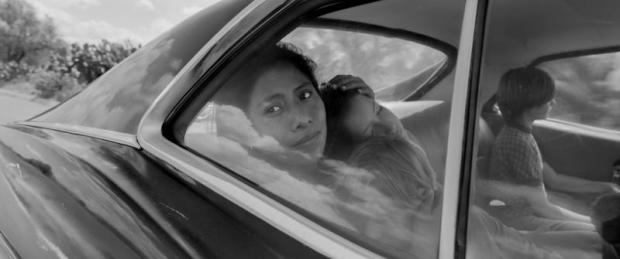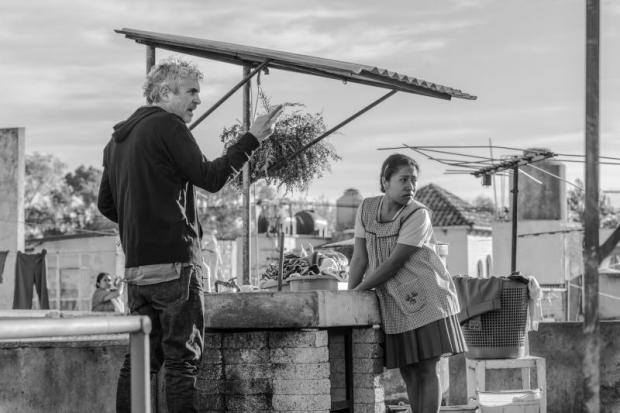
People who've watched Roma on Netflix can agree on one thing: this is the kind of film that deserves to be seen on a big screen.
"The ultimate experience is, of course, in the cinema with Atmos sound, and ideally 4K," said Roma's director Alfonso Cuarón during an online interview with Life.
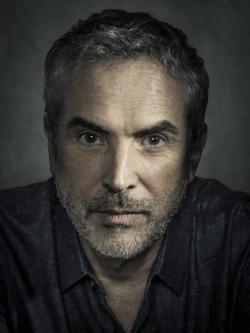
Alfonso Cuarón. Netflix
Shot in digital 65mm, Roma is visually gorgeous in its glorious monochrome. A contemporary look into the past instead of a nostalgic black-and-white emulation of the 50s, according to the filmmaker. Roma is set in the 1970s of Mexico City where Cuarón himself grew up. It's an engrossing recollection, a love letter to his own childhood, which centres around a live-in maid Cleo and a middle-class family she serves.
In telling this most personal story of his career so far, Cuarón called it an immersive and eventually complex experience to reconstruct moments of his own past. "I was OK and ready to be completely exposed," he added. He cast non-actor Yalitza Aparicio as his lead Cleo, and chose his cast based on their lookalike appearances and qualities to those he knows in real life. On set, the cast wore the same clothes as their real-life counterparts, interacting with props and even the house that were replicas of the one where he grew up.
Cuarón -- aside from serving as writer, co-producer and co-editor -- is also a cinematographer of his own feature for the first time. He fell into the role quite accidentally after his go-to cinematographer Emmanuel Lubezki pulled out of the project. Lubezki also became the one who ultimately convinced Cuarón to undertake the role himself. Anyone who's seen the film would unanimously agree it was a great decision and that Cuarón did embrace this additional task splendidly.
Reflecting on his role as a cinematographer, Cuarón said it was quite important for him to step up to the task due to the personal nature of the story. This way, he could translate it from memory to screenplay, then finally to images with neither filters nor distortion.
Roma, like his previous projects Gravity and Children Of Men, features a lot of long takes in various scenes, trailing characters through the neighbourhood of Colonia Roma in Mexico City and even down into the ocean. The filmmaker said that getting all visual elements, environment, narrative and even social context to flow together were quite crucial in his storytelling.

"It's that relation between time and space, and honouring them, and trying to bring that sense of time and space into a cinematic form," he explained. "Also, it's about embracing foreground and background as one and the same, not giving more weight to [either one of them]. One informs the other. But the most important thing was to allow those moments to flow in a unity of time and space."
Roma is earning its deserved universal acclaim, so far winning the Golden Lion at the Venice International Film Festival among its other accolades. The film was also selected as the Mexican entry for the Best Foreign Language Film at the 91st Academy Awards, to be held on Feb 24. It has since made the December shortlist, and it remains to be seen later this month when the official list of nominations are announced which other categories this Mexican glory will receive an Oscar nod.
Roma is also one of the few films distributed by Netflix to get a theatrical release, and Cuarón said he hopes as many people as possible would get to experience the film in cinema.

"Nevertheless, the life of films in a theatrical experience is very reduced. The way that our films exist in the context of history tends to be, nowadays, in different digital home formats," Cuarón said. While he acknowledged its popularity, he doesn't think streaming platform is going to replace cinema, at least not anytime soon.
"I think that the theatregoing experience is going to exist for a long time from now. I don't know if it's eventually going to disappear. I don't know if streaming will disappear or cinema will disappear. But I think, for the time being, the moviegoing experience is something that is a particular, collective experience. It's about going out from your home and it's an activity that can be shared with many other people."
"My concern, if anything, is that the theatrical experience has been reduced in the last decade. The theatrical experience is very limited to only about Hollywood or superhero films. This is the rest of the world as a general rule. In Thailand, it's probably the same. Besides Thai films that are shown in cinema, I'm sure most of the multiplexes are taken over by Hollywood films, and it's harder to see films from all around the world," he said.
Cuarón added that he's very happy to hear that Roma has a theatrical release in Thailand. He hopes that the balance between the theatrical experience and streaming can bring a more diverse distribution of films, and he definitely would like to see more films from streaming companies to be shown in cinemas.