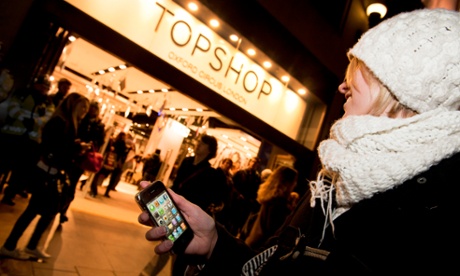
For a company that’s done so much to bring the retail experience onto the web and out of the physical world, Amazon is particularly keen to make friends with shops these days. The e-commerce giant can now deliver parcels to – or accept returns from – any one of a growing UK network of post offices, Co-op supermarkets and newsagents, or via one of the Amazon Lockers it pays bricks-and-mortar retailers to host.
Last Christmas, Amazon even opened its own pop-up stores in New York and San Francisco. Even the world’s largest internet retailer can’t ignore the fact that we have entered an age of omni-channel commerce, in which a major retailer needs to be accessible everywhere – on the high street, on our computers and, perhaps above all, on our mobile phones – if it is to keep the demanding modern customer satisfied.
John Lewis, for example, thrives in part because it manages to be itself across every possible channel, driven by a deep knowledge of what the customer wants.
And since you’re asking, we – the customers – want to:
- Browse pleasurably for an item on our phone or tablet
- Pick it up, rattle it and ask a few questions about it in the shop
- Order it that evening online
- Collect it from the nearby Waitrose the next day
- Talk to customer services about it on Twitter (or maybe on the phone) if something goes wrong
While John Lewis is the mass-market master of omni-channel retail, Burberry leads the world in its vision of cutting-edge commerce. The fashion brand’s Shanghai Kerry Centre store, which opened in April 2014, has radio-frequency identification technology (RFID) woven into clothes to trigger multimedia content on mirrors, as well as mobile checkout and shop assistants who can access consumers’ shopping history.
More technology is always on the way – and all the signs are that modern consumers are pretty keen. According to DigitasLBi’s 2014 Connected Commerce survey, 75% of shoppers in Singapore say they would try on clothes virtually using a digital mirror; 63% of Italian consumers would use an interactive store window display to shop when a store is closed; while 48% of US consumers said they would happily use a system that identifies them in-store in return for discounts and offers.
Challenges for retailers
Today’s innovation, of course, is tomorrow’s standard practice. Burberry may talk about blurring the line between the physical and digital worlds, but the fact is: consumers aren’t obliged to acknowledge that there even is such a line. They simply expect shops and websites to operate in perfect synchronisation.
All of this puts retailers in an immensely challenging position. In the dotcom boom of 15 years ago, no pure-play internet retailer pictured itself opening a shop or building a high-street distribution network any more than established shopkeepers particularly wanted to launch huge mail-order fulfilment operations. Yet here we all are.
In the meantime, the major global shift from computers to smartphones has significantly complicated the back-end task for anyone selling online. Pity the retailers who are already masters of the singular art of stocking, staffing and managing a busy store now additionally need to master the machinery of data analytics, platform implementation, systems integration and distribution.
Behavioural differences between markets
Retailers that operate globally also quickly discover that no single insight is necessarily transferrable from one country to the next. In China, for instance, 78% of social media users have shared a purchase on social media, compared to an average of 35% in the UK and Germany. In Europe, we are less likely to buy on our smartphones than in the far east. Although, that said, many of us still do – partly because, unlike in those more mobile-centric parts of the world, tablet and laptop use here remain comparatively high.
In the UK and elsewhere, the gradual realisation has been that there is hope still for our high streets, which is surely welcome. The hard part for those who occupy them is the simultaneous need to also be everywhere else, all the time – which, when you look at it, is a great opportunity too.
Jim Herbert is a managing partner at DigitasLBi Commerce
This advertisement feature is brought to you by the Marketing Agencies Association, sponsors of the Guardian Media Network’s Agencies hub