Forsythe Company
Sadler's Wells, London EC1
Ghosts
Linbury Studio Theatre, London WC2
When William Forsythe's new company was announced as the headline event of this year's Dance Umbrella festival, his choice of programme was expected to be a manifesto of where he was going next. Ballett Frankfurt, which he had directed for 20 years, was disbanded last year as a consequence of municipal cost-cutting. After a bitter battle with Frankfurt's mayor, Forsythe set up his own group of 18 dancers, funded by a package of supporters in Germany and Switzerland.
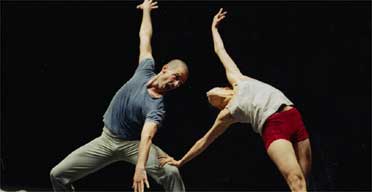
He launched the Forsythe Company in April this year. But instead of bringing his latest creations to London, he presented us with the repertoire he'd taken on Ballett Frankfurt's final tours of the United States and France some 18 months ago. So what statement is he making? That the new group is simply a continuum of the previous company - or that the new work isn't right, for whatever reason, for London? Since these pieces hadn't been seen in London before, maybe we're catching up, belatedly, with his farewell phase. These, after all, are mostly the same dancers, accustomed to his method of choreographing from their improvisations. He displays their joint efforts as starkly as though we were watching work in progress. Dressed in rehearsal clothes, the performers are hyper-alert to each other's signals, ignoring the audience. It's up to us to engage with their physical intelligence, guess at the codes they're using.
The first two pieces, both from 2002, look like an advanced form of capoeira, fighting by dancing. In The Room as it Was, eight dancers cluster in shifting combinations, accepting or rejecting each other's propositions. An impassive girl bats away unwanted kisses; a man negotiates a route around his partner's lethal pointe shoes. Encounters so close demand split-second timing, cued by exhalations of breath. A scrim lifts in the final moments, revealing two silhouetted dancers in performance. This is the show: we've been backstage all along, immersed in the creative process.
In N.N.N.N, four men get to grips in a chain of ever-faster reactions. Like watching a gambling game without knowing the rules, it intrigues while leaving us little the wiser. Then comes a dramatic duet from 1995, Of Any if And, pairing Dana Caspersen and Fabrice Mazliah. The disjointed grammar of the title gives a clue to the conjunctions made by the dancers' bodies, spanning gorgeous to grotesque. In spite of stagey distractions (lighting rigs going up and down, whispered words, nerve-trilling noise by Thom Willems), the bouts of dancing are knife-sharp.
The concluding assault course, One Flat Thing, reproduced, involves the company hurtling over 20 tables in a grid that occupies most of the stage. A version of this piece was performed at the opening of Tate Modern, when it was lost in the huge space and noisy partying. Contained within a proscenium, waves of movement surge with a secret logic that brings order out of incipient chaos. By ending an otherwise irresolute programme on a high, Forsythe keeps us curious about his intentions for the new group. When are we going to find out?
Cathy Marston ends her three-year tenure as associate artist with the Royal Opera House tonight, with the last performance of Ghosts, part of the ROH2 programme in the Linbury Studio. She has been able to work with exceptional collaborators, transforming the black-box theatre into a series of very different worlds. Though her choreography has often reflected the themes of productions on the main stage, Ghosts stands alone, anticipating Ibsen's centenary next year.
She tells the back-story of the characters in the play, haunting the present with parallels from the past. The most moving of the duets are those involving Matthew Hart as Oswald, his innocence infected from the start. Given Ibsen's doom-laden plot, everyone is wracked with lust, guilt or disease, leading to relentless hand-wringing and thrashing about. Brief changes of mood bring relief, until anguish contorts each body that isn't already a corpse. Marston can't escape monotony in this hour-long piece, however skilfully she shapes her dark material. She sets off now to start her own company, profiting from all she's learnt.