‘The end of an era’
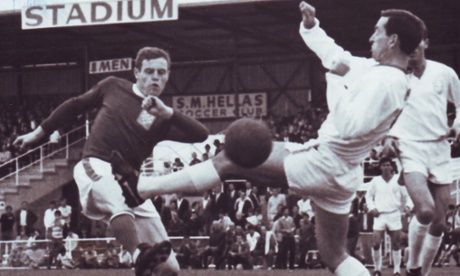
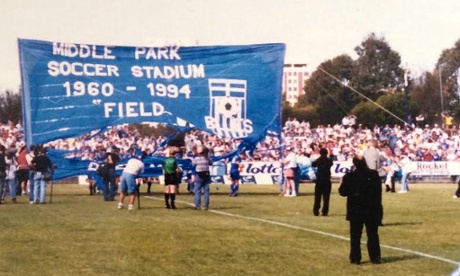
It was a warm summer’s afternoon in South Melbourne. The Albert Park Lake sparkled in the sun and the city skyline shimmered in the distance. Young men filed into Middle Park in baggy colourful t-shirts and shorts, as was the style at the time, while the elderly Greek men wore sunglasses with their usual Sunday shirt and slacks. The blue and white of South Melbourne Hellas was complemented by the familiar sound of Lefteri’s trumpet and the sweet smell of souvlaki. It was a time to say goodbye. October 23, 1994, 20 years ago to the day, was the opening round of the 19th season of the National Soccer League, and the final game at Middle Park, the cradle of football in Australia.
Middle Park, or Oval 18 as it was once known, sat on an old landfill site in between the Albert Park Lake and the St Kilda railway line, and 18,000 fans could cram inside for a big game. Built on land that was once shared with cyclists, the ground traced the shape of a velodrome, and a tin shed grandstand with wooden seats faced northwest towards the lake. Spectators were free to wander around the ground to select the best vantage point, but from the bleachers you could see all the way to the city. When it was full, as it was for the final match between South Melbourne and Heidelberg, it was a fortress.
“It was a Greek derby, but although there was intense rivalry between the clubs there wasn’t any nastiness,” remembers Francis Awaritefe, who was left on the bench for South Melbourne by coach Frank Arok.
South Melbourne went ahead after just three minutes through Con Boutsianis, but he went off injured half an hour later, to be replaced by Awaritefe. Minutes after Boutsianis left the field and just before half-time, South midfielder Jason Polak handled the ball on the goalline. Suddenly, South were back on level terms and down to 10 men. To add insult to injury, it was an ex-South man Peter ‘Gus’ Tsolakis who converted the penalty for Heidelberg.
“Tsolakis celebrated like a dickhead,” remembers South Melbourne fan Paul Touliatos. “He was celebrating in front of the stands, tapping his chest and gesturing towards us in the crowd.”
South Melbourne didn’t often lose to Heidelberg, and the pressure mounted when Mehmet Durakovic missed a penalty that would have given them the lead. “Teams were always intimidated coming to Middle Park because they knew that South Melbourne had such a tremendous advantage towards the end of the game,” explains Kimon Taliadoros, who played with South from 1987 to 1992. “Even when we were down in games we would often rescue a point simply because we had that crowd behind us.”
It wasn’t until 1993 that Taliadoros fully understood just how influential the atmosphere was at Middle Park. “I could hear the insults. Coming back as a Marconi player I came to realise how irresistible South Melbourne was in the second half with that home support. The intensity and momentum created at Middle Park was incredible. It was so intimate, it was a cauldron of emotion and pressure. It was a state of mind, it was like riding a wave of emotion, and that wave powered South Melbourne.”
Coming on for Boutsianis, it was Awaritefe who changed the game for South Melbourne. “I went on and I played out of my skin,” he says. Awaritefe put the home side ahead after half-time with a tremendous goal from an acute angle, and wheeled away to the crowd with his trademark celebration, his dreadlocks flying wildly as his legs whirred up and down on the spot.
Ivan Kelic scored the final two goals for South Melbourne to complete a famous second-half comeback, and Middle Park was given the farewell it deserved. “You had a sense that something historic had happened,” explains Awaritefe. “Middle Park just had a magic and a history that the others didn’t. It was a privilege to be able to play the last game at that ground. I remember people running on, hugging and thanking us. It was a big deal that we didn’t lose that last game.”
“That final day it just forced you to think about all those times, and the fact you weren’t going to be able to show people the grandstand and the dressing rooms and the history,” says the current Socceroos coach Ange Postecoglou, who was on the bench as the assistant to Arok. “It was the end of an era.”
A place to belong
Middle Park was demolished as a result of state government planning and opportunism by the South Melbourne board in late 1994 but by 1989 the ground was already in a state of disrepair. “The toilets stunk, and the social club was tiny,” says Touliatos. “It was pretty run down and needed a lot of work.” A federal government grant was initially meant to redevelop the stadium, however these plans were interrupted in December 1993 when the Victorian Liberal government controversially bought the Australian Grand Prix to Melbourne, and announced that a new race track would be built at Albert Park.
As Jill Barnard and Jenny Keating note in People’s Playground: A History of the Albert Park, motor racing was not a new phenomenon at the park. Just as in the 1950s, the sport promised to bring much needed revenue for the park’s management. However, local residents were outraged by the imposition of a noisy racetrack on crown land, while South Melbourne were told that their home needed to be demolished. The place where Middle Park once stood is now a pit lane, and although junior fields bearing the names of Ange Postecoglou, Alan Davidson and Paul Wade still surround the site, there is little to show for the place which nurtured successive generations of Australian footballers.
If history is written by the victors, perhaps it is fitting that Middle Park was bulldozed to make way for another sporting event. From the early days, the ground had to be fought for by football people in the face of local opposition. When the state Labor government tried to enclose the ground for football in the 1950s, they were met with protests against the siphoning off of community land, despite the fact that both cricket and Australian Rules had their own enclosed grounds at Albert Park.
Furthermore, the plan by South Melbourne Hellas and Hakoah to erect a grandstand was criticised by a 1961 report into the management of the park. “All kinds of exotic exercises have been introduced into Victoria, and few have flourished to the same extent as cricket and Australian Rules football”, wrote Oliver James Gillard, QC, the author of the report, who noted that football “is comparatively novel to our country … because of the influence of persons from overseas.”
Although Middle Park had been home to football since the 1880s, the great Australian chauvinism towards the game and its participants remained prevalent. “Nothing can draw them [immigrants] from their national games,” read an article in the Argus newspaper in 1954. “What they do has no effect upon Australian Rules. What does matter, however, is what their children do.”
In Victoria at least, assimilation meant speaking English, finding a job, and dropping soccer for Australian Rules football. During the 1960s anti-soccer slogans were daubed at Middle Park, the grandstand was set on fire and the goalposts were chopped down.
In this context, the fight for Middle Park was important not only for the co-tenants Hakoah and South Melbourne, but for soccer in Victoria. “There must be a united front from all Australian football clubs to halt the soccer movement,” commented Harold Snook, the secretary of the Victorian Football Association, in 1954. “After all, the grounds and their amenities were built by the pioneers of the Australian game, yet soccer is just stepping in and taking it all away.” As other soccer clubs, often backed by immigrants, were bullied by Australian Rules football into marginal areas of outer Melbourne, Middle Park remained soccer’s refuge in the heart of the city. If Albert Park is “the lungs of Melbourne”, then Middle Park provided the crucial oxygen for the world game.
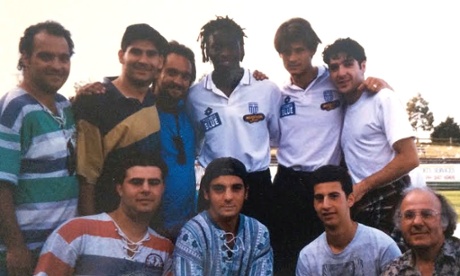
In the face of often xenophobic opposition, friendships were forged between those who became Australians at Middle Park. As an Englishmen of African descent, Awaritefe remembers being welcomed into the community. “Middle Park was open and it was accessible. The openness of the ground lent itself to a diverse support base,” he says. “They couldn’t do enough for you. A lot of the guys I ended up hanging around with were Greek, and we’d go out to a restaurant or bars and if the owner was a South supporter we wouldn’t have to pay. It was just incredible the generosity.”
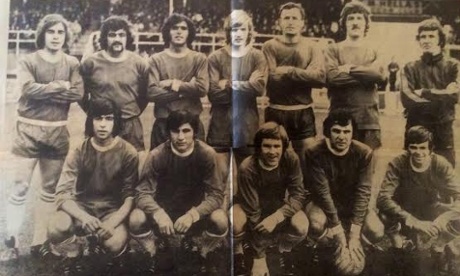
Michael Mandalis and Jimmy Armstrong played for both Hakoah and South Melbourne Hellas at Middle Park during the 1960s and 1970s, and have remained friends ever since. I meet them at Jimmy’s house in Ivanhoe, where we pore over old black and white photos and newspaper clippings from scrapbooks. “Good on you, Jimmy! This is like a museum,” grins Mandalis as he finds old photos of himself. “Look at my hair, my goatee! You better enjoy yours while you’ve still got it” he says, winking at me.
Jimmy and Michael are an odd pair. Jimmy is a tall, thin Scotsman, with a neat pageboy haircut and a quiet, no-nonsense demeanour. Michael is short, squat and dark, with a moustache and white hair as wild as his stories. As he recalls the goals he scored at Middle Park, he rises from his seat for dramatic effect. “I loved to dance, man,” he says as he swivels his hips and drops his shoulder. Of his many tales, the best is about meeting the legendary Indigenous activist and soccer player Charles Perkins. “We became very good friends because he thought I was Aboriginal,” he explains with a mischievous grin. “He said to me ‘what mob are you from, boy?’ I said ‘I’m from the malaka tribe’.”
The son of the chef to the King of Egypt, Mandalis arrived in Australia in 1958 from Egypt via Israel and Greece. “I went to Prahran when I arrived, and they were waiting for me,” he says. “If I went to the Prahran Market with my mum and spoke Greek because she didn’t speak English … The wog problem upset me a lot back then. I really wanted to make my parents welcome in a very racial situation.”
Football became the bridge into Australia for the Mandalis family, and as Michael tells it, he turned down an offer from Chelsea in order to stay with the club. “It was the wog game, and I was a wog. How could you change this face of mine back then? The migrants suffered, they went to factories where they were called wogs and dagoes, so the weekend when you played for South Melbourne Hellas, they belonged somewhere. I survived to win five premierships with Hellas. But my biggest achievement was to put a smile on the face of the wogs, to put a smile on the face of those workers.”
Two of those workers were Postecoglou’s mum and dad, who emigrated to Australia from Greece to give their children a better life. “It certainly wasn’t a better life for them, because all I can remember is them working,” says Postecoglou. “My dad was a cabinet maker and my mum was a machinist. Mum would work in the factory and at home at night while dad was always doing overtime. Football became my social connector with my dad, because that’s the only time I got to see him.
“You know, it was all part of my dad’s plan. He came from a foreign country, he didn’t know the culture of the place, he didn’t understand a lot of the things that happened here, and he wanted me to have the same values as him. At South he knew who my friends were going to be and what my values were going to be.
“It went beyond football. That place moulded me as a person. I grew up playing at the grounds around Middle Park. You know I only have a few close friends, and many of them were made there.”
As a kid, one of Postecoglou’s favourite players was Jimmy Armstrong, who is still spoken of in reverential tones by those who watched him play at Middle Park. Transformed from a midfielder to a striker by coach Manny Poulikakos, Jimmy found a new position and a new home in Australia. He remembers crowds of people coming to watch the team train, and the generosity of the Greeks who adopted him. “As we’d walk into the dressing rooms they’d say ‘here you are Jimmy’, and I’d end up with $20 a goal. It was unbelievable.”
The field of dreams
It’s not just South Melbourne players who remember the allure of Middle Park. “What I always admired about Hellas was the crowd,” says the former Socceroo Hammy McMeecham, who played with Melbourne Croatia in the 1960s. “Its size, its passion, its noise. I would have loved to have played there every second week with that crowd behind me for at least a season or two.”
“I remember when we were at Melbourne Croatia, Ivan Kelic used to rave about Dougie Brown,” says Awaritefe, “that was his hero! When I went to South Melbourne I was told about all the great stories of Jimmy Armstrong, Charlie Egan, Alan Davidson and Dougie Brown.”
Combined with the vociferous supporters, many former players believe the small dimensions of Middle Park gave South Melbourne a great advantage. “The crowd was really really close, almost on top of you,” says Awaritefe. “It was a lovely little ground, a proper football ground.There was the tradition of terracing where people could stand. It adds to the energy and the atmosphere when the fans are standing.”
“A goalkeeper with a good strong shot could virtually kick it to the other end,” says Armstrong, “You felt like you were part of the crowd, that’s how close you were.”
“Middle Park during the day was like the old lady,” says Mandalis. “But come the weekend it was like an exploding volcano. The crowd, the amazing voices, the arguments, the roar. It was like an eruption. The thing was built like a mouth of a volcano, and the noise would carry as far as St Kilda!”
In 1966, Con Nestoridis, one of Greece’s greatest players, came to Middle Park as captain/coach of South Melbourne Hellas. “Beckham was nothing, man,” says Mandalis who, like many players of his generation, raves about Nestoridis’ ability to score from corners.
“There was a corner kick, and Nestoridis scored directly from the corner,” explains Armstrong. “The referee blew his whistle and said take it again. So what did he do? He scored again. Do you remember it?”
“Yeah,” replies Mandalis with a wistful smile. “I was playing that game. When I was a young kid in Egypt, I went to see Greece play Egypt, and who was playing for Greece? Con Nestoridis. We were never accepted as Egyptians, so we stayed Greek. I’m sitting with my dad, and I’m watching this guy and thinking, I want to be like him!
“And then, in 1966, to have him come over to Australia and I’m playing next to him! I play No10, he plays No8. I’m there getting goosebumps, man. He showed me how to run with the ball, he said, ‘don’t look down, you know where the ball is. You haven’t been playing all this time to not know where the fucken ball is!’”
Mandalis stands up from his chair and in slow motion imitates running with the ball with his head in the air. “I learned so much from him. That was the best feeling I ever had at Middle Park. To watch my hero, and then come to Australia to play with him. Unbelievable. I was 21, he was 37. That was my best moment.”
Nestoridis was one of several football luminaries to grace Middle Park. In 1989, Hungarian legend Ferenc Puskas came to coach South Melbourne in the NSL. Paul Touliatos remembers trying to get as close to him as possible in the stadium. “How often do you get that opportunity? He was a figurehead, he was like an emperor.”
Training sessions with Puskas were all ball work and no fitness, team meals were steak and consomme, and the approach to the game was ‘you score six, we score seven’. “For him it was all about ball mastery and calisthenics,” remembers Taliadoros, who says Puskas introduced them to the 4-3-3 formation. “Puskas liked to see one-on-one contests and Ange Postecoglou, who was the overlapping left-back, was particularly effective at Middle Park. He was tremendous the way he got down the left side. He was one of the guys who was able to generate momentum and enthusiasm from the crowd by beating his defender.
“It [4-3-3] was a complete anathema to us at the time,” continues Taliadoros. “He was different from a structural perspective with strikers. I played on the right as a right winger, and it took me a while to understand how to play high and wide. We used to dominate possession against most sides, particularly at Middle Park.”
Indeed the knowledge transfer at Middle Park and its legacy for Australian football is nothing short of incredible. Perhaps more than any other player, Postecoglou – then affectionately known as Angie – was a product of Middle Park. He watched superstars Malcolm ‘Supermac’ McDonald and Charlie George play there in 1977 with his dad in the first season of the NSL, and he was assistant coach to Arok for that final game in 1994.
Postecoglou’s playing debut in 1984 occurred in drastic circumstances. Alan Davidson, the South Melbourne left-back, had swallowed his tongue after a heavy challenge. While he was shaking on the ground, a spectator jumped the fence and rushed to his aid. Davidson literally had his life saved at Middle Park, and as he was rushed to hospital, his replacement was a skinny young Angie Postecoglou.
“I was only a young player but I ended up being captain of the club,” explains Postecoglou. “When Puskas came he didn’t speak a lot of English but his Greek was OK, so he’d go through me a lot of the time as an intermediary with a lot of the boys.
“I’d often pick him up from his house and drive him to the ground. I spent a lot of time chatting about football with him – people talk a lot about me being an attacking coach and I think that was where the seed was sown. I loved it. He was so much more open than the previous coaches who were so regimented and structured.
“He was so humble that you’d quickly forget that he was once one of the world’s best players. He had no tickets on himself at all. The biggest lessons I learned in life were from those days”
‘Because we’ve been here’
I first met Paul Touliatos at the Cascade Hotel in Hobart in September. He, along with many other traveling fans, was celebrating South Melbourne’s victory over South Hobart FC in the second-tier National Premier Leagues preliminary final. As we entered the pub the rugged, hard-as-nails Tasmanian men at the bar turned around quickly to size us up, then slowly away, returning to their beer and conversation. It was the typical wary response of smalltown barflies to having their local overrun by dozens of strangers from the mainland.
The gold earring of Paul’s youth has gone the way of his once-thick hair, the loud shirts have been replaced by a more sensible polo, and these days a blue South Melbourne cap faces forwards rather than backwards on his head. When he’s not wearing his sunglasses, his eyes sparkle and smile wider than his mouth. And he grins a lot as we chat. The conversation at our table is typical state league football fare: giggling at insane internet messageboard arguments, recounting the ridiculous stories of the NSL, recalling the great players. “We got long memories, man,” Paul chuckles as he remembers Kimon Taliadoros’ return to Middle Park.
Paul’s uncle Con has been a South supporter since the days of Nestoridis, Armstrong and Mandalis, and he was the one who took him to games as a little kid. With South Melbourne Hellas running through his veins, Paul can’t bring himself to support the new franchises Melbourne Victory or Melbourne City. “I don’t see it,” he says, shaking his head. “I mean, you pick a club, you’ve just got to stick with it. Why? Because we’ve been here ... people get married, they get divorced, but they always keep their same footy club don’t they? They never change their clubs.”
Paul has never been to an A-League game, but he’s only missed three South Melbourne games since they were kicked out of the national league in 2004. “You can’t abandon your club and mates,” he says. “If I abandoned the club, if my brother did, if all these guys did, there wouldn’t be a club left. Who would be here? You have to come back. They gave us four titles and so much joy over the years, it’s just like repaying it by sticking around.”
There is something wonderfully Nick Hornby-esque about his dedication to South in such trying circumstances. With no system of promotion or relegation in Australia, I put it to him that he might be slightly mad. “Maybe,” he replies, “maybe I am crazy in a way. You’ve gotta be a bit nuts to come week in week out.”
After Middle Park was bulldozed, South Melbourne relocated to the old Lake Oval, just a 10-minute walk across Albert Park. Surrounded by an athletics track, Lake Oval - or Lakeside Stadium as it is now called - is still home to South Melbourne. Embedded at the base of the grandstand is a plaque, which was originally laid at Middle Park in 1961. Carrying the names of Messrs Maramas, Zola, Drew and Keneally, the plaque is a testament to the multicultural spirit of football at Albert Park.
“I knew what was done was for the progress of the game, and we were going to get a bigger stadium,” says Mandalis. “We thought something big was going to happen, and it did for a while. We can always build and destroy, but we carry the stories of Middle Park into the new ground. The club is now run by kids who used to come with their parents and watch Jimmy and me play.”
South Melbourne have a 40-year licence at Lakeside Stadium, which director Tom Kalas describes as “basically ownership”. This new stadium, along with the training grounds at Albert Park, is the centrepiece of the club’s push to get back into the A-League. A new social club and bistro is currently being built underneath the stadium as a revenue driver for the club, while a Legends Bar will house the memories of Middle Park.
In 2009, Kalas began a reform process at South Melbourne. “We had to market ourselves to something bigger,” he explains. “We asked FFA if they were comfortable with us, and they are. We were approached to bid for a licence.
“65% of our membership is non-Greek, and they all have voting rights. We are not an ethnic club that plays footy on the side. We are a football club. We have a women’s side, we have juniors, we have an NPL side, we have our own TV show.”
Expansion will be back on the agenda for the next television rights deal in 2017, and FFA chief executive David Gallop says the A-League will “fish where the fish are”. The major centres along the Eastern Seaboard are the target, and South Melbourne know that they are well-positioned. And this time, there is a rare spirit of mutual trust and understanding with head office following the leading role Kalas and the board at South Melbourne played in the establishment of the NPL in Victoria last year.
When the South Sydney Rabbitohs won the 2014 rugby league grand final, their first since being kicked out of the competition, more than a few South Melbourne fans wondered if they’d ever get their own chance to right the wrongs of history. “We want to play in the top flight,” says Touliatos. “We deserve a chance. A chance. That’s all we want. We said that before Victory came in, we said that before City came in, and we still didn’t get it.”
However, unlike in previous years where South Melbourne have tried to reenter the national league, there is now a precedent for their bid. The expansion success of the Western Sydney Wanderers over the last two seasons was predicated largely on history. It was marketed as “the newest, oldest club”, while the first chief executive Lyall Gorman spoke eloquently and frequently about the importance of football in the region dating back to the 1880s. The now-famous Poznan performed by the fans in the 80th minute is a tribute to that heritage. The community was encouraged to look back in order to imagine the future.
Can the same process be replicated with South Melbourne? Albert Park has hosted football since 1884, from the pre-war English, Irish and Scottish immigrants to the post-war arrivals from southern Europe. Clubs and players of all hues have played football at Albert Park, either at the Middle Park ground or at Lakeside. Where the AFL has long since abandoned Albert Park, there is an uninterrupted lineage stretching back to the genesis of soccer in Australia.
“Mate, I think if they do it the right way, they should go back to the A-League as a complete Australian side,” says Mandalis. “South Melbourne was a bunch of English migrants, then the Greeks, then Australians. Now it’s just South Melbourne football club. History blends into the future, and that will take us to other places. The Greeks played their part, now let the multicultural side take it back. What other club has this culture?”
- With special thanks to Paul Mavroudis.