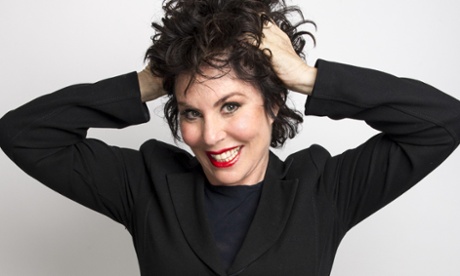
It’s not a huge stretch to claim standup as a Jewish artform. It was honed in the so-called Borscht Belt (or “Jewish Alps”) of upstate New York in the 1940s, as the vaudeville style evolved into something brasher and more gag-heavy. Its big names mid-century were Jewish: Lenny Bruce, Mort Sahl, Joan Rivers. Even today, it would be the most natural thing in the world to announce a Jewish-American comedy festival, at which giants like Jerry Seinfeld, Larry David and Jon Stewart might jostle for top billing.
But what about a festival of UK-Jewish comedy – could such a thing work? “We’ve kept our heads down for too long,” says Raymond Simonson, the comedy geek who runs London’s new JW3 centre. “There isn’t a strongly definable British-Jewish voice in comedy. We’ve been scared of our own shadow.”
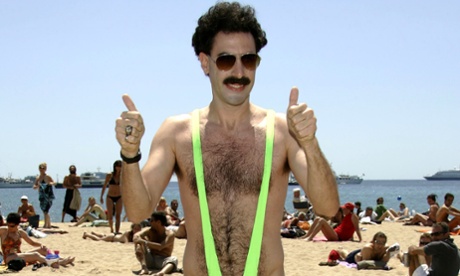
Simonson (Twitter handle and salient characteristic: @FatSideburns) is out to change all, with the inaugural UK Jewish Comedy festival. Certainly, there’s no shortage of talent. Sacha Baron Cohen – arguably Britain’s most successful comedian and the man who sang “Throw the Jew down the well” in Borat – is Jewish, as is David Baddiel, who will perform in the festival. Then there’s Arnold Brown, a Glaswegian-Jewish veteran of the dawn of alternative comedy. Brown claims that that particular revolution was authored by Jewish talents: Peter Rosengard, who helped set up the Comedy Store; half-Jewish Alexei Sayle; Ben Elton, whose dad was a German-Jewish refugee. Then there’s Jerry Sadowitz, also Glaswegian-Jewish, and Stephen (“I’m a Jew but don’t follow Judaism”) Fry. As Brown says: “People don’t realise, or even care, how significant the contribution of Jewish people to UK comedy is.”
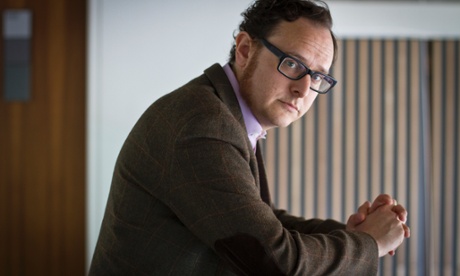
The problem, as far as Simonson is concerned, is that none of these acts address Jewishness, or even trade in recognisably Jewish humour. This, to use Brown’s words, means “angst-ridden, neurotic, outsider stuff”. Or as Ruby Wax says: “It’s boom-boom, it’s great lines, it’s self-deprecating. That’s what [Jewish comedians] are brilliant at: that real whipping of the self, but of everyone else too.”
The self-deprecation is a defence mechanism, says Simonson. “A lot of comedians talk about having been bullied at school. Well, imagine having been bullied for centuries.” In perpetual persecution, a type of humour was forged. “But in England, I’ve never seen it,” says Wax flatly. “There is no Jewish comedian here that I’ve ever seen. It’s nice to celebrate that stuff, but the festival’s going to have to scrape around to find it.”
Simonson, unsurprisingly, doesn’t think it’s that simple. UK talents would love to be overtly Jewish, he says. In 1981, Birds of a Feather writers Laurence Marks and Maurice Gran wrote Roots, a sitcom about a Jewish dentist, but it flopped. And at one point, Little Britain’s Matt Lucas planned his own Jewish sitcom, but in vain. It’s a numbers thing, says Simonson. “We are a tiny, tiny minority in this country.”
He cites the example of David Schneider, who starred in the 1990s TV news parody The Day Today. “He always says he has two acts: the Jewish act and the non-Jewish act. And he does the Jewish act only when he’s booked for a Jewish audience.” In the UK, such an audience isn’t big enough to sustain a career – while in the US, says Simonson, a young Jewish comic “might think of becoming the next Mel Brooks or Jackie Mason. Here, are they going to be the next Maureen Lipman?”
But he believes things are beginning to change. “Until recently, when people asked me what’s the most Jewish comedy on British TV, I’d always say Goodness Gracious Me – jokes about pushy mothers, the food, being an ethnic minority. You wouldn’t need a significant rewrite to make that Jewish.” (Sanjeev Bhaskar, its creator and star, is taking part in a discussion in Simonson’s festival.) But four years ago, along came BBC2’s Grandma’s House by the Woody Allen de nos jours, Simon Amstell, and then Channel 4’s Friday Night Dinner, both out-and-proud Jewish sitcoms. Well, out-ish. “They’re not piling on loads of Bibles and wearing the kippah and all that,” says Simonson, slightly regretfully. “The Jewish stuff is mostly only obvious to Jews.”
I ask if the Israel-Palestine situation makes life difficult for Jewish comics, given that some people now associate Jewish people not with the bullied, but with the bullies. In reply, he cites two comics who were in Edinburgh in the summer, when Israel was bombarding Gaza. They were heckled when they announced they were Jewish. “If you’re a new comedian now,” he says, “I don’t blame you for not referencing your Jewishness.”
Alternatively, you could broach the subject head-on, as old-timer British-Jewish comic Ivor Dembina did in his 2010 show This Is Not a Subject for Comedy. Maybe there’ll be more where that came from, if the festival fulfils its dream of raising the volume and confidence of Jewish comedy. “Hopefully within a couple of years,” says Simonson, “it’ll be annual and a big thing, encouraging more comics to talk about being Jewish. We want to have that impact.”
• The UK Jewish Comedy festival is at JW3, London NW3 (020-7433 8988, jw3.org.uk), until 7 December.
More comedy coverage
Comedians’ 10 best Christmas cracker jokes
Revealed: the nation’s No 1 toilet joke
Lee Evans steps down from standup – who else can do what he does?
Shappi Khorsandi review – perky gags about porn and prejudice
Harry Hill on tour: ukuleles, inflatable sausages and Bradley Wiggins’ sideburns – video
Kevin Bridges: ‘I prefer real to surreal’
Stewart Lee review – tricksy gags about liberals, rightwingers and ‘the Islams’
Noel Fielding review – solo standup set is a holiday from reality
Aziz Ansari: ‘It’s time to get serious’
Lee Mack review – latterday Eric Morecambe is gloriously daft
Q&A: Dave Gorman gets to the point – ‘most of the world is lovely’