When Werner Herzog was asked to make a second film in the Amazon rainforest, after his delirious classic Aguirre, the Wrath of God, he wasn't initially enamoured with the idea, until he heard the story of a rubber baron at the turn of the last century, who dismantled a riverboat and carried it overland through the jungle, from one tributary to another. He also learned of the Teatro Amazonas, an improbable, neo-classical opera house in the Brazilian city of Manaus, built at the height of the rubber boom. Putting the two elements together, the director had his crazy conceit.
While shooting Fitzcarraldo, Herzog had to contend with a border war, a tribe who attacked his cast with arrows, the logistical nightmare of hauling his own boat through the forest, and his demented star, Klaus Kinski, whom the native extras offered to kill on his behalf. Herzog declined, only because he needed Kinski for a few more scenes.
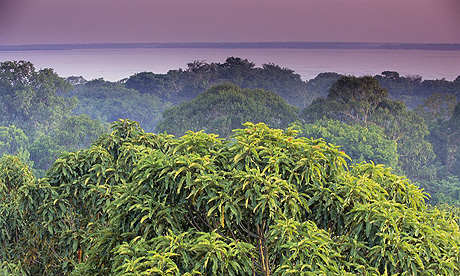
The Amazonas film festival, whose flagship venue is that same opera house in crestfallen Manaus, is a much gentler affair, of course, whose guests could not be more mollycoddled. In its way, though, the festival is just as bizarre as Herzog's mythic-mad films. Here we are, 150 film-makers and journalists from all over the world, congregated in a luxurious hotel, fed succulent fruits with impossibly beautiful names – the cupuacu, caju, abacaxi, the pupunha and the jambo – and connected to intravenous drips of caipirinha, looking across the inky-black waters of the aptly named Rio Negro, the river that will take us into the Amazon. Here we are, ostensibly, to discuss the end of the world.
That is to say, the environment. Nearly 40% of the world's remaining tropical rainforest resides in the Brazilian Amazon, whose protection is imperative in the fight against global warming. Amazonas state, which has a good record in preventing deforestation, launched this festival in 2004, with the primary aim of promoting sustainable development, at home and internationally.
The introduction of a film festival with such an important theme is welcome. But what that means, in practice, is difficult to grasp here. And the reason for that lies in the Brazilian personality. From red carpets and nightly parties, to a trip into the jungle where we enjoy a spectacular beach carnival and swim with river dolphins, these are unadulterated good times, fuelled by ebullience that no human with a pulse could resist. How it will lead to informed pieces about the environment, however, is a puzzle.
So intent are the festival organisers not to overburden us with their message, that the event's tagline is the woolly "Aventura, natureza e meio ambiente" (adventure, nature and the environment) and, despite the media presence, the jurors – including Alan Parker, Parker Posey and the French actor Tcheky Karyo – have not been briefed on the hot topic. During the symposium Can Celebrities Save the Planet?, the celebs themselves are absent.
The festival's oversight is epitomised by the untapped environmental firebrand in their midst. Neve Campbell, who recently starred in the BBC global warming drama Burn Up, is currently campaigning against the mining of the Canadian tar sands. During one of our riverboat excursions, she talks passionately about her meetings with scientists and first nations chiefs on the effects of the mining, and of her plans to engage other celebrities in an exercise of collective clout for the cause.
No chance of that here. Of her experience in Manaus, Campbell laments, "I'm a little in the dark, to be honest. I'm still learning about the Amazon, so thought it was a good opportunity to come here and talk to people. That hasn't happened. I think the idea is great, but I wish they had educated us, so we could speak on the issues in an informed way."
Amazonas is a great idea, whose conscientious approach includes off-setting its own carbon footprint with the planting of 12,000 trees, and careful selection of competition films that focus on both the human and environmental costs of development. The prize-winning documentaries are excellent: Robert Nugent's End of the Rainbow heart-breakingly revealing the exploitation of a Guinean community by an industrial gold mine, and Ian Connacher's Addicted to Plastic investigating the consequences of that most ubiquitous material. Marco Bechis' prize-winning drama Birdwatchers, about a rebellion of indigenous people dispossessed of their land in southern Brazil, is hugely impressive.
As one organiser comments, "The best way to convince people today is through film, through the image. An Inconvenient Truth did more than Kyoto. Birdwatchers is a stronger statement than any speech could ever be."
He may have a point. But what this still-developing festival must do next is invite distributors to Manaus to pick up such films, while nurturing guests like Campbell, who might then lead a generation of eco-conscious actors to spread the word.