Welcome to the Friday, June 19, 2026, Brew.
By: Lara Bonatesta
Here’s what’s in store for you as you start your day:
- The federal and state judiciary's evolving role in American democracy
- A look at legislative history related to Juneteenth
- Three statewide candidate filing deadlines in the next two weeks
The federal and state judiciary's evolving role in American democracy
Today, we're sharing the fifth installment in our project marking America's 250th anniversary: The Blueprints of Democracy.
State and federal courts have become central to shaping politics and policy. They're handling major issues like executive power, birthright citizenship, free speech, redistricting, and abortion, while also raising fundamental questions about judicial independence and checks and balances that trace back to America's founding.
Understanding the court system's critical role requires recognizing its scale and complexity. The federal judiciary extends far beyond the nine Supreme Court justices. There are more than 1,700 federal judges and judicial officers who, each year, handle approximately 400,000 cases.
That sounds like a lot — and it is. But when we think about the nation’s judicial system, it’s in the states where more cases are decided, affecting more people in more ways than most people realize.
According to a report from the University of Denver's Institute for the Advancement of the American Legal System, roughly 30,000 state judges manage approximately 100 million cases every year. These state judges preside over everything from traffic violations (which make up more than half of all state court proceedings) and divorces to capital murder cases. States also have courts that hear only certain types of cases, such as probate courts, juvenile courts, family courts, and more.
In a 2023 speech at Harvard University, Alabama Supreme Court Justice Greg Cook said:
… there is a great deal of action going on in state courts today. This should not surprise us. The majority of our Bill of Rights came from pre-existing state constitutions in the 13 original states. At our nation’s founding, the real need for protection was from state governments. The federal government was smaller than state governments. States ran everyday life. No one believed that the federal Constitution applied to states (and it really didn’t—with a very few exceptions). Hamilton even said: “There is no need for a Bill of Rights because states would be sentinels over the rights of the peoples.”
An essential part of understanding how this massive system functions is understanding how judges are chosen. Future Supreme Court Chief Justice John Marshall made this point during Virginia’s constitutional ratifying convention debates in 1788: “What is it that makes us trust our Judges?--Their independence in office, and manner of appointment.”
How judges are chosen
Supreme Court justices and other Article III judges are nominated by the president and confirmed by the Senate, while bankruptcy judges and federal magistrates are chosen through separate procedures.
Voters indirectly influence the ideological leanings of nominees for the federal bench through their choices in presidential and U.S. Senate elections.
State judicial selection varies considerably. Some states use gubernatorial appointments with legislative confirmation (which is handled by the state senate, a commission on judicial appointments, or a state executive council). Other states get their judicial nominees from a judicial commission, which prepares a list of potential candidates from which a governor then chooses a new judge. In Virginia and South Carolina, the legislatures elect judges. Voters elect judges in 21 states. Historically, these judicial elections attracted minimal political attention, but this dynamic has shifted in recent years.
Wisconsin is one example of this change. In 2023, a liberal justice won election. This changed the state supreme court’s ideological balance from a 4-3 conservative majority to a 4-3 liberal majority. This shift motivated national groups to invest heavily in the race, with candidates and outside groups spending more than $56 million — a record for state judicial contests.
That record didn't last long. In April 2025, another Wisconsin Supreme Court election occurred with the court's ideological balance again at stake. This time, spending exceeded $100 million, surpassing what both major party candidates combined spent on the 2022 gubernatorial race.
Understanding how courts function requires recognizing this interconnected system. That’s why Ballotpedia created a database of all U.S. Supreme Court decisions dating back to 1790. It’s also why we regularly update readers on the Supreme Court’s latest activity in our Robe and Gavel newsletter, and for state-level supreme court justices in a regular Daily Brew feature on retirements, appointments, and judicial elections.
Click here to read past installments of this series.
A look at legislative history related to Juneteenth
Juneteenth, celebrated on June 19, commemorates the day in 1865 when Major General Gordon Granger arrived in Galveston, Texas, to deliver the news of the end of slavery and the Civil War. In 2021, it officially became the United States' 11th federal holiday.
Previous presidents, including Barack Obama (D) and Donald Trump (R), recognized Juneteenth before it became a federal holiday in 2021.
In June 2018, the U.S. Senate passed SR 547, a bipartisan resolution "designating June 19, 2018, as 'Juneteenth Independence Day' in recognition of June 19, 1865, the date on which slavery legally came to an end in the United States." The late U.S. Rep. Sheila Jackson Lee (D-Texas) introduced a similar resolution, H.Res.948, in the U.S. House of Representatives that month. However, lawmakers took no further actions on the bill after it was referred to the House Committee on Oversight and Government Reform.
On June 19, 2020, U.S. Sen. Ed Markey (D-Mass.) introduced S.4019, a bill to make Juneteenth an official federal holiday. Jackson Lee also introduced corresponding legislation in the House that day. The bills were referred to committees, and lawmakers took no further action.
On June 15, 2021, the Senate unanimously passed S.475, a bill establishing June 19 as a legal public holiday called Juneteenth National Independence Day. The House voted 415-14 to approve the bill on June 16. President Joe Biden (D) signed the bill on June 17, 2021.
According to the Pew Research Center, Juneteenth is a permanent legal holiday in 30 states and Washington, D.C.
Ballotpedia tracked state legislation related to Juneteenth introduced between 2011 and 2025 with the help of our partners at BillTrack50, which aggregates legislative data from all 50 states. During that time, state lawmakers approved 184 bills or resolutions related to Juneteenth, with the most legislative activity occurring from 2021 to 2023. During those three years, an average of 24 Juneteenth-related bills were approved each year. These numbers include bills signed into law or resolutions legislatures approved commemorating, establishing, observing, or recognizing the Juneteenth holiday or local Juneteenth celebrations. This figure does not include resolutions memorializing or recognizing individuals or groups.
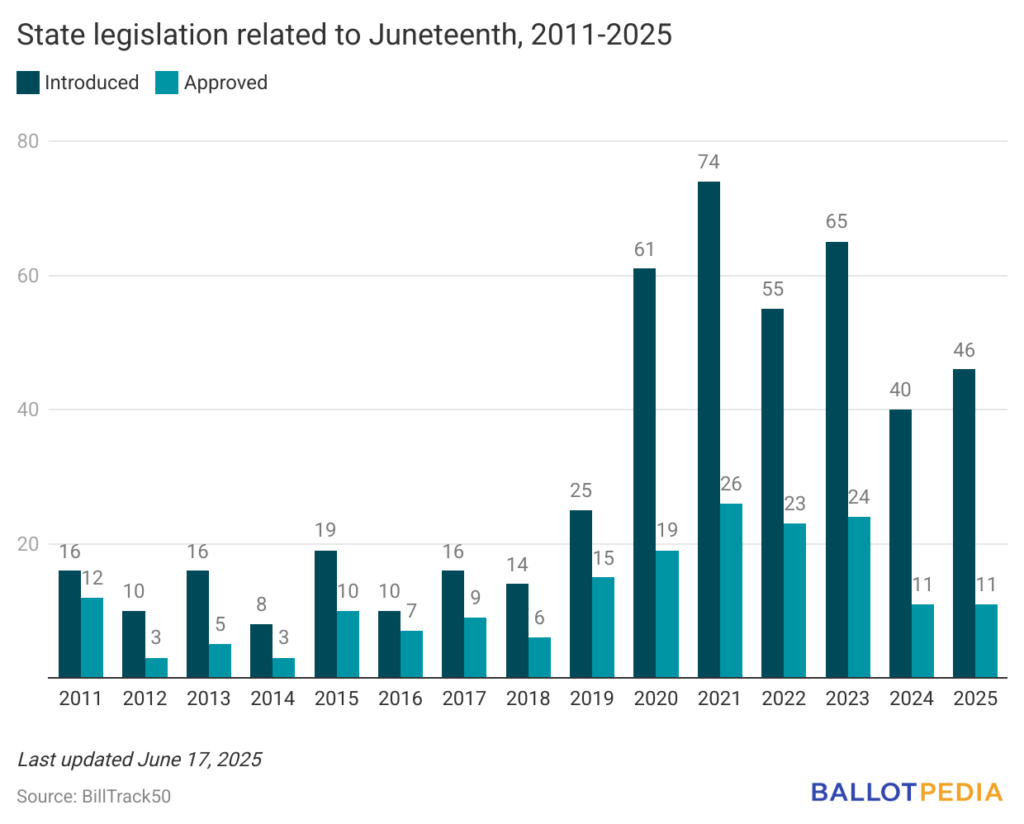
There are currently 11 federal holidays. The last federal holiday established before Juneteenth was Martin Luther King, Jr. Day, which Congress established in 1983.
Click here for more information about legislative activity associated with Juneteenth.
Three statewide candidate filing deadlines in the next two weeks
As we approach the longest day of the year on June 21, candidates and voters in multiple states have election-related deadlines to be aware of as the 2026 election cycle continues.
Three states have statewide candidate filing deadlines in the next two weeks. The map and bulleted list below show which states have candidate filing deadlines scheduled between June 20 and July 3.
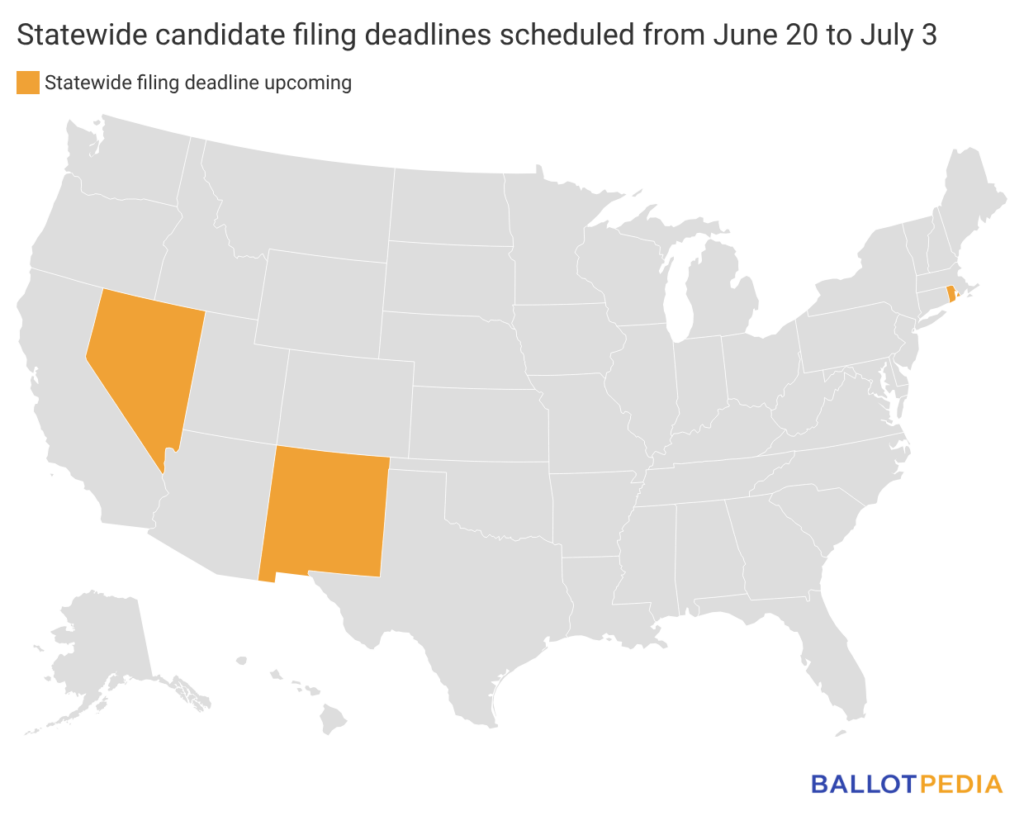
- Nevada : June 22 (statewide unaffiliated candidate filing deadline)
- New Mexico : June 25 (statewide general unaffiliated, minor party, write-in candidate, and judicial retention candidate filing deadline)
- Rhode Island : June 24 (statewide primary candidate and general unaffiliated candidate filing deadline)
Looking back
Six states had candidate filing deadlines in the past two weeks:
- Connecticut : June 9 (statewide primary candidate filing deadline)
- Florida : June 12 (statewide candidate filing deadline for U.S. House of Representatives, governor, attorney general, agriculture commissioner, chief financial officer, state senator, state representative)
- New Hampshire : June 12 (statewide primary candidate filing deadline)
- Tennessee : June 17 (statewide primary write-in candidate filing deadline)
- Utah : June 15 (statewide unaffiliated candidate filing deadline)
- Virginia : June 16 (statewide unaffiliated candidate filing deadline for U.S. Senate)
Candidates must meet various state-specific filing requirements and deadlines to appear on primary and general election ballots. These regulations, known as ballot access laws, determine whether and how candidates can make it onto the ballot. These laws are set at the state level and apply to candidates running for state and federal offices.
Voting in upcoming elections
There are six statewide elections taking place in the next two weeks:
- Colorado : June 30 statewide primary election
- Louisiana : June 27 statewide party primary runoff
- Maryland : June 23 statewide primary election
- New York : June 23 statewide primary
- South Carolina : June 23 statewide primary runoff election
- Utah : June 23 statewide primary election
Voter participation deadlines
Four states have early voting periods that start in the next two weeks:
- Arizona : Early voting begins June 24 for the July 21 primary.
- Colorado : Early voting begins June 22 for the June 30 primary.
- Minnesota : Early voting begins June 26 for the Aug. 11 primary.
- Vermont : Early voting begins June 27 for the Aug. 11 primary.
Four states and the Virgin Islands have voter registration deadlines in the next two weeks:
- Arizona : June 22 is the last day to register to vote in the July 21 primary.
- Colorado : June 22 is the last day to register by mail or online to vote in the June 30 primary. In-person voter registration is available through June 30.
- Maryland : June 23 is the last day to register in person to vote in the June 23 primary.
- Utah : June 23 is the last day to register in person to vote in the June 23 primary.
- Virgin Islands : July 2 is the last day to register by mail or online to vote in the Aug. 1 primary.
Three states have absentee/mail-in ballot request deadlines in the next two weeks:
- Louisiana : June 23 is the last day to request a ballot for the June 27 primary.
- Maryland : June 23 is the last day to request a ballot in person for the June 23 primary.
- New York : June 22 is the last day to request a ballot in person for the June 23 primary.
Click here to see our list of upcoming election dates and filing deadlines.