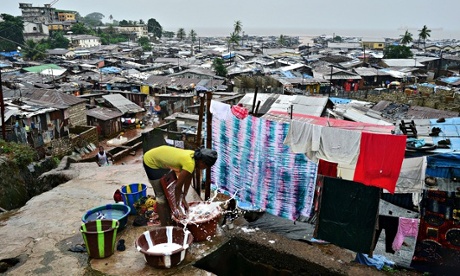
December will mark a year since west Africa’s Ebola epidemic took hold in Guinea, killing a two-year-old child, who became the outbreak’s patient zero. Since then, the crisis has unfolded beyond Guinea’s borders, affecting people in eight countries. We asked readers in Ebola zones to tell us what life is like where they are, using GuardianWitness. We have received more than 50 contributions from readers in west Africa capturing the mood from their communities, from the deserted streets of Freetown during Sierra Leone’s three-day lockdown, to life continuing as usual in Guinea. Here are some moments of the crisis so far through the eyes of readers in west Africa.
Lockdown in Sierra Leone
As the Ebola death toll reached more than 500 in Sierra Leone, authorities announced an ambitious three-day lockdown, dubbed “ose to ose” (meaning house to house in Krio), across the country. Residents were told to stay inside their homes as health workers visited them to answer questions about the virus, deliver soap and identify potential cases.

'ose to ose' sensitisation
Soap package deliveries as part of the sensitisation in Freetown.
Photo by Seray Bangura posted by On Our Radar due to connectivity issues.
GuardianWitness user Leslie Roberts shared the challenges of the lockdown:
Looking out from my window, I see that my street is completely deserted of commuters and vehicles. One big hiccup on this lockdown is the logistics: like soap, the leaflets that the sensitisation team members should distribute to households did not reach them on time. As a result, house-to-house Ebola sensitisation has not even started in the area where I live.
Meanwhile, morale was still high in some parts of Freetown, according to ECinSL:
It’s day three of the three day-period when the government has asked all people in Sierra Leone to stay at home, and the feeling in my community is positive. Someone in the community is playing the radio quite loudly, and there’s upbeat music interspersed with messages about Ebola.
A sensitisation team came to visit us on day one, and gave excellent information, answered all our questions, distributed soap and demonstrated proper hand-washing. The sun is out and children are starting to emerge to play in the little dirt road in front of our compound. Life goes on in Sweet Salone.

Residents of Freetown celebrate the end of the lockdown
Spending the last hours of the lockdown on the eve of my birthday with friends boiling Ataya. The night has been great so far with young up and coming hiphop artist, Meco Jay.
Report by Amjata Bayoh, posted by On Our Radar due to connectivity issues.
Food shortages in Liberia
When the Liberian government quarantined areas of Liberia’s capital, Monrovia, to stem the spread of Ebola in August, tensions overflowed, leading to clashes between residents and armed forces. Concerns over food shortages grew, as residents were unable to leave quarantine zones to work or find food. Fears of an impending food crisis continue today, with Fewsnet (famine early warning systems network ), forecasting that about 1.3 million people could need emergency food aid from January (pdf) in Liberia, Guinea and Sierra Leone.

Food for West Point slum, Monrovia
This is a woman called Angeline who I met in West Point slum, Monrovia. She was picking up food at a distribution organised by the UN World Food Programme (who I work for) and the Liberian Red Cross. It was a tense atmosphere and everyone was keen to explain why they should be given food. There were many arguments. Angeline told me she was relieved to get a supply of food because there was very little work to be had these days and food prices were going up. There was a lot of fear and some anger in West Point that day.
Celebrations and false alarms
Aid agencies attempted to set the record straight on Ebola as rumours about the origins of the virus, and how it was contracted, flew around. We received stories from GuardianWitness users of people mistakenly thinking the outbreak had been contained, including this submission from Mariama Jalloh, a citizen reporter with On Our Radar:
As I am talking right now, people in Makeni are dancing and shouting, saying Ebola is finished in Sierra Leone. They said they had heard it on the radio.
On our Radar reporter Mohamed Camara told a similar story:
People are beginning to think Ebola is a man-made disease, as only man-made diseases have an end date and natural diseases do not. The local radio show Monologue, mostly listened to by Sierra Leoneans, revealed that the government had said Ebola would be eradicated by November. The show also said that some patients who had been admitted were not Ebola-positive.

"Jesus! Ebola is gone!"
People running through the streets shouting JESUS EBOLA IS GONE! People shouting EBOLA DON DON DON!!
Report by Seray Bangura on the last day of the lockdown, posted on behalf of On Our Radar due to connectivity issues.
The Italian NGO the Avsi Foundation reported that Ebola patients were leaving health clinics as tension in the city rose.

Information and awareness needed
People of Sierra Leone keep on be suspicious, they don’t trust authorities and medical staff. In this picture, that was taken this morning in Freetown, a young man escaped from the hospital, where he was in quarantine after he was diagnosed with Ebola virus, and get caught by authorities to prevent the spread of the disease. This is just an example of how things in Freetown have become tense and desperate, with people fearing not only Ebola, but also doctors, authorities and us volunteers. As staff of the Italian ngo AVSI Foundation, we are working on information and awareness activities with affected communities, informing the population about the pconcrete possibilities of healing” Ernest Sesay, President of Family Home Movement (AVSI Foundation network). http://www.avsi.org/
Shortage of health workers
The slow international response to the crisis meant training local health workers became paramount to tackling the outbreak.

Conducting Case management trianing for health workers in Liberia
Conducting Ebola case management training for health workers in River Cess County, Liberia. From late July 2014 to present River Cess have had nine cases with 114 contact. we have trained worker how to manage cases related to Ebola.

"I look forward to each Ebola patient to be discharged"
Aliou Dongue, from Senegal, is running the World Food Programme operations, providing food and logistics assistance in Gueckedou, southern Guinea: "Even though so many people fear to come and work here, being on the front-line is very valuable work because it allows me to help feed the patients, contribute to their quick recovery and ensure their families do not go hungry. While working for WFP in Gueckedou, I made some really good friends with people at the treatment center and I can only look forward to each and every one of them being discharged."
- Do you have stories or photos to add to this story? If you are living in an Ebola hotspot, or in a country on high alert for the virus, we want to know what life is like where you are. Share your pictures and stories via GuardianWitness.