
His hair was a mess of seaweed, the straggly green strands bobbing up and down on the surface of the water. His expressionless face looking skyward, drained of its life. How he died, they didn’t know. How long he’d been there, they couldn’t tell. He wasn’t exactly human, but some of his features were at least human-like. The party needed sustenance, but looking at this poor creature, floating lifeless in the water, they wondered: “Could we eat him?”
“Delicious in Dungeon” is an anime about food. It is an anime about food and all that food represents as part of human culture. Flavors that excite. Memories recalled by the sensation of taste. The aesthetics of a well-plated entree. The sociology of eating a meal together. Love. And even the ethical considerations we make in our consumption.
It’s that last point that really sets “Delicious in Dungeon” apart from so much of the media on food out there in the cultural zeitgeist.
Star Wars, throughout its history, has included scenes that allude to an ethics of consumption in its galaxy far, far away. But strangely, these scenes rarely include a confrontation of the ethics (or lack thereof) they depict; rather often these scenes are merely played for laughs. In “The Last Jedi,” Chewbacca eats a roast Porg in front of a group of Porgs. The adorable creatures look up with their saucer-sized eyes as one of their own is about to be consumed by the Wookiee. Some of the comments on the YouTube video of this scene talk about how funny it is, which is a fair read as it is played in a humorous manner – even as it depicts something horrific for the Porgs, who clearly are sentient beings. Chewbacca shoos the Porgs away so he can eat in peace.
Meanwhile, on “The Mandalorian,” a Kowakian monkey lizard is seen roasting on a spit as the camera slowly pans down to show us another of the monkey lizards in a cage watching his friend slowly roasting over the open flame. He looks distressed, but his horror feels like it’s also being played up as comedy. While these animals have previously been depicted as a nuisance (you may recall Jabba the Hutt’s cackling pet Salacious B. Crumb), a scene later on in the series shows the monkey lizards to be quite helpful, warning Mando of an ambush. At what point does an animal go from being simply food, to having a level of intelligence that might make us think twice about whether people in this world should be eating them?
Unfortunately, Star Wars never really interrogates the ethics of eating. Then again, it isn’t often that the ethics of eating are ever considered in fiction, which is why “Delicious in Dungeon” is such a standout series. Among the many things it does right is it gets us thinking, really thinking, about our relationship to food.
* * *
When we write about food, so often it is experiential. It’s understandable, as consuming food is sensory. Food ingrains itself into our brains, into our memories, into our soul so much so that we can’t help but enter a confessional mode of speaking when we talk about it. Food has a strange intimacy to it that allows for such emotional response. But writing on food also speaks to the solipsism of our cultural times, where we place more value in something as an experience and are insistent on including ourselves in our writing. We get absorbed in our own navel gazing. Our relation to food, and the way we talk about it, becomes limited to the personal. Our connection to food is between us and the plate in front of us.
It’s also a sign that we live in outrageous excess that we can wax poetic about an ice cream sandwich the way that only King Louis XV could talk of his love for coffee or bouchée à la reine. Don’t ask an 18th century French peasant how their bread was that day. They’re not performing a monologue and giving that s**t five stars. They’re just happy to have food on the table. We’d rather write about how a heavenly bowl of ramen transformed us rather than grapple with the ethics of what went into the bowl itself. Don’t tell me about the little piggy that sacrificed itself to become chashu for my tummy.

–Danish Author Christian Coff
We think very little about where our food comes from. We often don’t want to think of the barbarism of the act, which is why slaughterhouses and factory farms are often located out in the middle of nowhere. Out of sight, out of mind. We may be vaguely aware of modern animal husbandry practices, some of us may have even read “Omnivore’s Dilemma” author Michael Pollan’s seminal 2002 essay “Power Steer,” but what do we really know about the animals that end up on our plate? The truth is we don’t want to know. Our heroes in “Delicious in Dungeon” have no such luxury of distance to shield themselves as the immediacy of the next meal requires them to be involved in the entirety of the food process. By centering food in this way, the series opens up discourse on how, in fact, our lives revolve around food, and challenges some of our thinking on food consumption.
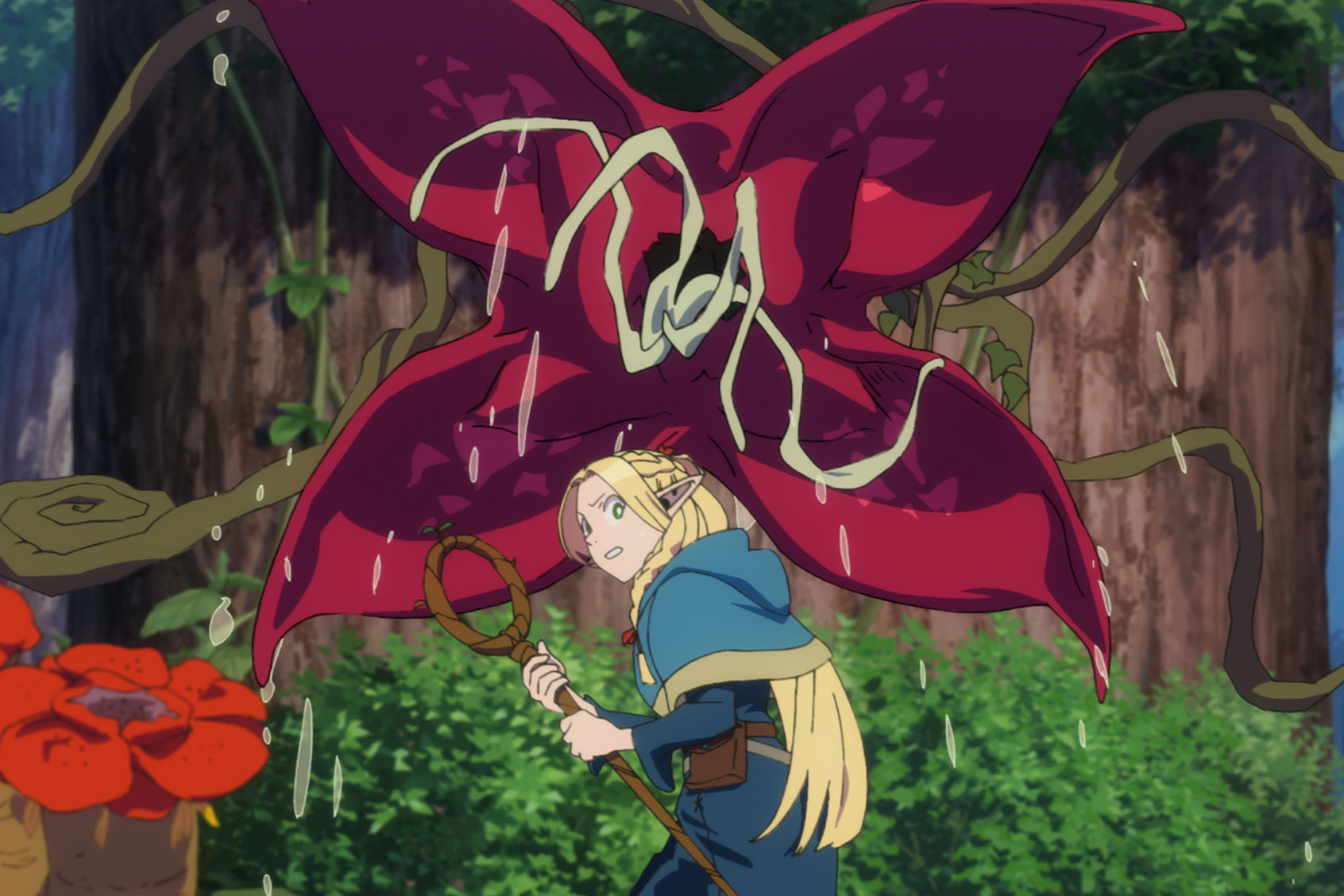
It’s a delicate balance, between the aesthetic and the ethical. The sensation of taste and the pleasure food brings versus the maintaining of a sense of rightness in how we pursue these pleasures. “Delicious in Dungeon” makes attempts to examine this balance through the viewpoints of the main party members. Senshi, a Dwarf and the party’s cook, advocates for a kind of utilitarian conservation. Respecting the balance of nature and taking only what one needs. His concern lies with maintaining the ecosystem of the dungeon. Senshi doesn’t kill for the thrill of the hunt or take more than the party needs to survive. But he does concede that something needs to be sacrificed so the party can eat. Which is why he believes that one must enjoy the meals made from the monsters in the dungeon. To turn one’s nose up at a dish would be disrespectful to the animal that was sacrificed.
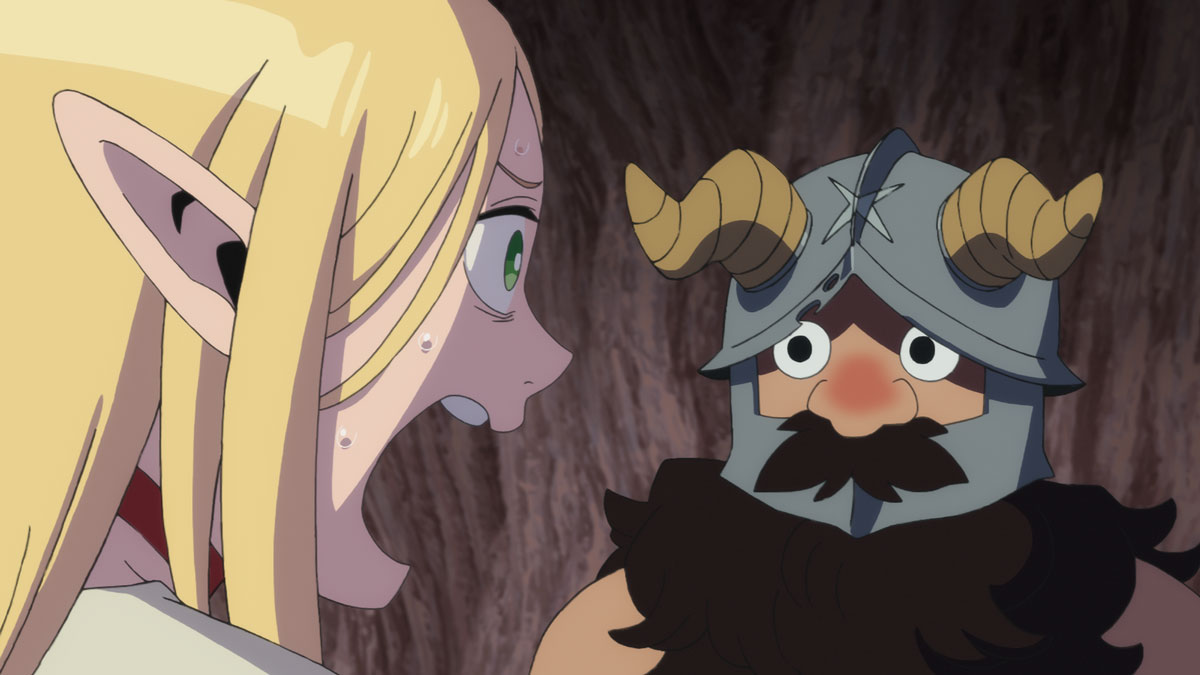
Such is the case with the merfolk that Laios wants to eat. The compromise reached between Chilchuck and Laios is that Laios can use the merfolk’s seaweed hair in a dish, but he also sneaks in some of the merfolk’s eggs, which in the lore of “Delicious in Dungeon” are kept in the hair to protect them from predators. When Marcille notices little pops of flavor, Senshi muses that they must be fish eggs, to which Marcille responds, “They’re delicious!”
This gets at one of Korsmeyer’s points on the nature of taste sensation: “If one finds a food delicious, then one tacitly recognizes it as good to eat — that is, as nontransgressively edible, in a permissible food category.” Marcille’s reticence towards eating monsters is overridden by her lack of knowledge (or willful ignorance) of a food item’s origin and by the taste being delicious. We do this in the real world too – turning a blind eye to a food’s production when it tastes good. We’re quick to put something into the nontransgressive category simply because we like it. Foie gras anyone?
* * *
Human flesh might be the only true universal taboo, but there are a number of foods that for religious or cultural reasons are off limits. To consume them would be to consume something that is transgressively edible, deliberately in opposition to societal norms. In Hinduism, the cow symbolizes a life of nonviolent generosity and has been venerated for millennia as an “unslayable” animal. The pig is considered haram (forbidden) in Muslim cultures. But there are also taboos not based in faith, where a food consumed in one place is frowned upon in another. For example horse meat is consumed in a number of countries in Europe and Asia, but the UK, United States, Canada, Greece and others consider it taboo. Often it is the relationship to a certain animal that can make the consumption of that animal’s flesh a transgressive act. In the world of “Delicious in Dungeon,” transgression occurs when someone is willing to take a bite out of a demi-human.
It’s here that we get into the way culture and norms shape what foods we see as taboo. From Chilchuck’s perspective, a demi-human has too much in common with a human to be eaten. He notes that the merfolk Laios wants to eat holds a trident as a weapon, making the conclusion that merfolk are smart enough to use tools. He also sees human-like features in the shape of the merfolk’s hands. Laios quickly retorts that humans actually have more DNA in common with the cows and pigs they eat every day and that merfolk are nothing like humans at all.
Erin McKenna, in her essay “Eating Apes, Eating Cows,” examines how different cultural narratives inform eating decisions and what we consider to be off limits. For Americans, the idea of eating a chimpanzee would be an unthinkable taboo. We are “fascinated with accounts of the intelligence and emotional lives of animal beings such as chimpanzees, gorillas, and orangutans, but there is still a general disbelief when it comes to accounts of intelligence and emotions of animal beings we generally consider livestock.” We suppress any feelings or beliefs that contradict this, by denying that cows and pigs have intelligence and are emotional beings, in order to justify eating them because we think they’re tasty. Despite the thousands of years of cattle domesticity and that connection through history, our relationship to cows is now one of complete dominance, we force dairy cows to produce ten times their natural amount of milk they would produce when raising a calf, which means that a dairy cow now only lives an average of six years, compared to a normal lifespan of 15-20 years. These animals live sad lives for our sake.
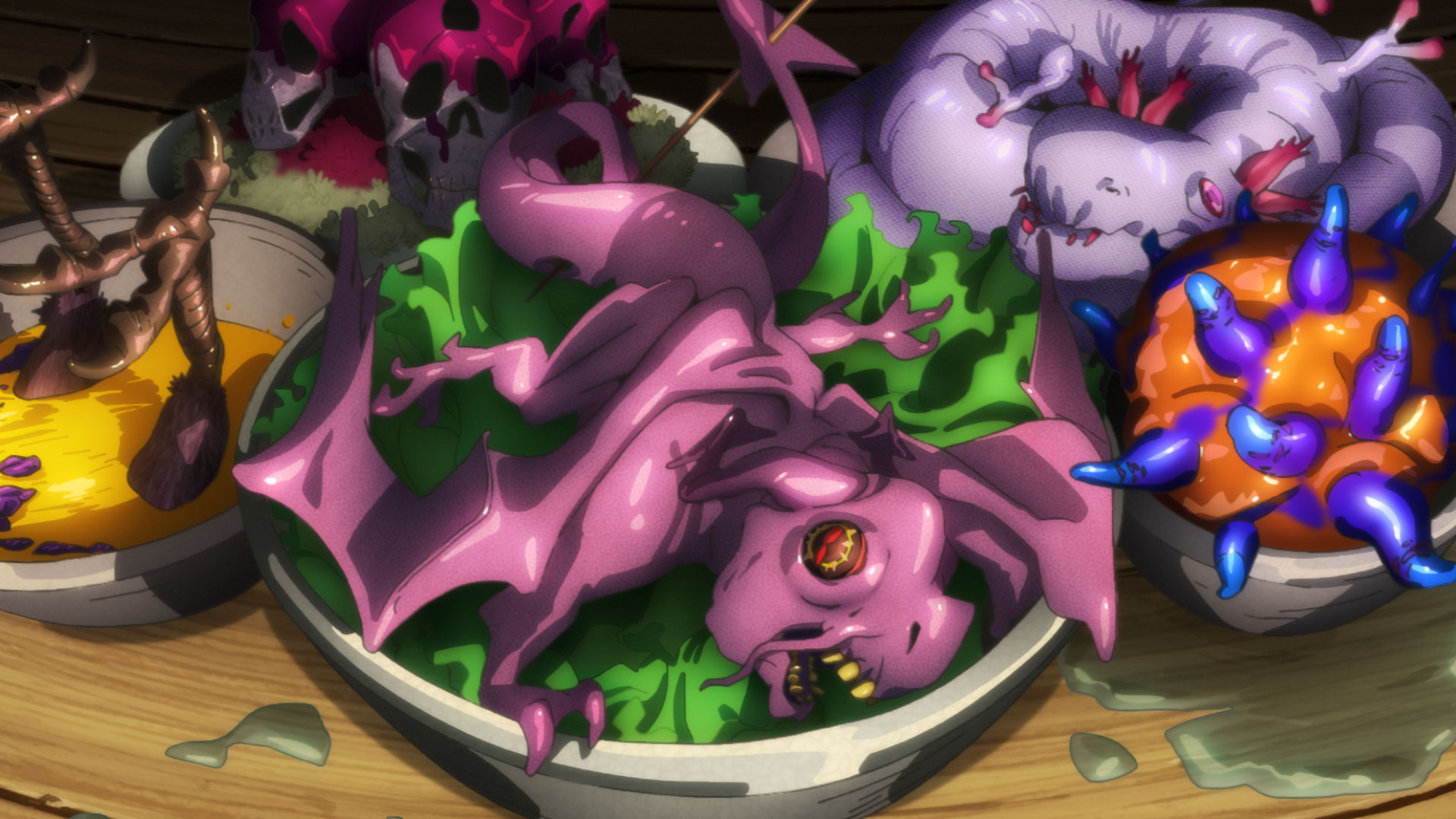
Laios’ approach to life in the dungeon is to eat everything he comes across. He is fanatical about monsters; their physiology, their behaviors and, perhaps most importantly to him, their taste. He is compelled by his consumption, which gives him an almost inhuman aura, yet what appears to be a complete lack of any ethics might be a philosophy in itself. Back to Christian Coff again, who states, “Living beings, including the human being, must eat to stay alive: what is eaten is the world. The need for nourishment forces organisms to open up to the outside world and to develop senses orientated towards the outer world.” Hunger makes one reach out into the world and gain understanding through this opening up to it. We often say that someone is “hungry for knowledge” and here we have Laios who seems to be taking the idiom literally and expanding his world through the act of eating.
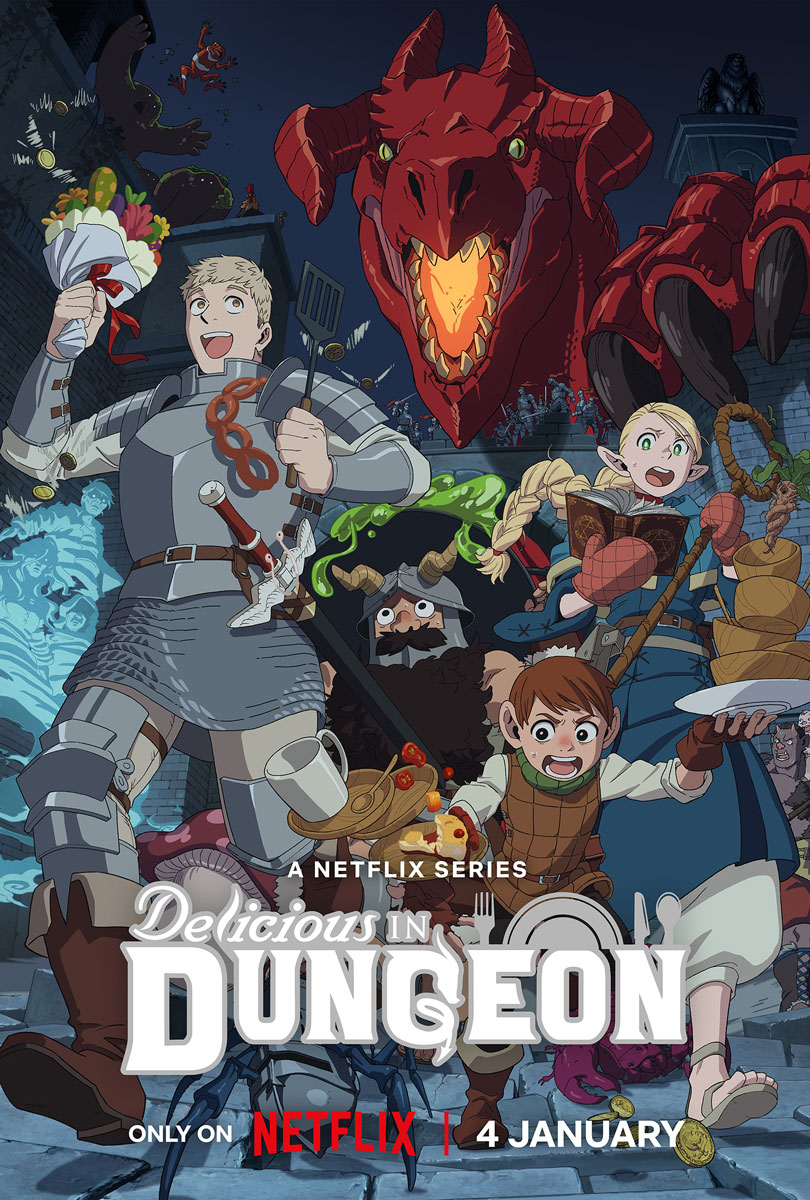
“Delicious in Dungeon” is an anime about food. It is an anime about food and all that food represents as part of human culture. We will all, one day, become food in some form. Buried in the ground, returned to the soil from which grass will grow and be grazed upon by animals that will end up on a dinner plate somewhere. Eat or be eaten, there is no escaping it.
“Delicious in Dungeon” is streaming on Netflix.