At 31, Jones wields a considerable amount of power. With an Oxbridge background, a column in one of the most widely circulated newspapers in the UK, and his frequent encounters with eminent politicians, some have put it to him that he is part of that shadowy group, The Establishment. Jones would disagree. He insists that the Establishment is comprised not, in fact, of old public school boys pulling strings for each other, bound by the friendships cemented over caviar, cocaine and champagne. There is no denying that these men have prominent roles in the Establishment, but they are only part of the network of “powerful groups that need to protect their position in a democracy”. He elaborates on this, claiming that what unites these groups is their shared mentality. This mentality is best summed up, in his view, by the L’oreal slogan: “Because I’m worth it”. It is their belief that they deserve the power they have, as well as their obscene fortunes. In this book, Jones explains how they achieved the positions they hold, and what they’re doing with their power.
Perhaps wrongly, I read this book with an underlying attitude of complacency (something Jones probably wouldn’t condone). I’ve done my time in secondary school, I’ve been informed that Beyonce, Jay-Z and David Cameron meet to discuss their plan for world domination in the Illuminati boardroom every month. I was pretty sure Jones wasn’t going to tell me anything that I didn’t know about the rich and famous being in control, so all I cared about was how it concerned me. As it turns out, it does concern me. At 16 years old, my generation is probably going to be on the receiving end of the some of the worst Establishment actions in history- we’re going to be the ones dealing with a privatised NHS, a media which drip feeds us a hard right narrative, and politicians who kowtow to CEOs rather than the people they’re meant to represent. Sounds like a bad Guardian cartoon, right? Wrong. It’s a stark reality, forming before our eyes.
Jones begins his manifesto with an interview with Paul Staines, who writes under the pseudonym Guido Fawkes – his blog is consistently ranked number 1 out of all political blogs in Britain. Staines is a man with his fingers in countless pies; his journalism has a massive audience, and he himself has links with a number of senior politicians and “high-profile right wingers”. He is opposed to the idea of democracy, and compares the issues he associates with it to the supposed problems created for powerful whites at the ending of apartheid. What Jones wants to draw attention to is how easy it is to dismiss Staines as a wayside eccentric, when it is outriders like him who help shift the ‘Overton Window’. This is a key term Jones has slipped into his manifesto, and he defines it as all that is considered to be within the political mainstream, and therefore is considered politically achievable at a period in time. What Jones argues is that it is far right outriders, like the IEA and the TaxPayers Alliance, influence government to the extent that in our day and age, everything that is within the Overton Window is part of a supremely right-wing ideology. It is not their suggested policies which are actually accepted by the government, but the imprint of their suggestions remain in the actual policies created. Later on in the book, when the numerous links between politicians and corporate types are revealed, Jones uses data to show that politics is dictated by neoliberal pressure groups and financial greed and this helps back up his case for proving the right-wing state of Britain’s Overton Window. He includes statistics that sent a chill up my spine and that make it hard not to doubt the integrity of our politicians.
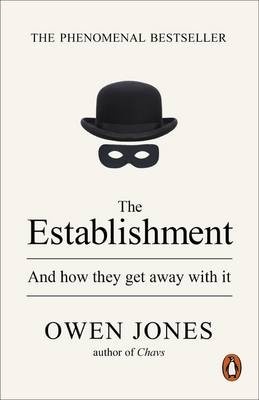
If you were to pick up the book at random, you might be startled by the strong allegations and statements Jones peppers his data analysis with. On his chapter on the media, he writes “the BBC is, more or less, a mouthpiece for the Establishment”. Our BBC? That familiar institution, relatable, reliable and so very unbiased? As you’ve probably guessed, Jones shows us just how untrue this assumption is. He writes lucidly about the BBC’s economics department’s corporate interests, about how he was told by a senior BBC journalist that the corporation is set up to be “the transmitter of mainstream ideology”, and about the story spinning which presented the Conservative government’s privatisation policies in a golden light.
And yet, there is more. The shift of the police force’s allegiance from the people to the government (and moreover, shouldn’t there be little difference between those two words?) as a direct result of Thatcherism has had devastating consequences, with cases such as the Hillsborough disaster of the last century highlighting everything which is wrong with an authoritarian police. Following on from this change in the relationships of the state, one of the last chapters is dedicated to a thorough dissection of the privatisation of state services, with Jones presenting us with figures and stories to hammer his point home. He writes scathingly of the hiring of the company A4e using government funds from the £5bn Work Programme set up in June 2011. Since the contracting of A4e, several issues have arisen, such as the short term nature of the work they found for job-seekers, as well the persistent allegations of fraud against them. Privatisation has been proven to be a doomed project for ordinary people, but as is increasingly apparent, the government is no longer working on behalf of ordinary people. Jones continues in this vein, commenting later on how Cameron propelled himself and his party out of the 2008 financial crisis by creating a narrative centred on the need for austerity, rather than controls on a financial services sector aided and abetted by the state at every turn in the road. In short, the time had come for the state to swear allegiance to it’s real masters – the tax-avoiding, unscrupulous men who had caused the crisis in the first place.
After angering and agitating the reader throughout, Jones’ conclusion seems a little anti-climatic. He calls for a democratic revolution, specifying the need for capital controls, changing the demographic of Parliament, more transparency in politician’s dealings outside of the political sphere, and a cap on donations to parties. In his most socialist paragraph, he calls for higher top rates of taxation and wants to mandate all media to include a “conscience clause” in their contracts. In this way, he implies, the Establishment can slowly be dismantled. Following the red hot nature of the main body of his book, this all seems a bit mild. But perhaps he is being realistic. Perhaps, in 15 years time, I too will agree with his ideas for gentle revolt. For now, I’ll take away from this book the haunting image of a corrupted Britain, as well as Jones’ great truth in his concluding paragraph:
change is not won through the goodwill and generosity of those above, but through the struggle and sacrifice of those below.
- Buy this book at the Guardian Bookshop