The bridleway leading into the woods is still muddy from the morning rain. Trees line the track on both sides. I look up at the brightening sky, through the intertwined fingers of the canopy above, and listen. The branches squeak, creak and rattle against each other, swaying in the cold wind. Soft seep calls fill the air as goldcrests and tits move hurriedly through the trees, feeding on what buds they can find.
A treecreeper shins up a trunk, hugging the bark. I can briefly see the little brown bird’s long down-curved bill and soft white underparts before it sidles round the tree and out of view.
At one edge of the wood, a field of winter wheat begins to glow in the strengthening sunshine. A large flock of finches – chaffinches, greenfinches and goldfinches – that had been feeding in the field suddenly surges into the air, and up into the trees.
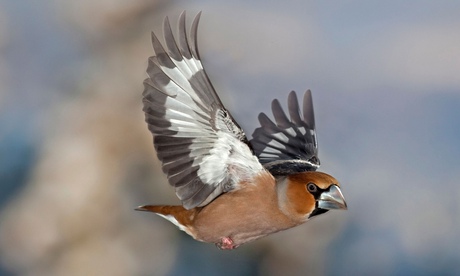
I peer at the finches through the tangle of branches, and pick out a hawfinch. Britain’s biggest finch, it is a stouter, thicker-set bird than the chaffinches, with a disproportionately large head, a heavy, powerful bill for cracking large seeds or fruit kernels, and a short, stubby tail.
Another hawfinch flies up to the top of a tree where the sun lights up its bronze head and sinister black eye-mask and bib. Despite their size, these birds are notoriously inconspicuous and elusive – they prefer dense, mixed and deciduous mature woodland – and so their numbers can be difficult to record accurately. But the British Trust for Ornithology estimates that the species has declined to about 800 or so breeding pairs. These numbers increase by thousands in winter, with the arrival of visiting birds from the continent.
The two birds fly over my head and land in the top of a tall tree by the track, flashing their broad, white wing bars and white-tipped tails as they land. They sit there, preening and watching, before flying off.
I hear the croaking call of a raven above, and look up to see its large, black silhouette making its way across the sky.