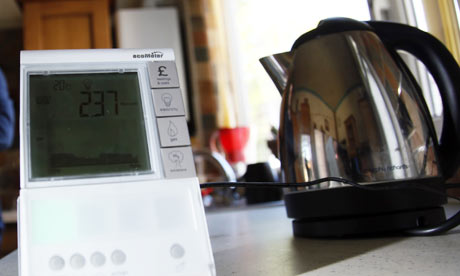
There is widespread anticipation about the benefits of smart metering. Consumers will get timely and accurate bills and have the tools to manage, understand and reduce their energy consumption; utilities will have reduced billing costs and can benefit from enhanced customer engagement. But, there are many decisions along the way that could impact these outcomes.
Here is a dystopian picture of the future in which a catalogue of wrong turns and missed opportunities have rendered the smart meter roll out ineffective.
It is 2020 and Smart Metering hasn't been rolled out across the UK. It all went wrong. Why?
The energy select committee reviewed the government's plans for a mandated smart metering roll-out. They were very critical of the mandating of energy displays as the sole means of providing information to the customer, noting that a piece of paper was a much cheaper universal requirement, and that the competitive market should be left to fight over web services, displays, and information through smart phones, etc.
An economic consultancy was commissioned to review the cost/benefits of the roll-out. They concluded that the costs were severely underestimated. At this level the cost/benefit case fell apart given that the benefits to the consumer and the contribution to the Government's greenhouse gas emission reduction targets were both small.
After further consideration, Ofgem concluded that metering should be part of the network's business given that it is a natural monopoly and that its being part of the energy retailers' responsibilities hindered competition. The retailers complained that the networks people didn't understand their needs and didn't care about the costs, because they were re-charged. No one could agree what was best because both answers had strengths and weaknesses.
One of the large energy companies deployed nearly a million meters before the UK specification was agreed. This led to animosity and the rest refused to ratify that design as the UK design because it gave the meter manufacturer and energy retailer an unfair advantage.
Hackers quickly exposed flaws in the communications networks, by turning off the power supply in streets where ministers lived. A review of security showed that practices and approaches long-established in industries like financial services had not been deployed.
A few start-ups created offerings built on the communications networks that were installed for smart metering. But they quickly failed when speeds were shown to be lower than pre-broadband internet connections. Fortunately the EU agreed on a universal mandate for broadband provision which undermined the case for a parallel communications network. Smart meters could now communicate using broadband connections so the money that would have been spent on smart metering was spent on getting broadband to every house.
And finally, electric vehicles and solar panels still haven't taken off. So much for 'smart grid'. Yes, there's a growing number of people with them but it's so far proving almost impossible to get to the tipping point with electric vehicles: adequate performance, enough charging points, acceptable price, etc.
Of course it's not 2020, it's 2010, and there's still time…
So, I recommend:
1. A sensor based solution universally mandated from 2012 to 2016. The sensor would need to be accurate and log detailed information. This information would be returned mainly over broadband or collected by the utility if the customer didn't have broadband. Customers could choose to receive a monthly printed energy report, would have access to a website, and could purchase a compatible energy display for real-time information. This approach will enable more accurate bill estimation, frequent billing, rewards for changes in time of use, and information that empowers the customer. It achieves many of the desired outcomes much sooner, at a much lower cost, and experiences from its use can inform future plans.
2. Five years before a single smart meter is rolled out: three years to trial and specify smart metering; one year to finalise specifications; one year for the industry and its suppliers to ready themselves. Energy companies are told that any deployment done before the roll-out date is done at risk and that they will be required to replace meters if they do not comply with the final specification. This provides sufficient time for testing and helps to ensure that security issues are properly addressed and that the industry and its suppliers can get ready.
3. The specifications should require that granular data can be returned for different applications over whatever communications networks are used so that the system is future proofed. This deals with the unknown possibilities for how the data and infrastructure will be used but maximises the opportunity for value to be created.
4. A geographical roll-out of smart metering will take place over five years from 2017 to 2021 run by the network operators with them owning the meter.
There's still time …
Joel Hagan is the CEO of Onzo, the customer engagement specialists
This content is brought to you by Guardian Professional. Become a GSB member to get more stories like this direct to your inbox