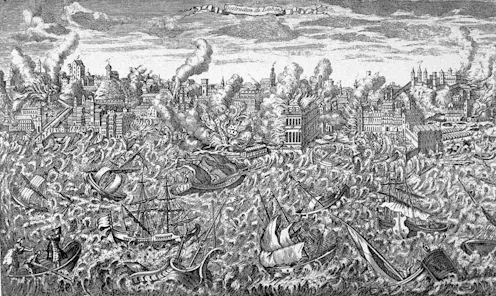
In this second episode of Recovery, a series from The Anthill Podcast exploring key moments in history when the world recovered from a major crisis or shock, we’re looking at what happened after the earthquake, tsunami and fires that devastated Lisbon in 1755 and shocked Europe.


In 1755, the grand and prosperous city of Lisbon was devastated by a huge earthquake. The Portuguese capital we see today is a product of the reconstruction and recovery after this catastrophic event. But the impact of the earthquake went far beyond the city it destroyed. It affected politics, trade, philosophy and religion across Europe. It has been described as the first modern disaster.
We talk to three academics whose expertise covers the impact and recovery from the Lisbon earthquake in the days, months and years that followed.
Mark Sabine, associate professor in Spanish, Portuguese and Latin American studies at the University of Nottingham, tells us about the relief efforts immediately after the quake and how the city was rebuilt. The decisive actions of one of the king’s ministers – Sebastião José de Carvalho e Melo, the Marquis of Pombal – fundamentally changed Portuguese politics, religion and society.
David McCallam, reader in French 18th century studies at the University of Sheffield, outlines the media sensation caused by the earthquake. News of the disaster followed the shockwaves across Europe. In its wake, Enlightenment philosophical beliefs like optimism, which claimed that the world is the best version of itself it could be, suddenly seemed untenable.
Finally, we hear from Katie Cross, research fellow in the school of divinity, history and philosophy at the University of Aberdeen. She explains the questions about divine judgement the earthquake prompted in a profoundly Catholic population, and how it shaped ideas about religion and punishment in 18th century Europe.
This episode was produced by Grace Allen, Gemma Ware and Annabel Bligh, with sound design by Eloise Stevens.







This article was originally published on The Conversation. Read the original article.