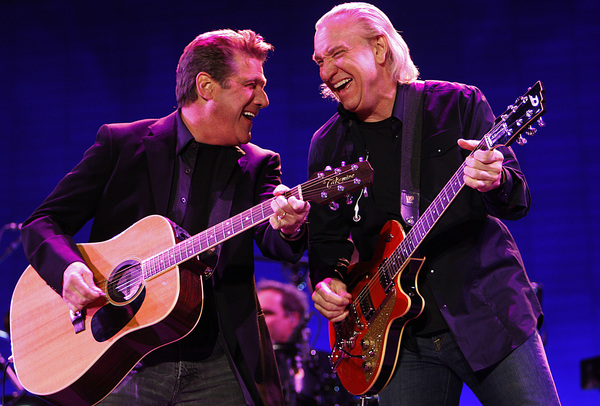
Glenn Frey died in January. Don Henley is on tour.
They were the co-leaders of the Eagles, a record-setting American band that is revered and reviled. Beloved? The Eagles have the second bestselling album of all time _ "Their Greatest Hits (1971-75)" at 29 million, compared with 32 million for Michael Jackson's "Thriller." Belittled? Remember how the Dude dissed them in "The Big Lebowski"?
It's a good time to reassess the Eagles _ why people love 'em or loathe 'em.
WHY WE LOVE 'EM
_When they emerged in 1972, the Eagles gave a fresh, peaceful, easy feeling in a turbulent era of psychedelic and hard rock. They were the perfect soft-rock soundtrack for traveling down back roads, feeling free and maybe a tad rebellious.
_The Eagles made pretty, catchy, singalong music, with lovely harmonies, meticulous sounds and well-crafted words. Sometimes the music was so pretty that the message got lost; "The Best of My Love" is about regret, and "Peaceful Easy Feeling" is about not connecting with the young woman in question.
_Frey and Henley were visionaries and respected songwriters. They took their art and mission seriously. Los Angeles Times critic Robert Hilburn wrote that the 1976 album "Hotel California" "chronicled the attitudes of a generation trapped between the fading idealism of the '60s and the encroaching greed of the '80s." He said the album "conveyed the innocence, temptations and disillusionment" of pursuing the American dream.
_When he signed on in 1975, Joe Walsh brought not only guitar heroics but much needed humor in song and conversation _ and much needed energy in song and onstage.
_The Eagles recorded "Ol' 55," by a scruffy, little known L.A. songwriter named Tom Waits on 1974's "On the Border."
_They always were a great hair band _ from Henley's 'fro to Timothy B. Schmit's frizzy mane, not to mention Frey's macho mustache.
_The Eagles created the template for modern country music as Nashville knows it today. From Garth Brooks to Lady Antebellum, you can hear the influence of the Eagles.
_Henley is a righteous do-gooder, who has created organizations and been involved with many causes including the Walden Woods Project (educating people about Henry David Thoreau), Caddo Lake Institute (to study ecology) and the Recording Artists Coalition (he testified before two U.S. Senate committees about the unfair practices in the music industry).
WHY WE HATE 'EM
_The Eagles were one of the most unanimated big-name bands in the history of rock. Obsessed with re-creating the immaculate sounds of their recordings, the guys seemed to be performing for themselves, not the sold-out audiences. Maybe because they didn't really get along, the singers said little in concert. It never looked like the businesslike Eagles were enjoying themselves onstage _ except for Joe Walsh, one of the clown princes of rock.
_Everything about the Eagles was bloated. Their egos, lifestyle, recording budgets, ticket prices. Even their image. They were grown men who presented themselves as cowboys even though they didn't even ride horses.
_"They were rich hippies," North Dakota-reared culture critic Chuck Klosterman wrote in the 2013 book "I Wear the Black Hat: Grappling With Villains (Real and Imagined)." "They were self-absorbed Hollywood liberals. They were not-so-secretly shallow. They were uncaring womanizers and the worst kind of cokehead. They never rocked, even after adding Joe Walsh for that express purpose. They lectured college kids about their environmental footprint while flying around in private jets."
_The Eagles were the most corporate of bands. When guitarist Don Felder was fired from the group in 2001 and subsequently sued them (there were countersuits), he received an invitation to appear in the Eagles' new "History of the Eagles" documentary through his lawyer _ from the Eagles' attorney, of course. The nub: Henley and Frey insisted they receive a higher percentage of Eagles income instead of splitting it equally among all members.
_After infighting to the point that Henley often said the Eagles would reunite "when hell freezes over," the band had a get-rich rock reunion in 1994 after a 14-year hiatus.
_The Eagles were the first act to charge $100 a ticket for a tour, starting with their 1994 reunion. Why? Because they could. Henley told me in 2001: "The analysts on Wall Street would tell you that rock 'n' roll as a market was undervalued and this is some sort of correction. We hadn't been (on tour) in 14 years. And may not be around again. Those things enter into the picture. As Frey said, 'We're worth it.'"
_The Eagles took themselves too seriously. They were humorless. When my interview with Henley in the Star Tribune greeted their arrival at Target Center in 1995 with the headline "The egos have landed," Frey made some pointed comments in concert about the headline. He clearly was not amused.
_The entire punk-rock movement was a reaction to the easy-listening style of the Eagles and the pompousness of prog-rock.
_The Eagles' songs were so overplayed. Just ask the Dude in "The Big Lebowski," who went ballistic when "Peaceful Easy Feeling" came on the radio in a cab in which he was riding.