What the Puranas Actually Say About the Third Age
The Vishnu Purana describes the Dvapara Yuga as the third of the four world-ages, a period in which the quality of sattva has diminished enough that dharma stands on two legs instead of four. The metaphor is a bull, in the Krita Yuga it stands on all four, in Treta on three, in Dvapara on two, and in the Kali Yuga on one. What the texts are measuring is not virtue in the moral sense. They are measuring the degree to which truth is self-evident to the people living inside it.
In Dvapara, the Vedas themselves undergo a change. The Vishnu Purana records that Vyasa, born in every Dvapara Yuga, not just the one the Mahabharata describes, divides the single Veda into four: Rig, Sama, Yajur, Atharva. The division is the symptom. When truth is whole and directly perceived, it does not need to be organized. It needs to be organized precisely because it can no longer be held all at once by a mind whose capacity for direct knowing has contracted.
Ritual as a Technology for a Contracted Age
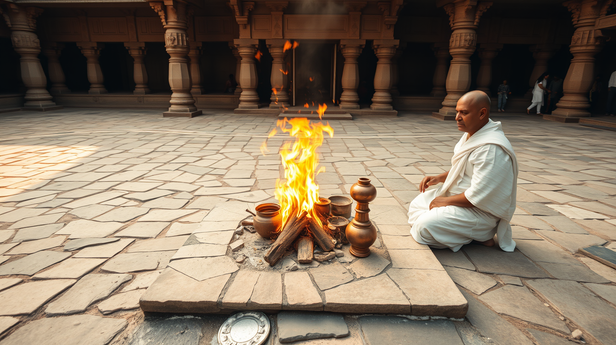
This is the move the texts are making that most readings miss: ritual in Dvapara is not a corruption of something purer. It is an engineering solution. When you can no longer see the fire directly, you build a lens. The elaborate yajna culture that characterizes the Dvapara period, the precise mantras, the exact measurements of the sacrificial altar, the strict sequencing of offerings, is a system designed to produce, through external precision, an interior state that earlier ages accessed without effort.
The Shatapatha Brahmana, one of the Vedic prose texts that comes into its own in this period, is essentially a manual for this. It specifies the dimensions of the fire altar, the number of bricks, the meaning of each layer, because the ritualist performing it cannot simply know these things through consciousness. The knowledge has to be carried in the form. The form has to be exact because an inexact form produces nothing, unlike direct knowing, which is self-correcting.
This is why the Mahabharata, the great text of the Dvapara Yuga's closing chapter, is so preoccupied with karma. In a world where dharma is no longer self-luminous, you need a precise accounting system. Karma is that system: every action has a consequence that can be calculated, stored, and eventually settled. It is a ledger for an age that has lost the ability to simply see the whole.
The Mahabharata as the Yuga's Own Testimony
The Mahabharata does not just describe the Dvapara Yuga, it enacts its central problem. The war at Kurukshetra happens because every party involved knows the rules of dharma and none of them can agree on what dharma actually requires in this situation. Bhishma knows the texts. Drona knows the texts. Yudhishthira knows the texts. And yet the field at Kurukshetra fills with the bodies of people who studied dharma their entire lives.
The Bhagavad Gita sits inside this failure. When Arjuna collapses at the start of the battle, what he is experiencing is precisely the Dvapara condition: he has the scripture, the lineage, the ritual preparation, and none of it is sufficient for the moment in front of him. Krishna's response across eighteen chapters is not to give him more ritual. It is to point him back toward direct knowing, toward the atman that does not require a yuga's worth of mediation to be real. Chapter 2, verses 11 through 30 of the Gita are Krishna dismantling Arjuna's grief by returning him to what cannot be divided, lost, or performed. The irony is that this teaching, the most direct pointing in the entire Vedic corpus, is delivered at the end of the age in which directness became inaccessible.
What an Age of Ritual Leaves Behind
The Dvapara Yuga ends with Vyasa writing down the Mahabharata. This is the act that closes the age: the oral living transmission of the entire epic, which had been held in memory and passed from teacher to student, gets committed to text. Writing it down preserves it. It also freezes it. A text can be copied, but it cannot correct itself the way a living teacher corrects a student's misunderstanding in real time.
What the ancient texts describe across the arc from Krita to Dvapara to Kali is a progressive externalization of knowing. What was once interior becomes ritual. What was ritual becomes scripture. What was scripture becomes commentary on scripture. Each step is a response to a genuine contraction in the capacity for direct experience, and each step is also what makes the next contraction more likely, because you have now built an institution around the mediated form, and the institution has interests in its own continuation.
The Dvapara Yuga's real lesson is not that ritual is inferior to experience. The texts do not say that. They say ritual was the appropriate response to the consciousness of that age. The question the texts leave open, and refuse to answer directly, is whether the ritual ever remembered what it was built to do.