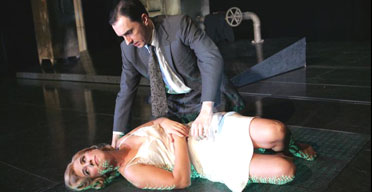
There is a moment in Philip Franks' fine revival of Webster's magnificent 1614 revenge tragedy that is both excruciating and exquisite. Imogen Stubbs' Duchess, who has secretly married her secretary, Antonio, is sitting in front of her dressing-table mirror fixing her hair. Believing she is talking to her husband, she prattles away, completely oblivious that her jealous, scheming brother, Ferdinand, has stolen into the room and is listening to her condemning herself with every word. She is staring into the mirror, but she cannot see what is reflected there. She only sees what she wants to see.
Franks' production is all about the gap between what we see and what we allow ourselves to know. Appearances are always as treacherous as the shiny marble floor of the Malfi palace. The Cardinal's mistress, Julia, wears a corset and not much else between her all-enveloping coat of respectability. Bosola is a spy who does not come up with the evidence until the Duchess has borne three children; Antonio refuses to see the danger he is in or that the rumpled bedroom sheet can also serve as a shroud.
In Leslie Travers' stunning design, Malfi - like the human body itself - is a place of public stages and passageways full of nasty, hidden secrets; it gleams with a surface gloss that disguises something unhygienic underneath. The Duchess ends up imprisoned and murdered in the dank bowels of her own palace next to the grubby boiler and the gurgling plumbing. The whole place needs a thorough dose of disinfectant.
Franks transposes the action from the 17th century to 1950s Italy with real flair, and avoids the pitfall of sacrificing substance for style in three hours that get progressively more sinister and morally murky. It is a journey into dark knowledge made all the more interesting by the ambivalence of Sebastian Harcombe's Bosla, a self-harming outcast who discovers himself too late, the distorting passion of Timothy Walker's incestuous Ferdinand, and Stubbs' Duchess, a child woman who floats around her court, flirting outrageously with her brother and recklessly charming and snaring Antonio.
It proves the death of her, and the suggestion here is that innocence is guilty of bringing about tragedy when it is so wilfully blind. Neither Webster nor Franks can quite sustain the momentum after the Duchess's death, but it is an impressive three hours, and gruelling in all the right ways.
· Until November 11. Box office: 0113 213 7700.