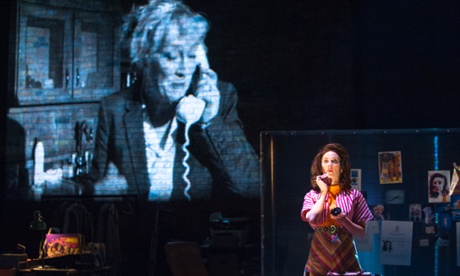
The stage is a crime scene, and the clues are still coming in. The victim – who may also be the culprit – is a young woman called Lise, a stressed-out office worker on a city break. Played by Morven Christie in this National Theatre of Scotland production, she is as hard to pin down as her counterpart in the Muriel Spark novel on which director Laurie Sansom bases this adaptation.
Short-tempered one minute, charming the next, she tries on accents, languages, even personalities, with abandon. The only consistency is her holiday wardrobe: a garish yet becoming collision of diagonal stripes and loud summer colours. We’re told early on she’s going to die.
All the while, she leaves behind a trail of evidence to be picked over by a besuited chorus of investigators who are lit by Chris Davey in the high-contrast style of Spooks and CSI. Like those police procedurals, the production shows us their accumulating data, blown up in forensic detail by the live video projections of designer Ana Inés Jabares Pita.
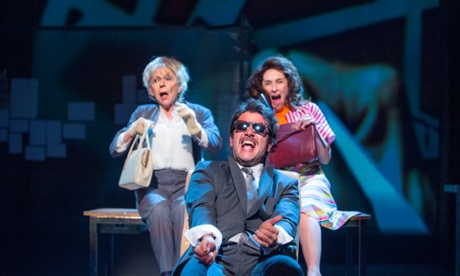
The clues mount up: an abandoned passport, a shopping trip, a date with a man on a macrobiotic diet. None of them, however, signifies anything. The closest we get to valuable information is the airport novel Lise describes as a “whydunnit”.
It was Spark’s favourite of her novels and, on the page, The Driver’s Seat offers a teasing, odyssey-like pleasure. Sansom maintains much of the quirky atmosphere, and adds a layer of dark alienation, but on stage, with a central character who is without subtext or motivation, it’s hard to know where the story is leading.
We’re conditioned to finding out more about the protagonist as a play goes on, but this one gives us less. It means that, for all the show’s pizzazz and polish, it leaves us feeling as empty as Lise herself.
- At Royal Lyceum, Edinburgh, until 27 June. Box office: 0131-248 4848. Then at Tramway, Glasgow, 2–4 July. Box office: 0845 330 3501.