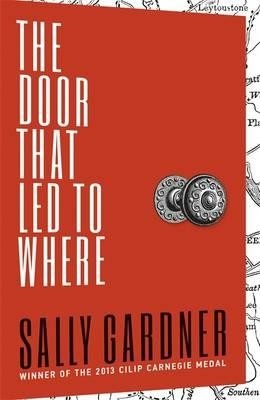
Part coming-of-age tale, part time-travel story, part elaborate, centuries-spanning mystery, The Door That Led to Where is one of the most enjoyable and thought-provoking YA reads I’ve consumed recently.
AJ, who with one GCSE seems doomed to be a failure, is offered a new lease of life by being given a miraculous job at a top law firm (with his abbreviated name he slips effortlessly into the jargon soup of lawspeak and solicitors’ parlance).
Finding a key, with his name inscribed on it, leads AJ to discover a doorway which connects him to Victorian London. AJ, a boy who has clearly grown up with the escapism of literature, and loves Dickens, is particularly delighted. (This seemed fairer to me than the rationing of time-travel experiences to the Doctor’s companions in a certain BBC television series in which Martha Jones, a recently-qualified medical student, gets to meet William Shakespeare, while Clara Oswald, an English teacher, is stuck with Robin Hood and a mummy).
Gardner’s short, snappy chapters – most of which end with a looming cliffhanger or miniature crisis – echo the episodic storytelling of Charles Dickens, while also acknowledging our highly compressed media exposure in the modern age of social media (just one of many clever comparisons between the past and present). Other Dickensian motifs abound: the restorative, redemptive power of Christmas; rags to riches; characters with deliciously apt names – such as the spiteful, scheming housekeeper Mrs Meacock.
There is a strong, social conscience running through this book. Gardner non-judgementally and curtly writes about the three main protagonists smoking weed, and there is a quiet anger in her description of a five-storey flat with no lift, or AJ’s astonishment at finding himself in the Old Bailey on the right side of the law.
Sally Gardner’s lucid writing is full of wordplay and literary allusions. Occasionally, she will head close towards a cliché, before veering suddenly and unexpectedly, side-stepping the reader, and do something new with the English language for the sheer, unadulterated joy of it: “his mind churned”; the Highway to Hell’s “advertising hoardings”.
Although this is a relatively short novel it has a complex plot. One of its strengths is that it ends in such a way that the many loose ends are tied up in both an emotionally and intellectually satisfying way while leaving just the slightest tantalising hint of a possibility for sequels.
Like John Steinbeck, Sally Gardner gives disenfranchised people a voice by literally (and quite comfortably, for an adult author) using their language, with its idioms and cadences, nuances of meaning, rhythms and slang – although, oddly, the ‘token Glaswegian’ character, Dr Jinx, feels at times like a forced stereotype (“Scooby do”).
My only criticism of the plot would be AJ’s best friend Slim’s sudden, inexplicable decision to begin dating the girlfriend of their brilliantly named, violent arch-enemy Moses. This makes sense structurally, as a means to get Slim through the door into the past, although it felt far less convincing and a little rushed and hasty to me in terms of the plot.
One thing I did find puzzling was AJ’s repeated worry about his friends being unable to survive outside “the electronic jungle”. Clearly, this is a phrase Gardner likes, but its seemingly endless repetition seemed to eventually ever-so-slightly belittle her otherwise thoughtful consideration of the similarities and differences between the past and present, and reduce them to a politician’s favourite sound bite. Elsewhere, there is a lovely moment when AJ realises just how difficult it is to explain to someone from the early 19th century just what a carpark is, let alone a derelict carpark.
Overall, though, this book achieves the wonderful status of being a story I would happily recommend to my younger sister, my own friends and my sixty-nine year old granddad alike; it’s a powerful story which seems to transcend ages (aside from a few swear words and references to casual drug-taking!). It also left me with a bittersweet feeling when I finally closed the covers for a final time, as though I was, in a small way (minor spoiler alert!) sharing in the parting of the ways.
-
Buy this book at the Guardian Bookshop
Want to tell the world about a book you’ve read? Join the site and send us your review!