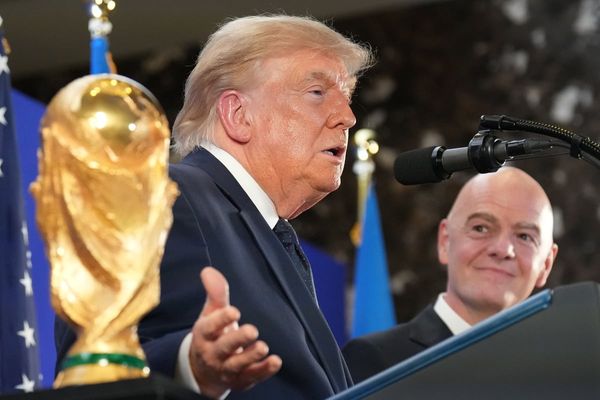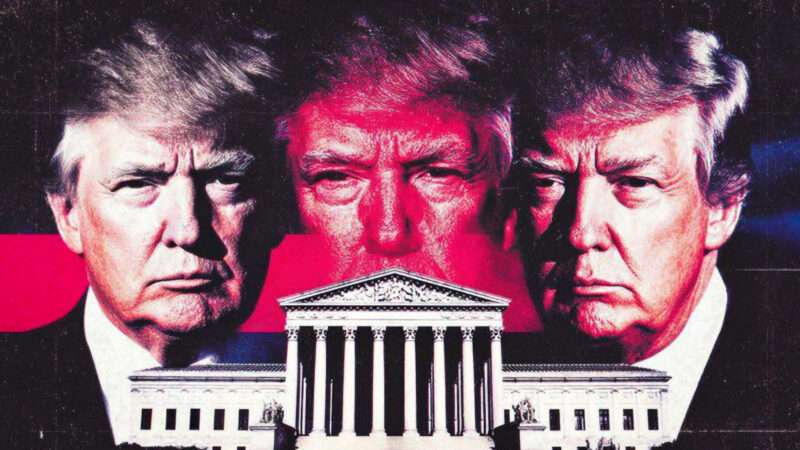
Last week, President Donald Trump settled his own spurious lawsuit against the government he controls by wresting $1.8 billion from the federal treasury to use for his own ends.
It seems clear the disbursement has no noncorrupt purpose, and the administration is relying on extremely weak legal arguments to make its case.
The case stemmed from a January 2026 lawsuit Trump filed against the IRS, seeking $10 billion in damages, after a disgruntled government contractor leaked his tax returns to the press.
"This claim is nonsensical and worthless," according to Cato Institute scholar David Post, who estimated "a reasonable valuation of this claim" was "$0.00."
Trump suddenly dismissed his own case last week, as the Department of Justice (DOJ) announced it would provide $1.776 billion for the "Anti-Weaponization Fund," which would "provide a systematic process to hear and redress claims" by those "who suffered weaponization and lawfare" at the hands of the federal government.
"In reality, this is a massive taxpayer-funded slush fund that Trump will be able to distribute to his friends and allies—including those who rioted at the U.S. Capitol in January 2021," wrote Reason's Eric Boehm. "The Anti-Weaponization Fund is merely the most blatant example (so far) of Trump's corruption."
As if that weren't enough, according to a settlement agreement, the IRS would issue Trump a "formal apology," and it would be "FOREVER BARRED and PRECLUDED from prosecuting or pursuing" him for any existing offenses—potentially saving the president from more than $100 million in fines for unpaid taxes.
The corruption is so blatant, even some Republican lawmakers have pushed back.
In fairness to Trump, an apology does seem warranted: As he noted in his lawsuit, "the IRS failed to establish safeguards to detect, let alone prevent, unauthorized access to confidential tax return information." Even after a rogue contractor pilfered hundreds of thousands of tax returns—including Trump's—and released them to the media, the DOJ did not learn the culprit's identity for three years.
In 2024, in fact, the IRS apologized to hedge fund billionaire Kenneth Griffin "and the thousands of other Americans whose personal information was leaked to the press." While that total theoretically also included Trump, a more personalized apology shouldn't be out of the question.
But making restitution by cutting a check for any amount, much less nearly $2 billion in taxpayer money, is completely unwarranted. Just check out the weakness of the administration's arguments for why this isn't a completely unprecedented arrangement.
"Previous cases have been settled on similar terms," Acting Attorney General Todd Blanche claimed in an order last week. He cited Keepseagle v. Vilsack, a class-action lawsuit filed in 1999 alleging that over the previous two decades, the U.S. Department of Agriculture discriminated against Native Americans when providing low-interest farm loans. The Obama administration settled the lawsuit in 2010, providing $680 million in direct compensation plus $80 million in loan forgiveness. But after all claims were processed, the fund still contained $380 million.
"In Keepseagle, hundreds of millions of dollars remaining in the fund were distributed to non-profits and NGOs that never made claims," the DOJ explained last week, "whereas any money remaining in The Anti-Weaponization Fund will revert to the federal government."
In 2018, Judge Emmet G. Sullivan of the U.S. District Court for the District of Columbia approved a revision to the Keepseagle settlement. The new plan gave extra money to each of the original claimants, plus $38 million to nonprofits serving Native American farmers; the remaining $266 million provided the initial funding for the Native American Agriculture Fund, a private trust that provides grants to support "business assistance, agricultural education, technical support, and advocacy services for Native American farmers and ranchers."
At National Review, Dan McLaughlin agreed that the Anti-Weaponization Fund "looks a lot like a collusive operation to create a slush fund to pay off friends and political allies" using "nearly $2 billion in taxpayer money that Congress never appropriated." But in doing so, he added, Trump was "really just taking another page from the left's playbook." McLaughlin cited Keepseagle as well as New York City Mayor Bill de Blasio's 2014 settlement with the so-called Central Park Five, who spent between five and 13 years in prison for a rape they didn't commit, for $41 million.
But there is a major difference with what Trump is doing: In both those cases, a court approved the settlements. While de Blasio pledged to settle the Central Park Five case before he even took office, it wasn't official until a magistrate judge approved the payout.
And while the Keepseagle case was controversial—The New York Times wrote in 2013 of concerns about overly lax antifraud procedures—it, too, survived judicial scrutiny. Not only did Sullivan approve the updated agreement, but the U.S. Court of Appeals for the D.C. Circuit affirmed it, and the U.S. Supreme Court declined to take up a challenge to it.
On the other hand, Trump dropped his lawsuit and drafted the settlement agreement just two days before the judge was set to hear arguments on whether the case should be allowed to proceed, likely because he knew the answer would be a resounding no.
"As a class action settlement, Keepseagle was subject to rigorous judicial oversight under Federal Rule of Civil Procedure 23. The district court was required to determine that the settlement was 'fair, reasonable, and adequate' to the class," Josh Gardner, a former DOJ attorney who served as lead counsel on the Keepseagle case, wrote on Substack. "In contrast, in Trump v. IRS, the parties settled the case without court approval and the claims administration process will not be subject to judicial oversight."
Besides, Trump's IRS settlement violates his own DOJ's stated policies. In his first term, the DOJ adopted a policy prohibiting settlements like Keepseagle with third-party beneficiaries.
"When the federal government settles a case against a corporate wrongdoer, any settlement funds should go first to the victims and then to the American people—not to bankroll third-party special interest groups or the political friends of whoever is in power," then-Attorney General Jeff Sessions said at the time. The government reaffirmed that policy most recently in February 2025.
Trump's first administration even defended the updated Keepseagle agreement before the Supreme Court by citing the new policy. It argued that the DOJ now "prohibits its attorneys from entering into settlement agreements in the future that require payments to persons or entities that are not parties to the dispute absent congressional appropriation."
One wonders how that squares with a settlement that explicitly leaves out the plaintiffs—Trump, his business, and two of his sons—but leaves open the door for an untold number of people who claim they were the victims of government weaponization—perhaps including "the political friends of whoever is in power."
The post The DOJ's Flimsy Legal Theories To Support Trump's 'Anti-Weaponization Fund' appeared first on Reason.com.