When the shortlist for this year’s Olivier theatre awards was announced in early March, there was only one story in town: London’s Young Vic. The theatre secured a remarkable 11 nominations, more than ever before, spanning nearly every major category. Powerhouses such as the National Theatre and the Royal Court were almost nowhere to be seen. Whatever happens at the awards ceremony, one man has more cause to celebrate than most: David Lan, the theatre’s artistic director, who should take credit for what has been by any measure a remarkable period. Fifteen years ago, some wondered whether the Young Vic could survive. Now it is impossible to imagine the British theatre scene without it.
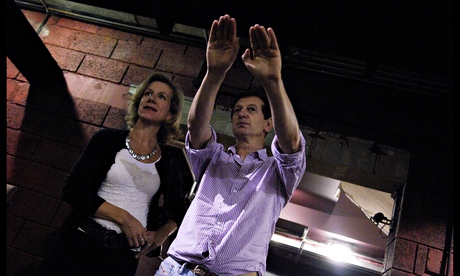
In a spartan meeting room backstage, Lan looks abashed when I raise the subject of the Oliviers, though whether out of humility or reluctance to jinx things isn’t clear. “It’s great ... everyone here feels that,” he says hesitantly, with the aspect of a man who would rather be debating the finer points of Brechtian irony than discussing statuettes. “I’m happy to acknowledge that. But the thing I really like is that I didn’t see it coming.”
This might be a touch disingenuous. Any producer will tell you that every new production is a gamble, but what has marked out the Young Vic is its willingness not simply to take risks, but stick with them through thick and thin.
When Lan took over in 2000, The Young Vic was still a breezeblock structure incorporating an old butcher’s shop. Founded originally in 1946 as an offshoot of the Old Vic theatre school, then refounded in 1969 under the wings of the National, the Young Vic finally made a break for freedom in 1974 with the pioneering director Frank Dunlop, as an independent, experimental, workshop theatre aimed at young audiences (hence the name). There were many successes – the time Keith Moon upstaged Richard Gere is still talked of with awe, as are revivals of everything from Ibsen to Grimm’s Tales – but by the time Lan arrived, it was losing steam. The building, near London’s South Bank, was 30 years old and crumbling. The organisation was in need of cash – and a purpose.
“We really had to work out what we were for, and do it,” Lan says. “It was challenging, but in retrospect really good.” As well as initiating a lengthy renovation, he created programmes aimed at young directors: a resident assistant’s scheme, awards and an online network offering access to workshops and collaborative opportunities.
British theatre has traditionally been chary about training directors, preferring to let aspirants sink or swim in the freelance piranha tank. Lan and his colleagues wanted to try to change that. “If you’re 22, you want to do Tamburlaine Parts I and II, Karl Kraus’s Last Days of Mankind, and three Shakespeares simultaneously. But you can’t afford rehearsal time – there’s very little support; we wanted to create better circumstances.”
From modest beginnings, the scheme has paid off handsomely, helping a new generation of theatre-makers – Carrie Cracknell, Bijan Sheibani, Matthew Dunster and Natalie Abrahami among them – make their mark. Scan the CV of many directors under the age of 45, and chances are they have had contact with the Young Vic. “People talk about the Young Vic as being a directors’ theatre,” says Lan. “I don’t. I think we’re a theatre.”
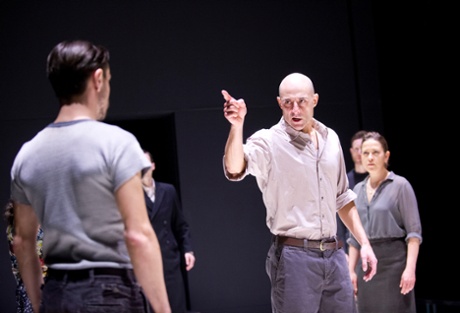
Lan has also tackled another truism: British theatre’s stubborn resistance to influences from outside these isles. The two Young Vic shows that dominate the Oliviers shortlist, Ivo van Hove’s startling reimagining of A View from the Bridge and Benedict Andrews’s icily exact A Streetcar Named Desire, may be American plays with primarily British casts, but their directors hail from Belgium and Australia respectively (in Andrews’s case via a stint at Berlin’s Schaubühne).
In recent years Lan has welcomed and nurtured directors from France, Norway, Iceland, Belarus and Palestine, and produced plays from Germany, Syria and Yoruba-speaking territories around the world, as well as his native South Africa. British directors have been dispatched to Berlin, St Petersburg, Warsaw and Munich. The theatre also has a long-standing relationship with Peter Brook’s Bouffes du Nord in Paris, and gave the legendary French auteur Patrice Chéreau a long-overdue British premiere.
Van Hove is certain that if British theatre seems more cosmopolitan than it once did, the Young Vic is at least partly responsible. “When I worked in Britain in the late 1990s, the reaction was venomous. We were called ‘Eurotrash’,” he says. “But we’ve been welcomed into the heart of the theatre community.”
“It’s a curious thing,” agrees Lan. “Dance, novels, poetry, opera – those are fully international artforms. Theatre has always lagged behind.”
Some of this open-mindedness might be down to his own background. Where most artistic directors are dyed-in-the-wool theatre types – with the occasional excursion into movies – Lan has had more careers than seems entirely fair. Born in Cape Town in 1952, he trained at first an actor, before writing for The Space, a renowned crucible for anti-apartheid theatre. After moving to London in 1972, he wrote for the Royal Court and the ICA, before retraining as an anthropologist and doing field research in the Zambezi valley (later turned into a book, Guns and Rain). He has directed and written documentaries, opera libretti and adaptations, not to mention his work as a director.
Lan looks momentarily stricken when I list this roll call of achievements. “I’ve really done the next thing that’s turned up. It’s not been a plan.” But has it influenced his approach to theatre? “You know, everyone should do fieldwork. It should be semi-compulsory to spend a period of time in a place which surprises you every day.”
Lan may have based himself in Britain for the past four decades (the accent is long gone), but he retains a South African’s scepticism about the operations of state power. In 2013 he co-founded the What Next? campaign, which tries to engage politicians in the work done by cultural organisations and make audiences part of the debate.
Dealing with the coalition government has been a battle, he admits. “However many times they say: ‘Oh, George Osborne goes to the opera,’ there is less and less long-term thinking. You sense the state feels that as long as we’ve got a Royal Opera House, we can lose the rest. What they give, they give through gritted teeth, and given the opportunity they’ll reduce that as far as they can.”
Is Labour any better? “Actually, I think the thinking Labour has done in the last two or three years is exceptional. For a prospective PM to say that he will put the arts at the centre of his political thinking, that no school will get a top rating unless it offers an excellent cultural education – that’s remarkable.”
Lan’s own future is a tantalising question. In 2013 he applied to take over from Nicholas Hytner at the National Theatre, in a joint bid with Stephen Daldry; the pair were rumoured to have lost out to the internal favourite, Rufus Norris, in the final round. Lan admits to a pang of regret. “We were saying the place should change, but they wanted more of the same. That’s their call. But it would have been interesting.”
There has been even more gossip about what’s happening on the other side of the Atlantic. Last year Lan announced that he’d agreed to become interim artistic director for an arts hub based at the rebuilt World Trade Center, while still doing his Young Vic job. New York politics make the British variety look like child’s play: Frank Gehry’s design was shelved last September (“I don’t want to go where I’m not wanted,” he told the New York Times). The revised plan is for a more modest, flexible space, perhaps not opening until 2019.
Lan won’t be drawn on specifics, but hints they will have a distinctly Young Vic-ish flavour: international co-productions and in-house work, a mixture of opera and theatre on a variety of scales, all in a building that talks to its neighbourhood rather than shouting it down.
Will he decamp to New York full-time? His smile doesn’t waver. “I have a job I love here, and it’s early days. We’ll see what happens.”
One thing he insists on: whatever happens at the Olivier awards, the theatre they showcase doesn’t emerge from thin air. The Young Vic’s success may seem abrupt, but it has been a long time coming, and is enabled by public subsidy. Subsidised theatre supports commercial projects; large venues are sustained by smaller ones. Development and the ability to take risks is crucial. In theatre, as in life, some things are worth the wait.
“It can take time to do what we do,” Lan says. “Time is what you hope you can get.”
• The Olivier awards will be shown on ITV on Sunday 12 April, from 10.15pm.
• David Lan takes part in a Guardian Live event about diversity in the arts on 15 April