One hundred years ago on 30 December 1916, Grigori Rasputin, the Russian mystic who became a confidant of Tsar Nicholas II and his wife, was brutally killed. After supposedly being poisoned, shot and beaten, he was thrown into the freezing waters of St. Petersburg’s Neva River by aristocrats fearful of the influence he wielded over the Romanov court.
The death of the ‘notoriously evil’ monk was reported in the Manchester Guardian on 3 January 1917, while the following day, amidst all the news about the war in Europe, it was noted that Russia could now breathe more freely.
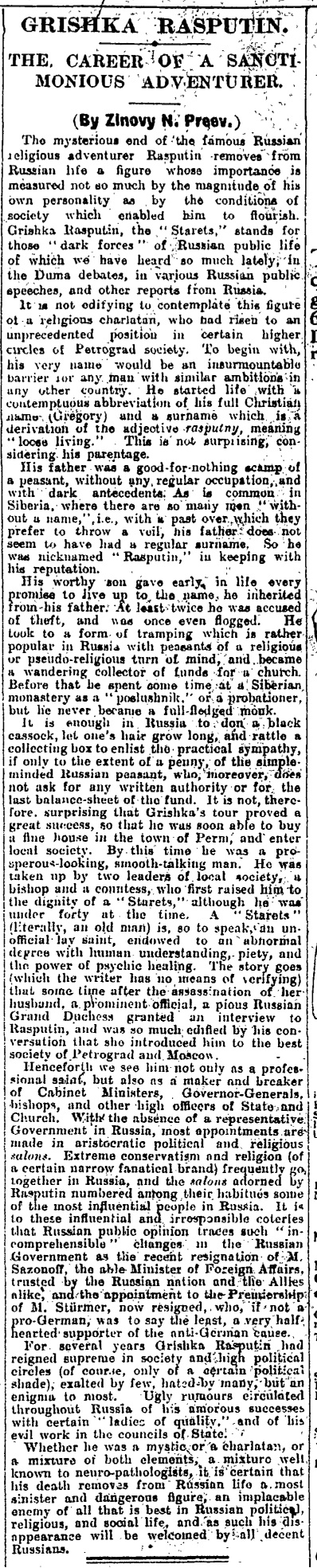
As more details about the death emerged, the Observer published a detailed profile, Grishka Rasuputin: The career of a sanctimonious adventurer, by historian Zinovy N. Preev. Mystic or charlatan, he concluded that the Siberian peasant was ‘a maker and breaker of cabinet ministers, governor-generals, bishops, and other high officers of state and church’.

Over the following decades some of the assassins would describe their role in Rasputin’s demise. In 1923, the diary of Vladimir Purishkevich was published with an excerpt, ‘How I killed Rasputin,’ appearing in the Guardian. A few years later, Prince Felix Yusupof described his role in the affair while giving evidence during a libel trial. By 1966 he was living in Paris and in a (very short) interview with Guardian writer Peter Lennon, he said he would, if necessary, kill Rasputin again.

Rasputin first appeared on the pages of the Guardian in 1913. A feature about him from January 1914 included the fact that ‘Gregory the rake,’ a translation of Rasputin, was the nickname given to him on account of his personal habits. It also noted the power this ‘crude imposter’ had over ‘fashionable women’.

A century after Rasputin’s death, numerous writers have attempted to disentangle the myths from facts, as well putting forward new theories as to what exactly happened in the early hours of 30 January 1916. For example, in 2004 it was suggested that MI6 officer Oswald Rayner fired the fatal shot that killed Rasputin. The recent biography by Douglas Smith presents a less sensational portrait of the ‘mad monk’.