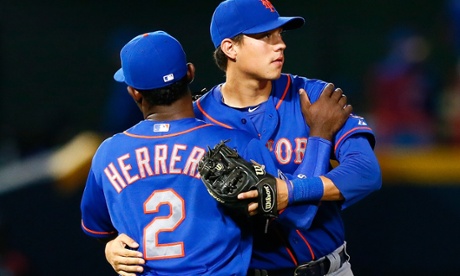
To understand the financial depravity of the New York Mets, you first have to understand why Wilmer Flores is currently a shortstop.
There will certainly be people who will try to sell you on the idea that Flores, 23, is a shortstop on merit – or at least, potential merit. They even have the depth chart on their side: the Mets have named Flores the starter at short going into camp for the 2015 season. But they are, at best, overgenerously optimistic – and regardless of what their depth chart says, the Mets have spent the last 10 months acting like they disagree.
Three years ago, it was essentially public knowledge that Flores would be moving off the position. Indeed, the Mets recognized this organizationally; in 2012 and 2013, he played second base, third base, even a little first base – pretty much everywhere in the infield except short. Everything that was true in 2012 about Flores remains true today except that he is older, and as a general rule players don’t get better defensively as they age; they get worse. There are certainly exceptions, but Flores did nothing to show that he was one of them.
Then, before the 2014 season, the Mets decided he was a shortstop again. The experiment didn’t begin particularly well; Flores, who was competing for playing time last year with luminaries such as Ruben Tejada and Dilson Herrera, did not win a job on the roster out of camp. The idea was barely entertained by the Mets coaching staff, not because of Flores’s prospect status or age (Tejada himself was a part-time player at age 20, and only a part-time player because he couldn’t stay healthy), but because Flores couldn’t play short well enough to even split time with Tejada or play a utility role around the infield. He cameoed the roster for the second game of the season in order to spell Daniel Murphy at second base during his paternity leave, then vanished down to the minors again to work on his defense.
He reappeared on the roster on 9 May after the Mets designated infielder Omar Quintanilla for assignment with the stated goal of his promotion being to add more offense to MLB roster. Flores started the next two games at short and immediately came down with some sort of illness – and that was enough for manager Terry Collins to give Ruben Tejada his job back for the next week. Flores wouldn’t appear in a game again until 17 May, when he’d be given his first substantial trial by fire against major league pitching as a starting shortstop.
It didn’t go particularly well. By early June, he’d lost the everyday job, now getting a start at short every four days or so and pinch-hitting in between. By the end of June, he’d been sent back to Triple A Las Vegas to get everyday playing time and work on his defense. Except here’s the weird thing about that demotion: he got back to Vegas, and suddenly he was playing second base and third base again. Some first base, too. In 26 games between 26 June and 23 July, Flores only spent time at short in six. Then, Ruben Tejada took a baseball to the head and suddenly, Flores was promoted again. To play shortstop.
Tejada was cleared to play very shortly afterwards -- he wouldn’t even spend time on the abbreviated seven-day disabled list for concussion or head-related injuries – but Flores would once again get the lion’s share of the work at short for the next few weeks. Then, predictably enough, in late August Daniel Murphy got hurt and Flores immediately started seeing time at second base instead. By the end of the season, the Mets had moved him off of shortstop entirely – his last seven starts of the season were all at second.
This organizational juggling routine wouldn’t be a big deal if Flores was hitting; in fact, Flores being the everyday shortstop wouldn’t be a big deal if he was hitting, bad defense and all. That’s supposed to be the one thing Flores does well, after all: hit. Does he hit in the minors? Sure – while playing in Las Vegas, one of the most notoriously hitter-friendly parks in the notoriously hitter-friendly Pacific Coast League. But in 375 MLB plate appearances, Flores is only batting .240/.275/.356 (.631 OPS). That’s at the low end of excusable for a top-three defensive shortstop league-wide. It’s unacceptable for a guy who got sent down in the middle of the season to play other positions.
This level of detail is necessary when examining Flores’ 2014 because it’s important to know the context in which the Mets have named him starter over and over again this winter, and why it seems so bewildering when judging Flores by what he’s shown on the field. But there’s one last piece of information that makes everything else slide into place: Wilmer Flores will only be paid around $500,000 next year.
That sounds like a lot of money, and it is in absolute terms; but for a shortstop at the major league level? That’s not just cheap. That’s the closest a team is permitted to free. Meanwhile, Colorado’s Troy Tulowitzki, who was constantly attached to the Mets in trade rumors last month? $20m. Chicago’s Starlin Castro, who was also a possible trade target before his recent legal troubles shut that talk down? Just over $6.8m. Stephen Drew, who signed with the Yankees to play second base but is still a competent shortstop? $5m. And Ruben Tejada, the guy who has publicly lost his job and is likely available for trade at this very moment? $1.2m last year, and in line for a raise to around $3m this offseason. Wilmer Flores is not a credible shortstop. He’s not even demonstrably a league-average bat. He is, however, the absolute smallest investment possible.
Now we consider the rest of the Mets’ moves this offseason. We’ll be brief, because there’s only two that concern the major league roster: the signing of outfielder Michael Cuddyer on 11 November to a two-year, $21m contract, and the signing of outfielder John Mayberry Jr, to a one-year, $1.75m contract a month later. That’s it. That’s all the Mets have done. It’s an old trick for them: making a couple of big-splash signings up front and disappearing for the rest of the offseason. You may remember it from last year, when they did the exact same thing with outfielders Chris Young and Curtis Granderson. At least in Granderson they signed a relatively upper-tier, name free agent. Cuddyer is three years older, only played 49 games last year and got his deal based on an age 34 season hitting in Colorado. It was an impressive season and a feel-good story for a well-liked veteran player, to be sure; it also happened two years ago in what remains the most ridiculous offensive environment in baseball.
Meanwhile, payroll in Queens looks set to either stagnate or outright decline for the fourth straight season. Arbitration commitments still haven’t been decided, but the Mets’ payroll sits at just under $68m for next year. Of the major players set for arbitration bumps – Murphy, Lucas Duda, Dillon Gee, Bobby Parnell, Jenrry Mejia – the Mets have openly discussed dealing Gee, who made $3.6m last year. If they do that, it’s hard to see those arbitration awards (or the one-year deals the Mets agree to in order to avoid arbitration) clearing $14 or $15m. Figuring in another three to four million dollars for league-minimum players and other expenses, and that leaves the Mets right around last year’s $85m budget.
That would be grudgingly acceptable, were the Mets playing baseball in Tampa, Florida instead of the largest media market in the planet, and had Major League Baseball’s massive new $12.4bn national television deal not just gone into effect. It might also be acceptable if the team was rebuilding, but it’s not: New York finished 2014 tied for second place in a division that has mostly stepped backwards or tread water this offseason. Given the young stars the team has hit on in the last few years like Matt Harvey, Jake deGrom and Juan Lagares, combined with franchise player and likely future Hall of Famer David Wright and mostly-solid group of roleplayers, the Mets should be spending the money necessary to shore up their bullpen, acquire a real everyday shortstop, and become a true Wild Card contender and an outside threat for the NL East divisional crown.
They won’t, however. We already know why they won’t. The Mets ownership is an embarrassment to their league, their fans, their employees and themselves; this is as close to established fact as sunrise tomorrow. And given that the Mets and their media apparatus are the only means by which the Wilpons can continue to live the lifestyle to which they’ve become accustomed, it’s unlikely they’re going anywhere anytime soon.
It’s sad. These Mets could’ve been something in 2015 with a reasonable budget. They could still be something, if incoming league commissioner Rob Manfred has a stronger commitment to the health of the sport than he does to the personal feelings of the Wilpon family. With Manfred’s predecessor Bud Selig remaining with the league as “Commissioner Emeritus” and “advising” Manfred on how to act, however, that seems highly unlikely.
There are a lot of things that could happen, were there other ways to remove hideously bad corporate citizens like the Wilpons from sports ownership besides something viciously embarrassing going viral.
Instead, Wilmer Flores will be the New York Mets’ starting shortstop, until like all of the other embarrassments, this too becomes too much to bear.