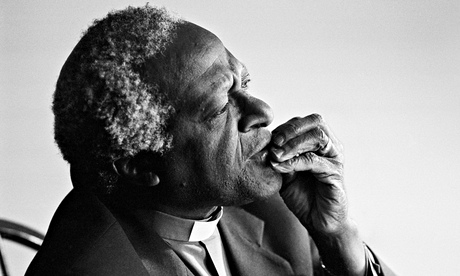
I have a photograph of Archbishop Desmond Tutu from a few years ago. I was making a film about him to mark his 75th birthday. In the picture Tutu and I are walking across a patch of open bushveld. He has hooked his arm around mine to steady himself on the uneven ground. We are chatting amiably. It makes us look like old friends, which, as you’ll see, isn’t true.
When he was elected Archbishop of Cape Town in the early 80s he broke the law just by moving into his official residence. It was in a suburb reserved for whites only. The apartheid government told him to apply to them to be declared, in law, an “honorary white”. He declined.
The first time I saw him was at St Paul’s Cathedral in London in 1984, addressing a congregation of at least 2,000 people. “I met an old lady in a forest in northern California,” he said. “She told me she included me in her prayers every morning. I am being prayed for in the woods of northern California! What chance does PW Botha stand against that?”
That was Tutu’s vision: that he could summon the goodness of the world and send it into battle against injustice.
I have interviewed him many times since. “Before you turn on your camera, let’s just pray together for a moment.” He says it every time. This most political of priests wants you to know that his life is, above all, spiritual.
The last time I saw him was in Edinburgh, addressing the General Assembly of the Church of Scotland. The church that year was divided on the question of whether a practising gay man could be a parish minister. “I have been fighting discrimination all my life,” he told me. “It’s very easy. On human attributes that are not chosen – skin colour, gender, sexual orientation – no discrimination.”
From the Assembly pulpit his rhetoric soared. “We are all born in the image of God. All. All! All! Black and white and yellow and brown and pink! African and European and Asian. Men and women and children. Lesbian and gay and so-called straight. All. All! All!” A nice touch, that stiletto “so-called”.
I saw him again at breakfast the next day. “You know, Bishop Tutu,” I said, “I have interviewed you maybe a dozen times over the years and you never remember me!”
He threw his head back and laughed that vast infectious laugh of his. And then, with perfect timing, he stopped laughing, looked me straight in the eye and said: “No. You are right. I never do!”
I treasure that photo, though, of us walking across that patch of open bushveld.